October 29, 2024
Matt Clutter
October 29, 2024
Matt Clutter
May 28, 2024
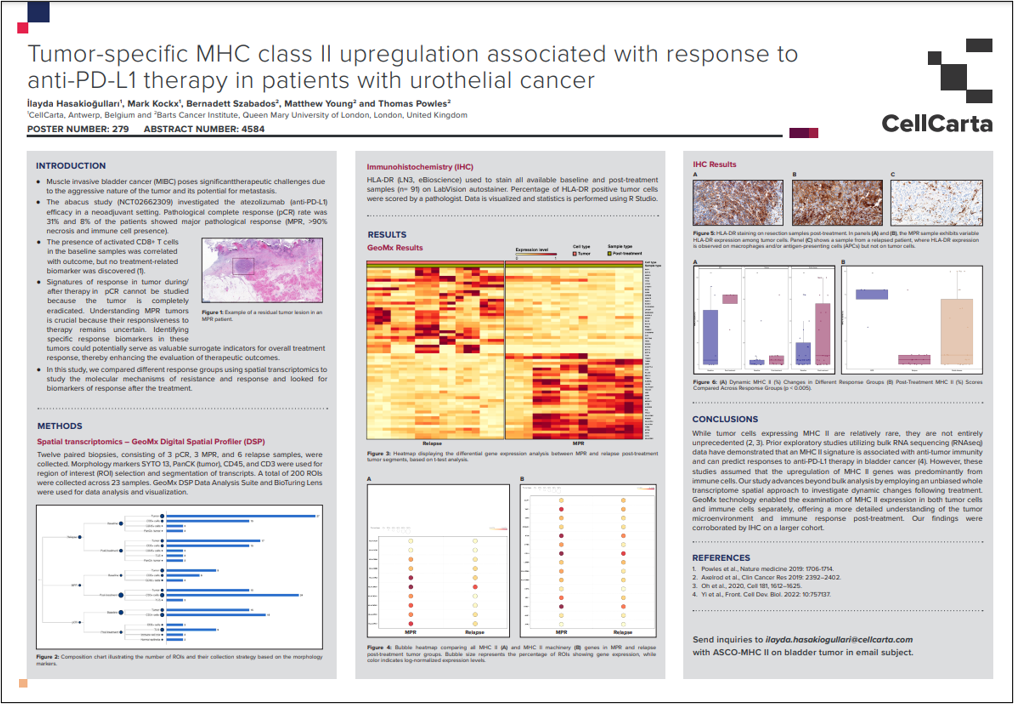
CellCarta’s poster, presented at ASCO 2024, discusses the study on tumor-specific MHC class II upregulation in patients with urothelial cancer undergoing anti-PD-L1 therapy.
The study, part of the abacus trial (NCT02662309), revealed that MHC class II expression in tumor cells, although rare, is associated with a positive response to atezolizumab. Utilizing spatial transcriptomics and immunohistochemistry (IHC), the research highlighted significant differences in MHC II expression between patients with pathological complete response (pCR) and those with major pathological response (MPR) or relapse.
The findings suggest that MHC II expression could serve as a biomarker for predicting therapeutic outcomes in bladder cancer treatment.
View the full poster:
May 28, 2024
CellCarta’s poster, presented at ASCO 2024, discusses the study on tumor-specific MHC class II upregulation in patients with urothelial cancer undergoing anti-PD-L1 therapy.
The study, part of the abacus trial (NCT02662309), revealed that MHC class II expression in tumor cells, although rare, is associated with a positive response to atezolizumab. Utilizing spatial transcriptomics and immunohistochemistry (IHC), the research highlighted significant differences in MHC II expression between patients with pathological complete response (pCR) and those with major pathological response (MPR) or relapse.
The findings suggest that MHC II expression could serve as a biomarker for predicting therapeutic outcomes in bladder cancer treatment.
View the full poster:
May 4, 2024
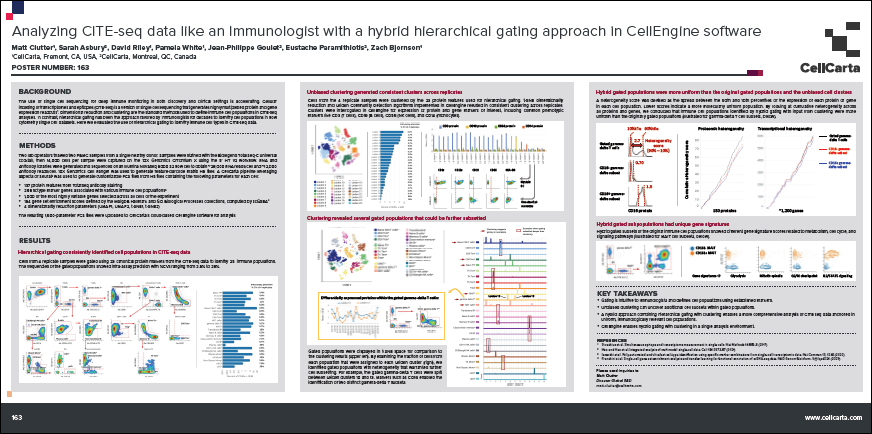
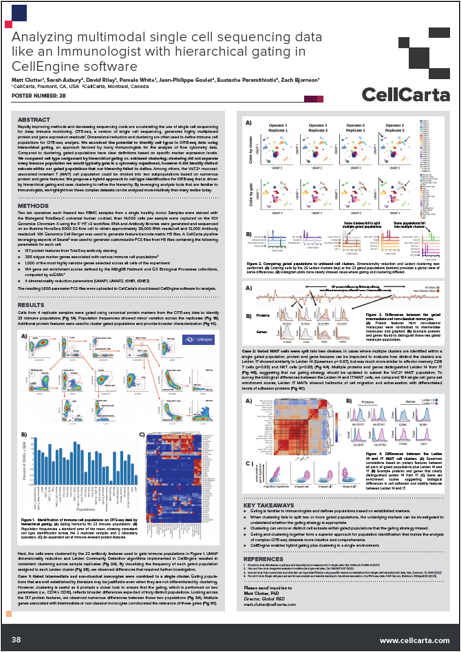
CellCarta’s poster details the analysis of multimodal single cell sequencing data using CellEngine software.
The study leverages CITE-seq, a technique that combines protein and gene expression analysis, to investigate immune cell populations. By comparing hierarchical gating—a method familiar to immunologists—with unbiased clustering, the research identifies clear definitions based on marker expression levels. The hybrid approach of using both gating and clustering enhances the identification and characterization of cell types, providing a more intuitive analysis of complex datasets.
The study specifically examines populations such as MAIT cells, highlighting differences in gene and protein expression to refine gating strategies.
View the full poster:
May 4, 2024
CellCarta’s poster details the analysis of multimodal single cell sequencing data using CellEngine software.
The study leverages CITE-seq, a technique that combines protein and gene expression analysis, to investigate immune cell populations. By comparing hierarchical gating—a method familiar to immunologists—with unbiased clustering, the research identifies clear definitions based on marker expression levels. The hybrid approach of using both gating and clustering enhances the identification and characterization of cell types, providing a more intuitive analysis of complex datasets.
The study specifically examines populations such as MAIT cells, highlighting differences in gene and protein expression to refine gating strategies.
View the full poster: