Emerging ADC Biomarkers

April 14, 2026

Antibody-drug conjugates (ADCs) have emerged as one of the most promising therapeutic modalities in oncology. To date, 21 ADCs have been approved worldwide1, with hundreds more currently in clinical development.2 While a small group of established biomarkers—HER2, TROP2, EGFR, and Claudin18.2—currently dominate the field and account for more than half of ADC clinical pipelines3, the landscape is quickly evolving.

A growing number of new biomarker targets are now entering ADC development programs, reflecting both advances in tumor biology and increasing investment across the pharmaceutical industry. As these targets emerge, laboratories must stay ahead of the field to support their measurement and validation.

Key biomarkers gaining traction in ADC development

Beyond the dominating, established biomarkers, recent advances in tumor biology have identified a number of additional antigens with characteristics that make them promising ADC targets.

HER3, for example, which is commonly overexpressed in non-small cell lung cancer (NSCLC) and breast cancer, has become the focus of several ADC programs, with the investigational therapy patritumab-deruxtecan showing promising efficacy in NSCLC and breast cancer.4

Similarly, B7-H4, an immune checkpoint protein, is overexpressed in several epithelial cancers while showing relatively limited expression in normal tissues, making it an attractive target for therapeutic development.5 In a phase-I dose-escalation trial, a B7-H4-directed dolasynthen ADC demonstrated promising antitumor activity and a manageable safety profile, highlighting the potential of this antigen as a therapeutic target.5

Other emerging targets are also gaining traction in ADC research. For example, ROR1 and CEACAM5 have been investigated as tumor-associated antigens in multiple solid tumors6,7, while CD142 (tissue factor) has been explored as a target for ADCs due to its role in tumor progression and angiogenesis.8

As researchers continue to identify tumor-associated proteins with favorable expression profiles and biological relevance, the number of potential ADC biomarkers will continue to grow.

Characterizing emerging ADC biomarkers

As new ADC targets continue to be identified, accurately characterizing their expression within tumor tissues will be critical for the development of next-generation ADC therapies. For ADCs, both the level and spatial distribution of target antigen expression can directly influence drug binding, internalization, and ultimately therapeutic efficacy.

Many tumor-associated antigens display heterogeneous expression across tumor types, between patients, and even within different regions of the same tumor, making biomarker evaluation more complex.9 In addition, newly identified targets may lack well-established antibodies or validated assays, creating further challenges when attempting to assess target prevalence and suitability during early development.

Enabling biomarker evaluation for next-generation ADC targets

To support the growing number of biomarker targets entering ADC development pipelines, we are expanding our portfolio of tissue-based biomarker assays at our California, Lake Forest laboratory. The site currently offers immunohistochemistry (IHC) assays for several established ADC targets and is actively developing assays for a range of emerging biomarkers identified through ongoing research across the ADC field (Table 1).

Current ADC biomarker assays Biomarkers coming in 2026
B7H3 CDCP1
Claudin18.2 B7-H4
cMET STEAP1
DLL3 CD25
EGFR HER3
FOLR1 CEACAM5
HER2 CD142
Nectin2 ROR1
TROP2 SEZ6

Table 1: Table to show current and emerging biomarker offering at the CellCarta Lake Forest Laboratory

At the Lake Forest facility, these targets are evaluated using singleplex and multiplex immunohistochemistry (IHC) and multiplex immunofluorescence, and spatial biology approaches, including COMET™, further enable high-plex analysis of biomarker expression within the tumour microenvironment. The site supports the rapid development of assays for emerging ADC biomarkers, enabling researchers to characterize antigen expression within tumor tissue and generate data that support biomarker discovery, target validation, and clinical development.

As ADC development continues to evolve, the range of tumor-associated antigens under investigation is expanding well beyond a small group of established targets. New biomarkers are emerging across multiple tumor types, reflecting both advances in tumor biology and growing interest from pharmaceutical developers.

As this landscape continues to broaden, the ability to rapidly evaluate and characterize emerging targets will be essential for translating new discoveries into viable ADC therapies.

 Working on an ADC development program?

Connect with CellCarta’s Lake Forest team to discuss how we can support biomarker evaluation for ADC targets.

About CellCarta’s California, Lake Forest Laboratory

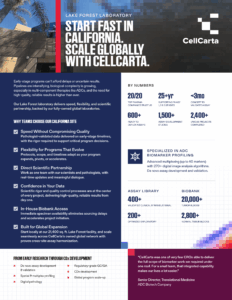
For over 20 years, CellCarta’s CLIA and CAP-accredited Lake Forest laboratory has supported pharmaceutical and biotechnology sponsors across preclinical, discovery, and clinical development programs. Key capabilities include:

  • Multiplex immunohistochemistry and immunofluorescence expertise
  • Integrated digital pathology and spatial analysis workflows
  • In-house tissue biobank access
  • Rapid turnaround times designed for early-stage decision-making

Since its opening, the Lake Forest team has worked with over 230 sponsors on over 2,400 unique projects. Operating independently and capable of participating in multi-site joint studies, Lake Forest delivers the speed and flexibility required to advance early-stage programs with confidence.

Find out more about our Lake Forest lab and how it can support your early-stage programs

About the Author:

author photo

Steven Wilkes is a Scientific Business Director at CellCarta, specializing in the histopathology platform.  Steven has 15+ years of experience in the field of histopathology at academic centers, large pharmaceutical companies, and clinical laboratories.  At CellCarta, Steven uses his expertise to help our clients find the best scientific and technical solutions to address their program needs.
References

  1. https://www.biochempeg.com/article/208.html
  2. https://www.biochempeg.com/article/447.html
  3. https://www.linkedin.com/pulse/global-adc-drug-clinical-development-2025-key-d3t5c/
  4. https://www.mdpi.com/1422-0067/26/13/6523
  5. https://www.targetedonc.com/view/early-phase-study-shows-promise-for-novel-b7-h4-targeted-adc
  6. https://academic.oup.com/abt/article/4/4/222/6397795
  7. https://www.sciencedirect.com/science/article/pii/S0923753422000035
  8. https://link.springer.com/article/10.1186/s40364-023-00504-6
  9. https://www.mdpi.com/1424-8247/18/6/915

Emerging ADC Biomarkers

April 14, 2026

Antibody-drug conjugates (ADCs) have emerged as one of the most promising therapeutic modalities in oncology. To date, 21 ADCs have been approved worldwide1, with hundreds more currently in clinical development.2 While a small group of established biomarkers—HER2, TROP2, EGFR, and Claudin18.2—currently dominate the field and account for more than half of ADC clinical pipelines3, the landscape is quickly evolving.

A growing number of new biomarker targets are now entering ADC development programs, reflecting both advances in tumor biology and increasing investment across the pharmaceutical industry. As these targets emerge, laboratories must stay ahead of the field to support their measurement and validation.

Key biomarkers gaining traction in ADC development

Beyond the dominating, established biomarkers, recent advances in tumor biology have identified a number of additional antigens with characteristics that make them promising ADC targets.

HER3, for example, which is commonly overexpressed in non-small cell lung cancer (NSCLC) and breast cancer, has become the focus of several ADC programs, with the investigational therapy patritumab-deruxtecan showing promising efficacy in NSCLC and breast cancer.4

Similarly, B7-H4, an immune checkpoint protein, is overexpressed in several epithelial cancers while showing relatively limited expression in normal tissues, making it an attractive target for therapeutic development.5 In a phase-I dose-escalation trial, a B7-H4-directed dolasynthen ADC demonstrated promising antitumor activity and a manageable safety profile, highlighting the potential of this antigen as a therapeutic target.5

Other emerging targets are also gaining traction in ADC research. For example, ROR1 and CEACAM5 have been investigated as tumor-associated antigens in multiple solid tumors6,7, while CD142 (tissue factor) has been explored as a target for ADCs due to its role in tumor progression and angiogenesis.8

As researchers continue to identify tumor-associated proteins with favorable expression profiles and biological relevance, the number of potential ADC biomarkers will continue to grow.

Characterizing emerging ADC biomarkers

As new ADC targets continue to be identified, accurately characterizing their expression within tumor tissues will be critical for the development of next-generation ADC therapies. For ADCs, both the level and spatial distribution of target antigen expression can directly influence drug binding, internalization, and ultimately therapeutic efficacy.

Many tumor-associated antigens display heterogeneous expression across tumor types, between patients, and even within different regions of the same tumor, making biomarker evaluation more complex.9 In addition, newly identified targets may lack well-established antibodies or validated assays, creating further challenges when attempting to assess target prevalence and suitability during early development.

Enabling biomarker evaluation for next-generation ADC targets

To support the growing number of biomarker targets entering ADC development pipelines, we are expanding our portfolio of tissue-based biomarker assays at our California, Lake Forest laboratory. The site currently offers immunohistochemistry (IHC) assays for several established ADC targets and is actively developing assays for a range of emerging biomarkers identified through ongoing research across the ADC field (Table 1).

Current ADC biomarker assays Biomarkers coming in 2026
B7H3 CDCP1
Claudin18.2 B7-H4
cMET STEAP1
DLL3 CD25
EGFR HER3
FOLR1 CEACAM5
HER2 CD142
Nectin2 ROR1
TROP2 SEZ6

Table 1: Table to show current and emerging biomarker offering at the CellCarta Lake Forest Laboratory

At the Lake Forest facility, these targets are evaluated using singleplex and multiplex immunohistochemistry (IHC) and multiplex immunofluorescence, and spatial biology approaches, including COMET™, further enable high-plex analysis of biomarker expression within the tumour microenvironment. The site supports the rapid development of assays for emerging ADC biomarkers, enabling researchers to characterize antigen expression within tumor tissue and generate data that support biomarker discovery, target validation, and clinical development.

As ADC development continues to evolve, the range of tumor-associated antigens under investigation is expanding well beyond a small group of established targets. New biomarkers are emerging across multiple tumor types, reflecting both advances in tumor biology and growing interest from pharmaceutical developers.

As this landscape continues to broaden, the ability to rapidly evaluate and characterize emerging targets will be essential for translating new discoveries into viable ADC therapies.

 Working on an ADC development program?

Connect with CellCarta’s Lake Forest team to discuss how we can support biomarker evaluation for ADC targets.

About CellCarta’s California, Lake Forest Laboratory

For over 20 years, CellCarta’s CLIA and CAP-accredited Lake Forest laboratory has supported pharmaceutical and biotechnology sponsors across preclinical, discovery, and clinical development programs. Key capabilities include:

  • Multiplex immunohistochemistry and immunofluorescence expertise
  • Integrated digital pathology and spatial analysis workflows
  • In-house tissue biobank access
  • Rapid turnaround times designed for early-stage decision-making

Since its opening, the Lake Forest team has worked with over 230 sponsors on over 2,400 unique projects. Operating independently and capable of participating in multi-site joint studies, Lake Forest delivers the speed and flexibility required to advance early-stage programs with confidence.

Find out more about our Lake Forest lab and how it can support your early-stage programs

About the Author:

author photo

Steven Wilkes is a Scientific Business Director at CellCarta, specializing in the histopathology platform.  Steven has 15+ years of experience in the field of histopathology at academic centers, large pharmaceutical companies, and clinical laboratories.  At CellCarta, Steven uses his expertise to help our clients find the best scientific and technical solutions to address their program needs.

References

  1. https://www.biochempeg.com/article/208.html
  2. https://www.biochempeg.com/article/447.html
  3. https://www.linkedin.com/pulse/global-adc-drug-clinical-development-2025-key-d3t5c/
  4. https://www.mdpi.com/1422-0067/26/13/6523
  5. https://www.targetedonc.com/view/early-phase-study-shows-promise-for-novel-b7-h4-targeted-adc
  6. https://academic.oup.com/abt/article/4/4/222/6397795
  7. https://www.sciencedirect.com/science/article/pii/S0923753422000035
  8. https://link.springer.com/article/10.1186/s40364-023-00504-6
  9. https://www.mdpi.com/1424-8247/18/6/915

Understanding the FDA’s Guidance for ADC Development

October 24, 2025

Antibody-drug conjugates (ADCs) have emerged as one of the most promising modalities in oncology treatment, and with more than 15 ADCs approved by the FDA (as of May 2025), they are now firmly established as a proven therapeutic class. To support the growing number of ADCs in development, the FDA issued its first dedicated guidance on clinical pharmacology considerations for ADCs in March 2024, bringing together decades of experience to provide developers with a clearer framework for evaluating these complex therapies throughout clinical development.1,2

So what does this guidance mean for ADC development? And what do developers need to do to meet these expectations

The FDA guidance: understanding the ADC as a sum of its parts1

The new FDA guidance makes it clear that ADCs must be evaluated as multi-component products, as the antibody, the payload, the linker, and any relevant metabolites all contribute to overall safety and efficacy. Evaluations across a clinical pharmacology program must therefore account for the contribution of each component, not just the ADC as a whole. As a result, sponsors are expected to measure each element with validated assays throughout ADC development and provide justification if any are excluded.

The guidance sets expectations across all the core areas of clinical pharmacology: bioanalytical approach, dose– and exposure–response analysis, intrinsic factors, QTc assessment, immunogenicity, and drug–drug interactions. Within this framework, the evaluation of intrinsic factors is a critical consideration, as it captures how patient characteristics, including genetic variation, may influence the behavior of ADC components.

Intrinsic factors and pharmacogenomic considerations

A notable inclusion in the intrinsic factors assessment is the expectation to evaluate pharmacogenomics. The FDA highlights that patient genetics can influence ADC exposure and response—for example, functional variants of enzymes and transporters such as CYP2D6 or BCRP can alter clearance of the unconjugated payload, while Fc-gamma receptor (FcγR) variants may affect antibody-mediated activity. Depending on an ADC’s mechanism, and absorption, distribution, metabolism, and excretion (ADME) profile, a pharmacogenetic evaluation may be recommended to capture these influences.

One area where pharmacogenomics may be particularly relevant is linker stability. ADC payload release relies on cleavage of the chemical linker, a process that can be mediated by enzymes, reduction, or pH-dependent hydrolysis. Reflecting this, the FDA calls out linker-derived analytes in specific assessments, such as QTc risk evaluation, where sponsors are expected to analyze the impact of the unconjugated payload, metabolites, and the linker itself. In practice, this means developers may need to incorporate pharmacogenomic data into studies that examine payload release and exposure, ensuring they capture the impact of patient variability on this critical step of ADC function.

What does the pharmacogenomics guidance mean for ADC development?

For ADC developers, the guidance raises the bar on clinical pharmacology planning. Programs should now:

  • Expand bioanalytical coverage to support pharmacogenomic analyses, with assays that assess, not just the intact ADC, but also the antibody, linker, payload, and relevant metabolites, with clear justification if any are excluded
  • Build pharmacogenomics early into study design, particularly where genetic variants may affect payload clearance or antibody function
  • Account for linker stability in pharmacogenomic assessments, including specialized studies such as QTc evaluations, where regulators expect to see data on both payload and linker analytes

Meeting these expectations will require more detailed planning and earlier integration of component-level assessments into ADC development programs. Teams that prepare for these requirements early can reduce regulatory risk and maintain momentum through development.

Find out more about how CellCarta can support your ADC development programs.

About the author:

author photo

Nathalie Bernard (PhD) is the scientific business director for the Genomic Services unit within CellCarta. Her background is in molecular biology, and she has many years of experience in PCR and sequencing, technologies used to discover or identify DNA and RNA biomarkers of clinical utility. At CellCarta, Nathalie is using her expertise to guide our customers in finding the best solution to their genomic questions.

References

  1. https://www.fda.gov/regulatory-information/search-fda-guidance-documents/clinical-pharmacology-considerations-antibody-drug-conjugates-guidance-industry  
  2. https://www.fda.gov/drugs/guidances-drugs/guidance-recap-podcast-clinical-pharmacology-considerations-antibody-drug-conjugates   

Understanding the FDA’s Guidance for ADC Development

October 24, 2025

Antibody-drug conjugates (ADCs) have emerged as one of the most promising modalities in oncology treatment, and with more than 15 ADCs approved by the FDA (as of May 2025), they are now firmly established as a proven therapeutic class. To support the growing number of ADCs in development, the FDA issued its first dedicated guidance on clinical pharmacology considerations for ADCs in March 2024, bringing together decades of experience to provide developers with a clearer framework for evaluating these complex therapies throughout clinical development.1,2

So what does this guidance mean for ADC development? And what do developers need to do to meet these expectations

The FDA guidance: understanding the ADC as a sum of its parts1

The new FDA guidance makes it clear that ADCs must be evaluated as multi-component products, as the antibody, the payload, the linker, and any relevant metabolites all contribute to overall safety and efficacy. Evaluations across a clinical pharmacology program must therefore account for the contribution of each component, not just the ADC as a whole. As a result, sponsors are expected to measure each element with validated assays throughout ADC development and provide justification if any are excluded.

The guidance sets expectations across all the core areas of clinical pharmacology: bioanalytical approach, dose– and exposure–response analysis, intrinsic factors, QTc assessment, immunogenicity, and drug–drug interactions. Within this framework, the evaluation of intrinsic factors is a critical consideration, as it captures how patient characteristics, including genetic variation, may influence the behavior of ADC components.

Intrinsic factors and pharmacogenomic considerations

A notable inclusion in the intrinsic factors assessment is the expectation to evaluate pharmacogenomics. The FDA highlights that patient genetics can influence ADC exposure and response—for example, functional variants of enzymes and transporters such as CYP2D6 or BCRP can alter clearance of the unconjugated payload, while Fc-gamma receptor (FcγR) variants may affect antibody-mediated activity. Depending on an ADC’s mechanism, and absorption, distribution, metabolism, and excretion (ADME) profile, a pharmacogenetic evaluation may be recommended to capture these influences.

One area where pharmacogenomics may be particularly relevant is linker stability. ADC payload release relies on cleavage of the chemical linker, a process that can be mediated by enzymes, reduction, or pH-dependent hydrolysis. Reflecting this, the FDA calls out linker-derived analytes in specific assessments, such as QTc risk evaluation, where sponsors are expected to analyze the impact of the unconjugated payload, metabolites, and the linker itself. In practice, this means developers may need to incorporate pharmacogenomic data into studies that examine payload release and exposure, ensuring they capture the impact of patient variability on this critical step of ADC function.

What does the pharmacogenomics guidance mean for ADC development?

For ADC developers, the guidance raises the bar on clinical pharmacology planning. Programs should now:

  • Expand bioanalytical coverage to support pharmacogenomic analyses, with assays that assess, not just the intact ADC, but also the antibody, linker, payload, and relevant metabolites, with clear justification if any are excluded
  • Build pharmacogenomics early into study design, particularly where genetic variants may affect payload clearance or antibody function
  • Account for linker stability in pharmacogenomic assessments, including specialized studies such as QTc evaluations, where regulators expect to see data on both payload and linker analytes

Meeting these expectations will require more detailed planning and earlier integration of component-level assessments into ADC development programs. Teams that prepare for these requirements early can reduce regulatory risk and maintain momentum through development.

Find out more about how CellCarta can support your ADC development programs.

About the author:

author photo

Nathalie Bernard (PhD) is the scientific business director for the Genomic Services unit within CellCarta. Her background is in molecular biology, and she has many years of experience in PCR and sequencing, technologies used to discover or identify DNA and RNA biomarkers of clinical utility. At CellCarta, Nathalie is using her expertise to guide our customers in finding the best solution to their genomic questions.

References

  1. https://www.fda.gov/regulatory-information/search-fda-guidance-documents/clinical-pharmacology-considerations-antibody-drug-conjugates-guidance-industry  
  2. https://www.fda.gov/drugs/guidances-drugs/guidance-recap-podcast-clinical-pharmacology-considerations-antibody-drug-conjugates   

Advance Your ADC Programs with CellCarta

April 16, 2025

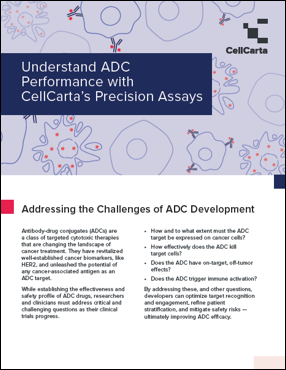
Our team developed a comprehensive suite of precision assays to support every stage of antibody-drug conjugate (ADC) development.

From confirming target expression and measuring density, to evaluating drug-target engagement, pharmacokinetics, and safety, CellCarta employs a data-driven, multiplatform approach.

Our solutions include multiplex IF and IHC, flow cytometry, mass spectrometry, RNA sequencing, and spatial biology technologies, ensuring precise target quantification and in-depth tumor microenvironment analysis.

With global facilities, companion diagnostic (CDx) expertise, and full logistics support, CellCarta helps biopharma partners accelerate their ADC programs.

Download the brochure now!

ADC

Advance your ADC programs with CellCarta! Contact us today to discover how our precision assays and scientific expertise can drive your clinical success.

Advance Your ADC Programs with CellCarta

April 16, 2025

Our team developed a comprehensive suite of precision assays to support every stage of antibody-drug conjugate (ADC) development.

From confirming target expression and measuring density, to evaluating drug-target engagement, pharmacokinetics, and safety, CellCarta employs a data-driven, multiplatform approach.

Our solutions include multiplex IF and IHC, flow cytometry, mass spectrometry, RNA sequencing, and spatial biology technologies, ensuring precise target quantification and in-depth tumor microenvironment analysis.

With global facilities, companion diagnostic (CDx) expertise, and full logistics support, CellCarta helps biopharma partners accelerate their ADC programs.

Download the brochure now!

ADC

Advance your ADC programs with CellCarta! Contact us today to discover how our precision assays and scientific expertise can drive your clinical success.

Keep your ADC programs on Target | CellCarta

Keep your ADC programs on Target

Our experts harness our comprehensive suite of precision assays to measure what matters throughout your ADC development. Navigate the complexities of ADC development and approval with our scientific & regulatory expertise.

Discover our ADC expertise. Request a consult today.

On Target:

Our multiplatform approach for reliable ADC analysis ensures you have a complete understanding of your target expression, engagement and ADC pharmacokinetics at all stages of development.

Download the resource

See our precision assays for ADC development

Beyond the target:

In-depth monitoring of the tumor microenvironment (TME) is crucial to understanding why patients may or may not respond to ADCs. We assess immune cell infiltration, activation and exhaustion with multiplatform approaches, plus spatial distribution of cells and targets including both transcriptomic and proteomic profiling.

On-target, off-tumor:

We understand that safety is key. Precisely assessing on-target, off-tumor ADC toxicity identifies concerns early.

On track for approval:

We conduct all assays using CAP/CLIA-accredited laboratories, ensuring the highest standards for regulatory compliance. Our team supports your pathway to approval with extensive knowledge on IVDR and HGRAC regulations.

See how we can support your ADC development. Request a consult with our ADC experts!

Streamline your ADC development with our additional benefits:

Contact our experts to advance your ADC programs today!

Keep your ADC programs on Target | CellCarta

Keep your ADC programs on Target

Our experts harness our comprehensive suite of precision assays to measure what matters throughout your ADC development. Navigate the complexities of ADC development and approval with our scientific & regulatory expertise.

Discover our ADC expertise. Request a consult today.

On Target:

Our multiplatform approach for reliable ADC analysis ensures you have a complete understanding of your target expression, engagement and ADC pharmacokinetics at all stages of development.

Download the resource

See our precision assays for ADC development

Beyond the target:

In-depth monitoring of the tumor microenvironment (TME) is crucial to understanding why patients may or may not respond to ADCs. We assess immune cell infiltration, activation and exhaustion with multiplatform approaches, plus spatial distribution of cells and targets including both transcriptomic and proteomic profiling.

On-target, off-tumor:

We understand that safety is key. Precisely assessing on-target, off-tumor ADC toxicity identifies concerns early.

On track for approval:

We conduct all assays using CAP/CLIA-accredited laboratories, ensuring the highest standards for regulatory compliance. Our team supports your pathway to approval with extensive knowledge on IVDR and HGRAC regulations.

See how we can support your ADC development. Request a consult with our ADC experts!

Streamline your ADC development with our additional benefits:

Contact our experts to advance your ADC programs today!

Beyond Affinity: Simplifying ADC quantitation without compromising sensitivity.

April 7, 2025

Beyond Affinity: Simplifying ADC quantitation without compromising sensitivity.

Beyond Affinity: Simplifying ADC quantitation without compromising sensitivity.

April 7, 2025

Beyond Affinity: Simplifying ADC quantitation without compromising sensitivity.