Case Study: Delivering Clinical-Grade Interpretable Findings from Hyperplex Spatial Biology

July 17, 2026

The challenge: Hyperplex data eliminates inter-slide variability, but introduces it's own challenges

By reading dozens of markers from a single slide, spatial biology approaches minimize tissue use and remove slide-to-slide variability. But it comes with its own challenges: huge data volumes, and the requirement for stringent phenotyping consistency and analytical rigor to make accurate, actionable conclusions.

The platform: Built on the COMET

How the COMET works: an integrated staining and scanning system analyzing up to 40 markers on a single slide through iterative stain-image-elute cycles, built for the standardized, documented protocols clinical trial contexts demand.

The assay was developed and validated for accuracy, sensitivity, specificity, and cross-site concordance between CellCarta's labs in Lake Forest, California and Antwerp, Belgium.

The study: Complete responder vs non-responder dataset

In a 20-plex hyperplex analysis of tissue samples from patients with muscle-invasive bladder cancer treated with neo-adjuvant immunotherapy, CellCarta's clinical-grade COMET workflow highlighted distinct differences in immune composition, spatial proximity, and tissue organization between an immunotherapy responder and a non-responder, all from a single slide per patient.

  1. Phenotype composition how immune, stromal, and tumor proportions differed between the two cases
  2. Spatial distance, co-localization and niche analysis
  3. What it means for IO programs how tissue organization, not just cell counts, reflects response
  4. How we build global assays for comparable results, regardless of data collection location
  5. The clinical-grade, platform agnostic workflow that turns hyperplex image data into reliable, interpretable biological findings

From early-stage biotechs to established biopharma, understanding why some patients respond better than others is essential.
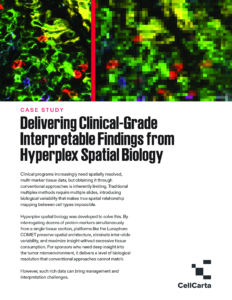
Read the full case study!

Case Study: Delivering Clinical-Grade Interpretable Findings from Hyperplex Spatial Biology

July 17, 2026

The challenge: Hyperplex data eliminates inter-slide variability, but introduces it's own challenges

By reading dozens of markers from a single slide, spatial biology approaches minimize tissue use and remove slide-to-slide variability. But it comes with its own challenges: huge data volumes, and the requirement for stringent phenotyping consistency and analytical rigor to make accurate, actionable conclusions.

The platform: Built on the COMET

How the COMET works: an integrated staining and scanning system analyzing up to 40 markers on a single slide through iterative stain-image-elute cycles, built for the standardized, documented protocols clinical trial contexts demand.

The assay was developed and validated for accuracy, sensitivity, specificity, and cross-site concordance between CellCarta's labs in Lake Forest, California and Antwerp, Belgium.

The study: Complete responder vs non-responder dataset

In a 20-plex hyperplex analysis of tissue samples from patients with muscle-invasive bladder cancer treated with neo-adjuvant immunotherapy, CellCarta's clinical-grade COMET workflow highlighted distinct differences in immune composition, spatial proximity, and tissue organization between an immunotherapy responder and a non-responder, all from a single slide per patient.

  1. Phenotype composition how immune, stromal, and tumor proportions differed between the two cases
  2. Spatial distance, co-localization and niche analysis
  3. What it means for IO programs how tissue organization, not just cell counts, reflects response
  4. How we build global assays for comparable results, regardless of data collection location
  5. The clinical-grade, platform agnostic workflow that turns hyperplex image data into reliable, interpretable biological findings

From early-stage biotechs to established biopharma, understanding why some patients respond better than others is essential.

Read the full case study!

Biomarker strategies to support success at every stage of therapy development

April 3, 2025

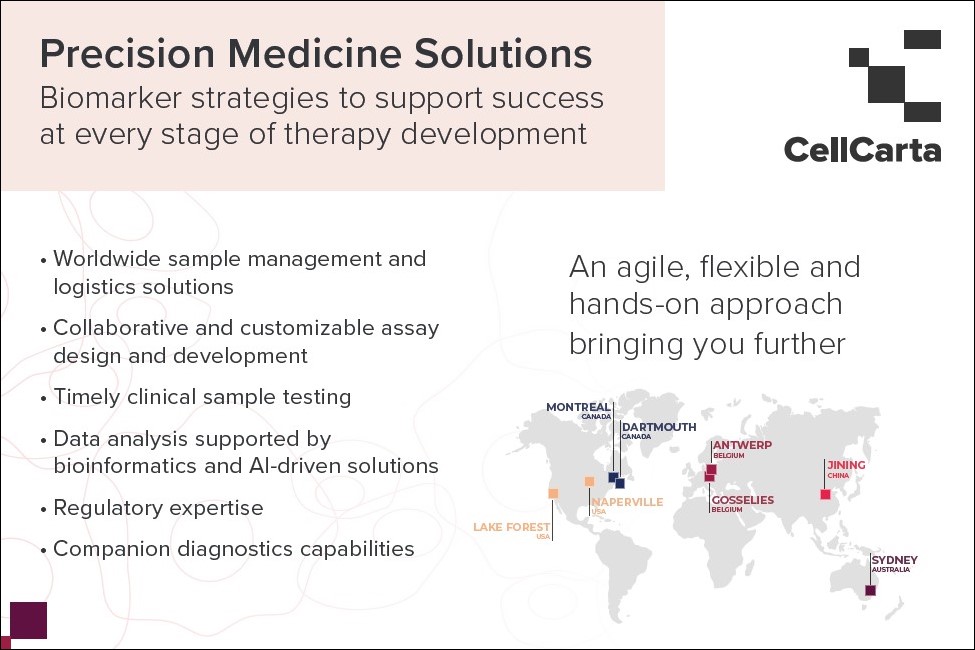
Precision Medicine Solutions: Biomarker strategies to support success at every stage of therapy development


Biomarker strategies to support success at every stage of therapy development

April 3, 2025

Precision Medicine Solutions: Biomarker strategies to support success at every stage of therapy development


Let's Talk: A Conversation with Dr. Thomas Powles

November 28, 2024

In this webcast, Dr. Thomas Powles, Chair of Barts Cancer Centre (UK), joins Christopher Ung, our Chief Scientific Business Officer, for an in-depth conversation on the latest on Antibody Drug Conjugates (ADCs) and other innovative cancer therapies.

Key topics discussed in this webcast:

  • The challenges of treating metastatic bladder cancer
  • Targeting metastatic bladder cancer with Nectin-4 ADC
  • New ways of thinking about biomarkers for ADCs
  • How spatial biology could improve ADC assessment
  • Bi-specifics and other innovative therapies for metastatic bladder cancer
  • Being a physician and running clinical trials
author photo

Dr. Powles is a renowned expert in urology cancer and drug development, serving as the Chair of the Barts Cancer Centre at St. Bartholomew’s Hospital, Queen Mary University of London. He leads numerous clinical trials across all phases. Notably, his work in bladder and renal cancer has been pivotal in establishing new immunotherapy and antibody drug conjugate treatments as standards of care globally. Dr. Powles has been included in TIME’s list of the 100 most influential people in global health and in the Nature10 list in 2023.

author photo

Christopher Ung is CellCarta’s Chief Scientific Business Officer and has served in the companion diagnostics field since its inception. He is one of the original pioneers of the personalized medicine field. Mr. Ung currently leads the development and execution of CellCarta’s strategic and business initiatives, leveraging the company’s solid tumor and anatomic pathology services.

Let's Talk: A Conversation with Dr. Thomas Powles

November 28, 2024

In this webcast, Dr. Thomas Powles, Chair of Barts Cancer Centre (UK), joins Christopher Ung, our Chief Scientific Business Officer, for an in-depth conversation on the latest on Antibody Drug Conjugates (ADCs) and other innovative cancer therapies.

Key topics discussed in this webcast:

  • The challenges of treating metastatic bladder cancer
  • Targeting metastatic bladder cancer with Nectin-4 ADC
  • New ways of thinking about biomarkers for ADCs
  • How spatial biology could improve ADC assessment
  • Bi-specifics and other innovative therapies for metastatic bladder cancer
  • Being a physician and running clinical trials
author photo

Dr. Powles is a renowned expert in urology cancer and drug development, serving as the Chair of the Barts Cancer Centre at St. Bartholomew’s Hospital, Queen Mary University of London. He leads numerous clinical trials across all phases. Notably, his work in bladder and renal cancer has been pivotal in establishing new immunotherapy and antibody drug conjugate treatments as standards of care globally. Dr. Powles has been included in TIME’s list of the 100 most influential people in global health and in the Nature10 list in 2023.

author photo

Christopher Ung is CellCarta’s Chief Scientific Business Officer and has served in the companion diagnostics field since its inception. He is one of the original pioneers of the personalized medicine field. Mr. Ung currently leads the development and execution of CellCarta’s strategic and business initiatives, leveraging the company’s solid tumor and anatomic pathology services.