Analyze single-cell sequencing data with CellEngine.

May 4, 2024

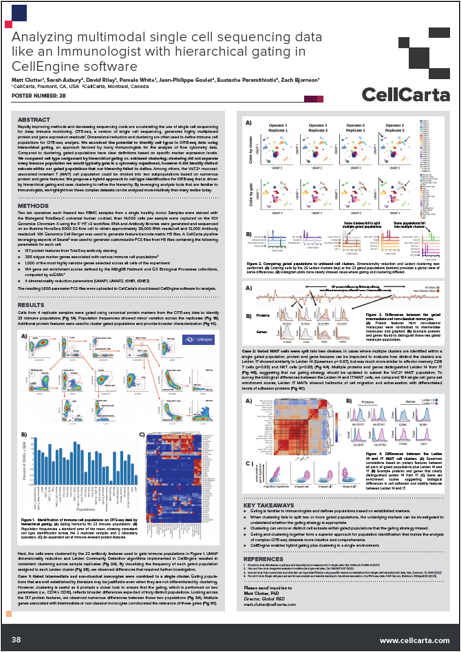
CellCarta’s poster details the analysis of multimodal single cell sequencing data using CellEngine software.

The study leverages CITE-seq, a technique that combines protein and gene expression analysis, to investigate immune cell populations. By comparing hierarchical gating—a method familiar to immunologists—with unbiased clustering, the research identifies clear definitions based on marker expression levels. The hybrid approach of using both gating and clustering enhances the identification and characterization of cell types, providing a more intuitive analysis of complex datasets.

The study specifically examines populations such as MAIT cells, highlighting differences in gene and protein expression to refine gating strategies.

View the full poster:

Analyzing multimodal single cell sequencing data like an Immunologist with hierarchical gating in CellEngine software

Analyze single-cell sequencing data with CellEngine.

May 4, 2024

CellCarta’s poster details the analysis of multimodal single cell sequencing data using CellEngine software.

The study leverages CITE-seq, a technique that combines protein and gene expression analysis, to investigate immune cell populations. By comparing hierarchical gating—a method familiar to immunologists—with unbiased clustering, the research identifies clear definitions based on marker expression levels. The hybrid approach of using both gating and clustering enhances the identification and characterization of cell types, providing a more intuitive analysis of complex datasets.

The study specifically examines populations such as MAIT cells, highlighting differences in gene and protein expression to refine gating strategies.

View the full poster:

Analyzing multimodal single cell sequencing data like an Immunologist with hierarchical gating in CellEngine software

CellCarta’s CellEngine Visualization Tool for Clinical Cytometry

April 8, 2024

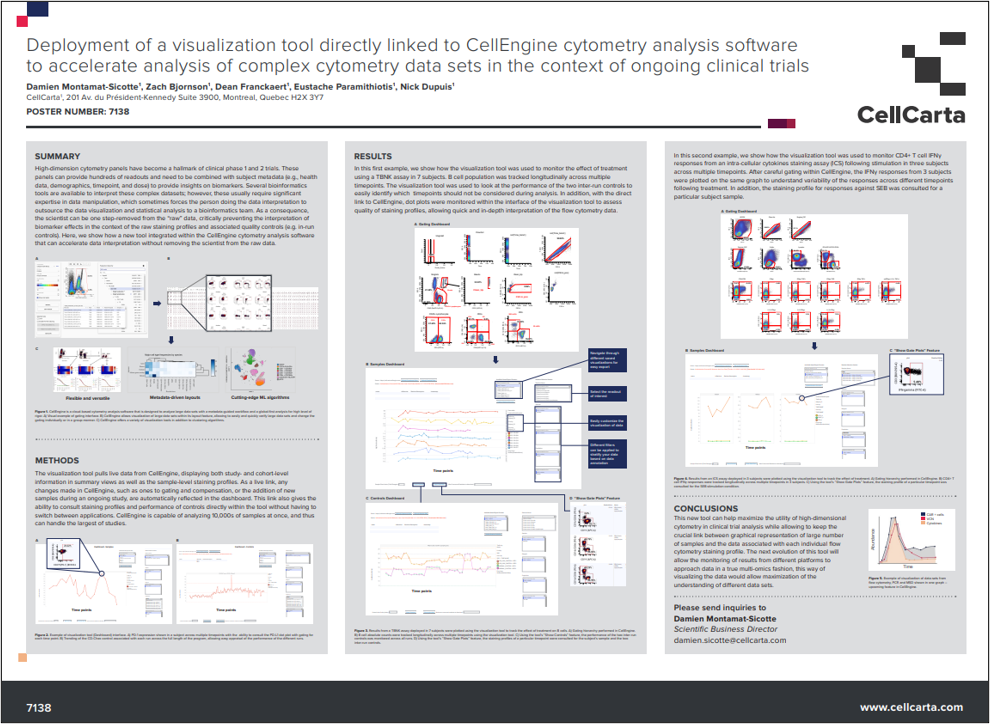
CellCarta’s poster introduces a visualization tool integrated with CellEngine cytometry analysis software to enhance the analysis of complex cytometry data in clinical trials.

The tool provides real-time data from CellEngine, offering intuitive visualization and interaction with high-dimensional cytometry panels. By linking directly to CellEngine, scientists can monitor and assess data quality and biomarker effects without losing connection to the raw data.

The tool facilitates the evaluation of treatment effects over time, demonstrated through TBNK and ICS assays in multiple subjects, improving the efficiency and accuracy of flow cytometry data analysis.

View the full poster:

Deployment of a visualization tool directly linked to CellEngine cytometry analysis software to accelerate analysis of complex cytometry data sets in the context of ongoing clinical trials

cell engine datasets

CellCarta’s CellEngine Visualization Tool for Clinical Cytometry

April 8, 2024

CellCarta’s poster introduces a visualization tool integrated with CellEngine cytometry analysis software to enhance the analysis of complex cytometry data in clinical trials.

The tool provides real-time data from CellEngine, offering intuitive visualization and interaction with high-dimensional cytometry panels. By linking directly to CellEngine, scientists can monitor and assess data quality and biomarker effects without losing connection to the raw data.

The tool facilitates the evaluation of treatment effects over time, demonstrated through TBNK and ICS assays in multiple subjects, improving the efficiency and accuracy of flow cytometry data analysis.

View the full poster:

Deployment of a visualization tool directly linked to CellEngine cytometry analysis software to accelerate analysis of complex cytometry data sets in the context of ongoing clinical trials

cell engine datasets

Enhance Flow Cytometry with Automatic Gating Tools

November 15, 2023

Automatic Gating Tools- autogating, range gating

Gating can be one of the more time-consuming parts of cytometry analysis. When gate positions need to be changed for every sample in an experiment, it can take orders of magnitude longer.

Two automatic tools built into CellEngine, CellCarta’s cytometry analysis platform, can be leveraged to increase speed and efficiency:

  • Automatic gate tailoring uses a machine learning algorithm to adjust gate placement. After defining a population hierarchy, select one or more gates to be adjusted to fit each sample’s data automatically. A set of manually gated reference files provide a model for the algorithm to position gates in the rest of the data. When faced with datasets with high variability, automatic gate tailoring is one of the most powerful tools to expedite analysis.
  • Automatic percentile gating precisely moves a gate vertex or edge to a specified percentile of one or more control files. For example, you can move a range gate to the 99th percentile of an unstimulated or isotype control. This approach facilitates comparative analysis of samples; for example, when comparing normalized outcomes donor-by-donor.

In order to streamline the gating process most efficiently, there are several important points to remember when using these tools.

1 – Understanding Automatic Gating Tools in Flow Cytometry with CellEngine

Experimental design is a fundamental factor for successful cytometry analysis. Autogating in CellEngine streamlines the analysis process, but the best results come from well-designed trials and high-quality data.

Taking time to design clear objectives, include appropriate controls, and optimize experimental conditions ensures that the results from autogating are meaningful and useful.

For example, including an unstimulated control in an intracellular cytokine or phospho-flow panel provides an ideal control for using percentile gating.

Picking dyes that provide good separation of populations improves automatic gate tailoring’s performance. By creating a well-designed foundation, researchers can extract meaningful insights from complex datasets.

2 – Quality control is indispensable for Flow Cytometry Analysis

One of the most important aspects of high-quality analysis is high-quality data. To generate high-quality data, build quality control processes into your workflows to ensure reliability and accuracy, and identify issues promptly.

For example, verify staining via positive controls, use beads to calibrate and verify cytometer performance, and reduce technical variability as much as possible.

This maximizes the potential from each dataset, whether you use automatic tools in analysis or not.

3 – How to Implement Automatic Gating in CellEngine

Automatic gate tailoring uses one or more files as a reference for setting gate positions. Training data must be representative of the overall dataset, and carefully gated for best results.

An experiment with different cell types, disease states, or experimental conditions should include examples of all of those in the training data. This enhances the algorithm’s ability to properly adjust gates.

Consistent choices when gating the training data will also reduce variability.

Combining meticulous experiment design, trustworthy data, and carefully curated training data with automated tools increases efficiency and accuracy.

By incorporating these best practices, researchers can harness the full power of autogating tools to optimize their workflows.

If you’re interested in trying autogating, you can sign up for a free two-month trial of CellEngine at https://cellengine.com/.


About the author:

author photo

Anita Ray is a technical application specialist with CellEngine. She has ten years of experience in cytometry and worked in translational immuno-oncology prior to joining the CellEngine team.
Enhance Flow Cytometry with Automatic Gating Tools

November 15, 2023

Automatic Gating Tools- autogating, range gating

Gating can be one of the more time-consuming parts of cytometry analysis. When gate positions need to be changed for every sample in an experiment, it can take orders of magnitude longer.

Two automatic tools built into CellEngine, CellCarta’s cytometry analysis platform, can be leveraged to increase speed and efficiency:

  • Automatic gate tailoring uses a machine learning algorithm to adjust gate placement. After defining a population hierarchy, select one or more gates to be adjusted to fit each sample’s data automatically. A set of manually gated reference files provide a model for the algorithm to position gates in the rest of the data. When faced with datasets with high variability, automatic gate tailoring is one of the most powerful tools to expedite analysis.
  • Automatic percentile gating precisely moves a gate vertex or edge to a specified percentile of one or more control files. For example, you can move a range gate to the 99th percentile of an unstimulated or isotype control. This approach facilitates comparative analysis of samples; for example, when comparing normalized outcomes donor-by-donor.

In order to streamline the gating process most efficiently, there are several important points to remember when using these tools.

1 – Understanding Automatic Gating Tools in Flow Cytometry with CellEngine

Experimental design is a fundamental factor for successful cytometry analysis. Autogating in CellEngine streamlines the analysis process, but the best results come from well-designed trials and high-quality data.

Taking time to design clear objectives, include appropriate controls, and optimize experimental conditions ensures that the results from autogating are meaningful and useful.

For example, including an unstimulated control in an intracellular cytokine or phospho-flow panel provides an ideal control for using percentile gating.

Picking dyes that provide good separation of populations improves automatic gate tailoring’s performance. By creating a well-designed foundation, researchers can extract meaningful insights from complex datasets.

2 – Quality control is indispensable for Flow Cytometry Analysis

One of the most important aspects of high-quality analysis is high-quality data. To generate high-quality data, build quality control processes into your workflows to ensure reliability and accuracy, and identify issues promptly.

For example, verify staining via positive controls, use beads to calibrate and verify cytometer performance, and reduce technical variability as much as possible.

This maximizes the potential from each dataset, whether you use automatic tools in analysis or not.

3 – How to Implement Automatic Gating in CellEngine

Automatic gate tailoring uses one or more files as a reference for setting gate positions. Training data must be representative of the overall dataset, and carefully gated for best results.

An experiment with different cell types, disease states, or experimental conditions should include examples of all of those in the training data. This enhances the algorithm’s ability to properly adjust gates.

Consistent choices when gating the training data will also reduce variability.

Combining meticulous experiment design, trustworthy data, and carefully curated training data with automated tools increases efficiency and accuracy.

By incorporating these best practices, researchers can harness the full power of autogating tools to optimize their workflows.

If you’re interested in trying autogating, you can sign up for a free two-month trial of CellEngine at https://cellengine.com/.


About the author:

author photo

Anita Ray is a technical application specialist with CellEngine. She has ten years of experience in cytometry and worked in translational immuno-oncology prior to joining the CellEngine team.
CellEngine Auto-Gate: Accurate Gating in COVID Study

May 22, 2023

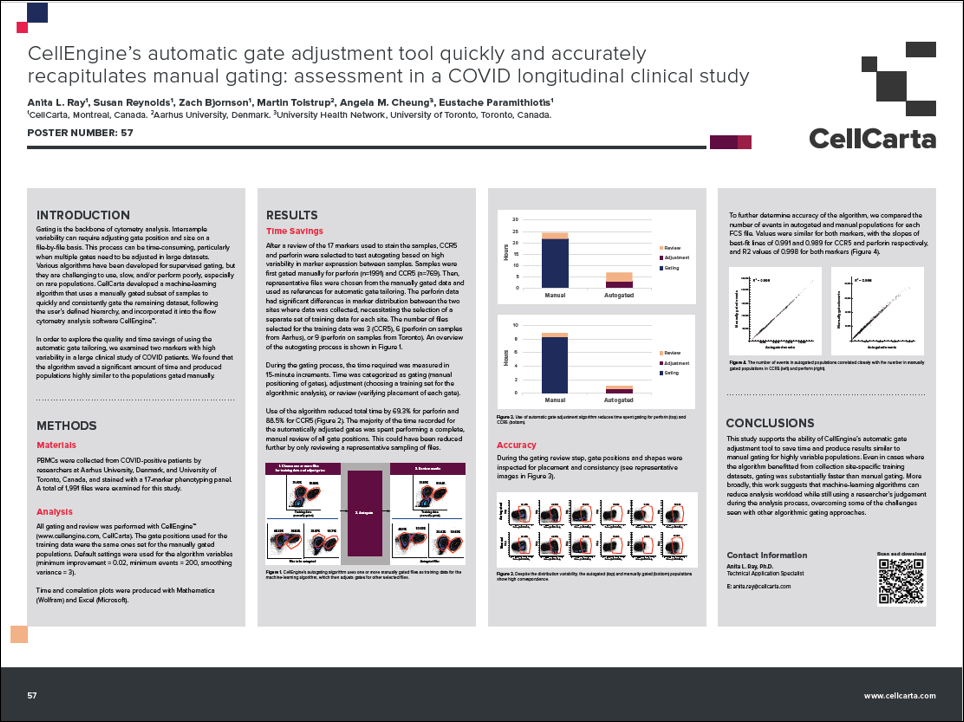
CellCarta’s poster demonstrates the effectiveness of CellEngine’s automatic gate adjustment tool in cytometry analysis for a COVID-19 longitudinal clinical study. The tool uses a machine-learning algorithm trained on manually gated samples to automatically gate large datasets, significantly reducing analysis time while maintaining accuracy.

The study focused on two markers, CCR5 and perforin, known for high variability, and showed that the tool produced results highly similar to manual gating, with a time reduction of 69.3% for perforin and 88.5% for CCR5

View the full poster:

CellEngine’s automatic gate adjustment tool quickly and accurately recapitulates manual gating: assessment in a COVID longitudinal clinical study

As presented in CYTO2023

CellEngine’s automatic gate adjustment tool quickly and accurately recapitulates manual gating: assessment in a COVID longitudinal clinical study

Autogating

  • Closely correlates with manual gating
  • Reduces analysis time by 69% to 89%
  • Adjusts gates for thousands of files in seconds
  • Full deterministic operation based on a few manually gated files

CellEngine Auto-Gate: Accurate Gating in COVID Study

May 22, 2023

CellCarta’s poster demonstrates the effectiveness of CellEngine’s automatic gate adjustment tool in cytometry analysis for a COVID-19 longitudinal clinical study. The tool uses a machine-learning algorithm trained on manually gated samples to automatically gate large datasets, significantly reducing analysis time while maintaining accuracy.

The study focused on two markers, CCR5 and perforin, known for high variability, and showed that the tool produced results highly similar to manual gating, with a time reduction of 69.3% for perforin and 88.5% for CCR5

View the full poster:

CellEngine’s automatic gate adjustment tool quickly and accurately recapitulates manual gating: assessment in a COVID longitudinal clinical study

As presented in CYTO2023

CellEngine’s automatic gate adjustment tool quickly and accurately recapitulates manual gating: assessment in a COVID longitudinal clinical study

Autogating

  • Closely correlates with manual gating
  • Reduces analysis time by 69% to 89%
  • Adjusts gates for thousands of files in seconds
  • Full deterministic operation based on a few manually gated files

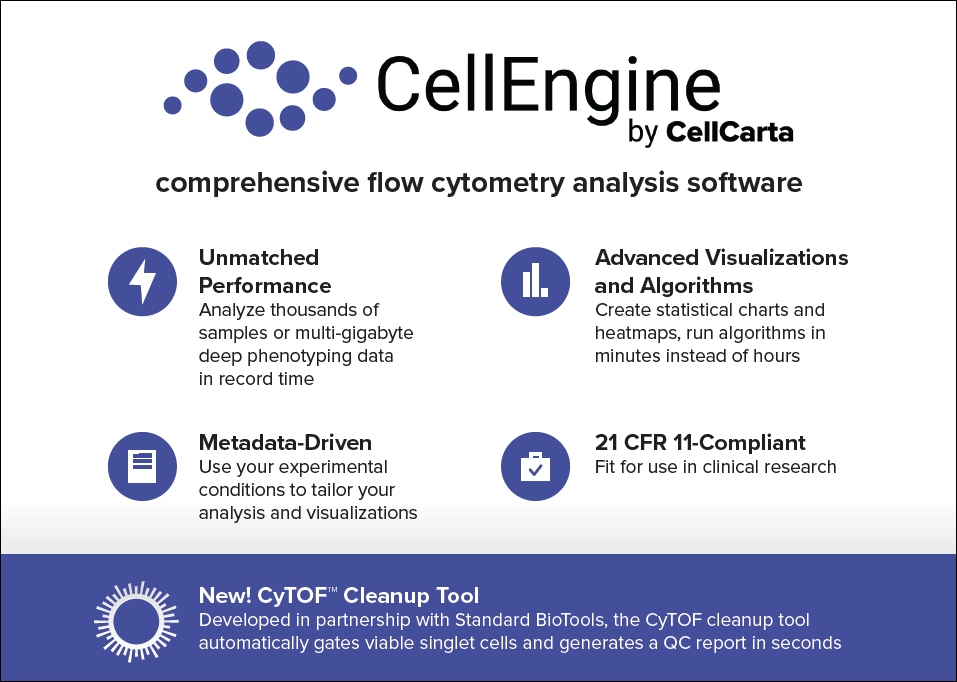
Next-Generation Flow Cytometry Analysis with CellEngine™

January 31, 2023

DOWNLOAD OUR INFOGRAPHIC

Next-Generation Flow Cytometry Analysis with CellEngine™

January 31, 2023

DOWNLOAD OUR INFOGRAPHIC