The role of cytokine profiling in a changing cell therapy testing landscape

August 6, 2024
The cell therapy landscape is evolving at unprecedented pace, with an increasingly complex and diversified catalogue of candidates now reaching the clinic, and urgency to bring new therapies to the market.

Together, these trends are putting an increasing burden on clinical testing programs.

In our recent Cell Therapy Trends Report, our experts discuss in more detail how clinical testing strategies are accommodating these rapid development strategies, as well as what that could mean for key clinical testing areas.

One of these key testing areas — the focus of this blog — is cytokine profiling.

Why is cytokine profiling so important for cell therapy clinical testing?

Throughout cell therapy development, cytokine profiling assays provide a report on various pharmacodynamic aspects of the therapeutic agent, including proliferation and activation of CAR T cells, as well as broader activation of endogenous immune components. Further expansion of CAR T populations can also lead to increased levels of cytokines in peripheral blood as hallmarks of a broader systemic inflammatory response. Unfortunately, this can lead to adverse events in various organ systems including the central nervous system (CNS).

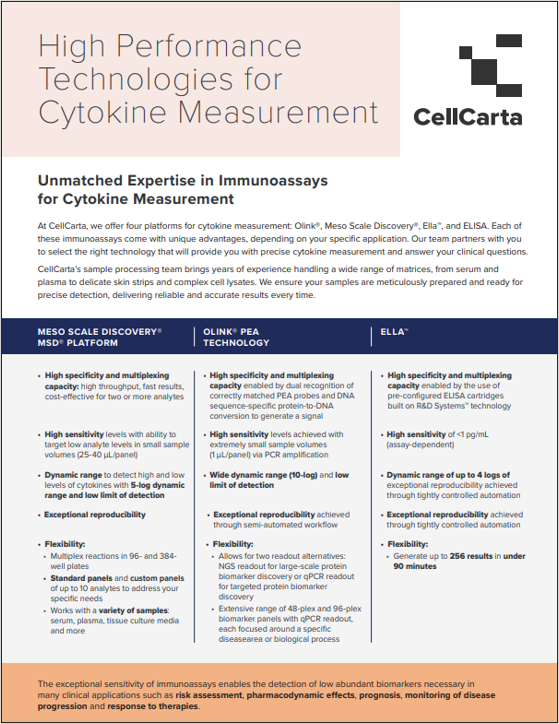
Today, several immunoassay platforms are used for cytokine profiling, each differing in detection signal and advantages for different testing scales and hypotheses. The most common platforms are:

  • Meso Scale Discovery® (MSD): MSD assays use electrochemiluminescent labels and enable ultra-sensitive detection
  •  Olink® PEA Technology: this technology combines an antibody-based immunoassay with polymerase chain reaction (PCR) to provide high-throughput multi-plex analysis
  • Ella™: a next-generation, automated benchtop ELISA multiplexing system that delivers high-speed precision with minimal user input

So, what insights can these assays give to developers, exactly?

When deployed in early clinical phases, cytokine profiling assays can provide crucial insight into the temporal dynamics of immune cell activation and adverse effects, such as cytokine release syndrome (CRS) and immune effector cell-associated neurotoxicity syndrome (ICANS). Combined with other assays (such as cell enumeration, cell phenotyping, and VCN determination), cytokine profiling can also support decision making on optimal dosing levels, reducing the reliance on the maximum tolerable dose.

The future of cytokine profiling: emerging roles and applications

As cell therapies diversify in complexity, target, and agent, the roles and applications of cytokine profiling in cell therapy testing are set to change in several ways.

Assessing novel secondary mechanisms

For every element added to a cell construct, monitoring of a new biomarker or signature is needed to show that the addition has the intended effect in the body. Cytokine profiling is likely to help here, potentially playing a key role in evaluating the secondary mechanisms of next-generation construct designs such as CAR T cell armoring.

Understanding the impact of patient immune status

Another emerging application of cytokine profiling is understanding baseline cytokine signatures that correlate with clinically relevant parameters. With these signatures, researchers can better understand how a patient’s immune status influences the quality and action of cell therapy. Naturally, such knowledge could have far-reaching impacts. For example, insight into how patient health affects therapy efficacy will be paramount for more confidently evaluating therapies approved as earlier-line treatments — treatments that operate in the context of a less depleted immune system.

Staying abreast of trends in cell therapy clinical testing

Keen to find out more about the current and anticipated future applications of cytokine profiling and other key testing areas? Our experts discuss all this and more in our Cell Therapy Trends Report.

Download the report for free today.

Alternatively, contact our team to speak to an expert about your cell therapy needs.

About the author: 

author photo

Nick Dupuis is a Senior Director of Scientific Business Development at CellCarta and has a background in in proteomics and biophysical measurement. He has held various roles in industry including as a scientist in LDT/IVD product and applications development, and business development for emerging analytical platforms. At CellCarta he leads commercialization initiatives touching on multiomic applications for biomarkers in cell therapy and pathways to support companion diagnostic development.
The role of cytokine profiling in a changing cell therapy testing landscape

August 6, 2024

The cell therapy landscape is evolving at unprecedented pace, with an increasingly complex and diversified catalogue of candidates now reaching the clinic, and urgency to bring new therapies to the market.

Together, these trends are putting an increasing burden on clinical testing programs.

In our recent Cell Therapy Trends Report, our experts discuss in more detail how clinical testing strategies are accommodating these rapid development strategies, as well as what that could mean for key clinical testing areas.

One of these key testing areas — the focus of this blog — is cytokine profiling.

Why is cytokine profiling so important for cell therapy clinical testing?

Throughout cell therapy development, cytokine profiling assays provide a report on various pharmacodynamic aspects of the therapeutic agent, including proliferation and activation of CAR T cells, as well as broader activation of endogenous immune components. Further expansion of CAR T populations can also lead to increased levels of cytokines in peripheral blood as hallmarks of a broader systemic inflammatory response. Unfortunately, this can lead to adverse events in various organ systems including the central nervous system (CNS).

Today, several immunoassay platforms are used for cytokine profiling, each differing in detection signal and advantages for different testing scales and hypotheses. The most common platforms are:

  • Meso Scale Discovery® (MSD): MSD assays use electrochemiluminescent labels and enable ultra-sensitive detection
  •  Olink® PEA Technology: this technology combines an antibody-based immunoassay with polymerase chain reaction (PCR) to provide high-throughput multi-plex analysis
  • Ella™: a next-generation, automated benchtop ELISA multiplexing system that delivers high-speed precision with minimal user input

So, what insights can these assays give to developers, exactly?

When deployed in early clinical phases, cytokine profiling assays can provide crucial insight into the temporal dynamics of immune cell activation and adverse effects, such as cytokine release syndrome (CRS) and immune effector cell-associated neurotoxicity syndrome (ICANS). Combined with other assays (such as cell enumeration, cell phenotyping, and VCN determination), cytokine profiling can also support decision making on optimal dosing levels, reducing the reliance on the maximum tolerable dose.

The future of cytokine profiling: emerging roles and applications

As cell therapies diversify in complexity, target, and agent, the roles and applications of cytokine profiling in cell therapy testing are set to change in several ways.

Assessing novel secondary mechanisms

For every element added to a cell construct, monitoring of a new biomarker or signature is needed to show that the addition has the intended effect in the body. Cytokine profiling is likely to help here, potentially playing a key role in evaluating the secondary mechanisms of next-generation construct designs such as CAR T cell armoring.

Understanding the impact of patient immune status

Another emerging application of cytokine profiling is understanding baseline cytokine signatures that correlate with clinically relevant parameters. With these signatures, researchers can better understand how a patient’s immune status influences the quality and action of cell therapy. Naturally, such knowledge could have far-reaching impacts. For example, insight into how patient health affects therapy efficacy will be paramount for more confidently evaluating therapies approved as earlier-line treatments — treatments that operate in the context of a less depleted immune system.

Staying abreast of trends in cell therapy clinical testing

Keen to find out more about the current and anticipated future applications of cytokine profiling and other key testing areas? Our experts discuss all this and more in our Cell Therapy Trends Report.

Download the report for free today.

Alternatively, contact our team to speak to an expert about your cell therapy needs.

About the author: 

author photo

Nick Dupuis is a Senior Director of Scientific Business Development at CellCarta and has a background in in proteomics and biophysical measurement. He has held various roles in industry including as a scientist in LDT/IVD product and applications development, and business development for emerging analytical platforms. At CellCarta he leads commercialization initiatives touching on multiomic applications for biomarkers in cell therapy and pathways to support companion diagnostic development.
High Performance Technologies for Cytokine Measurement

July 29, 2024

DOWNLOAD OUR BROCHURE

High Performance Technologies for Cytokine Measurement

July 29, 2024

DOWNLOAD OUR BROCHURE

Proteomic Assay List

June 4, 2024

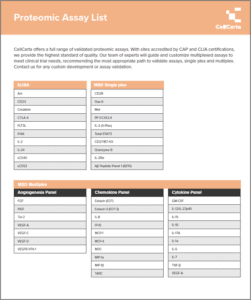
CellCarta offers a full range of validated proteomic assays. With sites accredited by CAP and CLIA certifications, we provide the highest standard of quality. Our team of experts will guide and customize multiplexed assays to meet clinical trial needs, recommending the most appropriate path to validate assays, single plex and mutliplex.

Contact us for any custom development or assay validation.

Proteomic Assay List

Proteomic Assay List

Proteomic Assay List

June 4, 2024

CellCarta offers a full range of validated proteomic assays. With sites accredited by CAP and CLIA certifications, we provide the highest standard of quality. Our team of experts will guide and customize multiplexed assays to meet clinical trial needs, recommending the most appropriate path to validate assays, single plex and mutliplex.

Contact us for any custom development or assay validation.

Proteomic Assay List

Proteomic Assay List

Enumerating Large Oncosomes with RareCyte CTC Platform

April 8, 2024

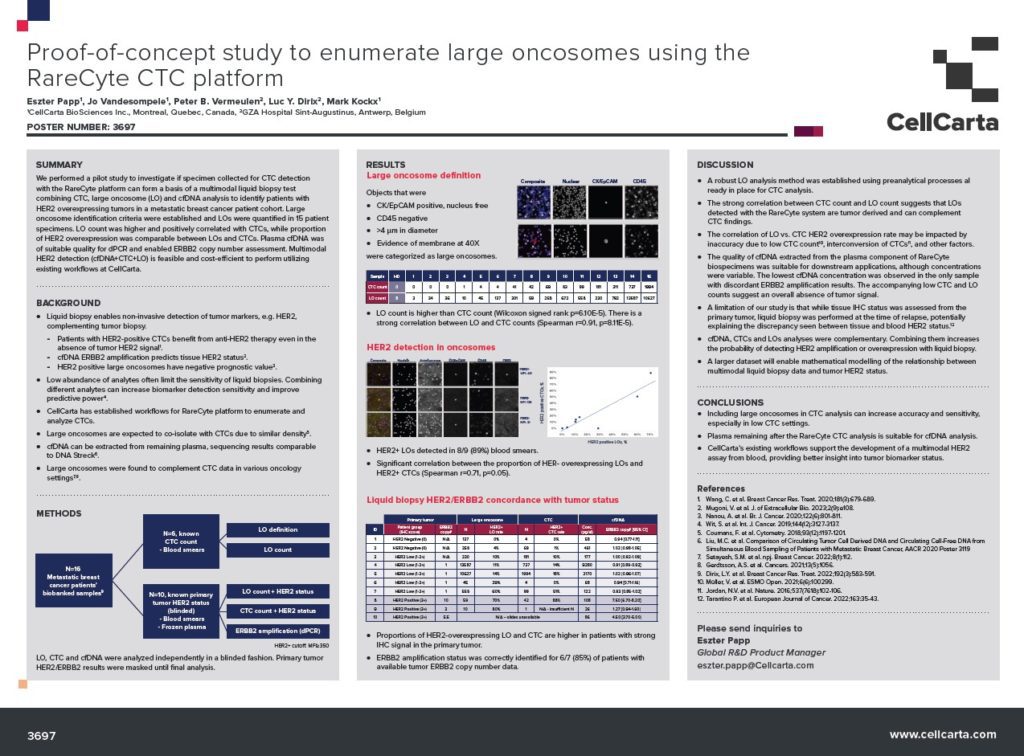
CellCarta’s proof-of-concept study utilizes the RareCyte CTC platform to enumerate large oncosomes (LOs) in patients with HER2 overexpressing tumors.

The study demonstrates that combining circulating tumor cells (CTCs), LOs, and circulating cell-free DNA (cfDNA) in a multimodal liquid biopsy analysis enhances the detection and monitoring of HER2 amplification in metastatic breast cancer.

The results showed a strong correlation between LO count and CTC count, and the combined analysis improved the accuracy of HER2 status assessment. This approach offers a cost-efficient and non-invasive method to monitor tumor biomarkers, providing valuable insights into tumor progression and treatment response.

View the poster:

Proof-of-concept study to enumerate large oncosomes using the RareCyte CTC platform

Proof-of-concept study to enumerate large oncosomes using the (visual)


Enumerating Large Oncosomes with RareCyte CTC Platform

April 8, 2024

CellCarta’s proof-of-concept study utilizes the RareCyte CTC platform to enumerate large oncosomes (LOs) in patients with HER2 overexpressing tumors.

The study demonstrates that combining circulating tumor cells (CTCs), LOs, and circulating cell-free DNA (cfDNA) in a multimodal liquid biopsy analysis enhances the detection and monitoring of HER2 amplification in metastatic breast cancer.

The results showed a strong correlation between LO count and CTC count, and the combined analysis improved the accuracy of HER2 status assessment. This approach offers a cost-efficient and non-invasive method to monitor tumor biomarkers, providing valuable insights into tumor progression and treatment response.

View the poster:

Proof-of-concept study to enumerate large oncosomes using the RareCyte CTC platform

Proof-of-concept study to enumerate large oncosomes using the (visual)


Immuno-MRM Assays

August 4, 2023

DOWNLOAD OUR BROCHURE

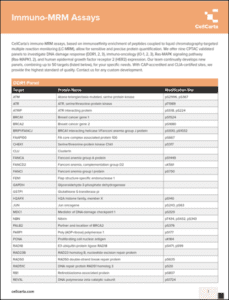
CellCarta’s immuno-MRM assays, based on immunoaffinity enrichment of peptides coupled to liquid chromatography-targeted multiple reaction monitoring (LC-MRM), allow for sensitive and precise protein quantification. We offer nine CPTAC validated panels to investigate DNA damage response (DDR1, 2, 3), immuno-oncology (IO-1, 2, 3), Ras-MAPK signaling pathway (Ras-MAPK1, 2), and human epidermal growth factor receptor 2 (HER2) expression. Our team continually develops new panels, combining up to 50 targets (listed below), for your specific needs. With CAP-accredited and CLIA-certified sites, we provide the highest standard of quality.

Contact us for any custom development.

Immuno-MRM

Immuno-MRM Assays

August 4, 2023

DOWNLOAD OUR BROCHURE

CellCarta’s immuno-MRM assays, based on immunoaffinity enrichment of peptides coupled to liquid chromatography-targeted multiple reaction monitoring (LC-MRM), allow for sensitive and precise protein quantification. We offer nine CPTAC validated panels to investigate DNA damage response (DDR1, 2, 3), immuno-oncology (IO-1, 2, 3), Ras-MAPK signaling pathway (Ras-MAPK1, 2), and human epidermal growth factor receptor 2 (HER2) expression. Our team continually develops new panels, combining up to 50 targets (listed below), for your specific needs. With CAP-accredited and CLIA-certified sites, we provide the highest standard of quality.

Contact us for any custom development.

Immuno-MRM