M-Protein Analysis in Myeloma via Mass Spectrometry
May 4, 2024
Luca Genovesi, Michael Schirm, Nick Dupuis, Gwenael Pottiez
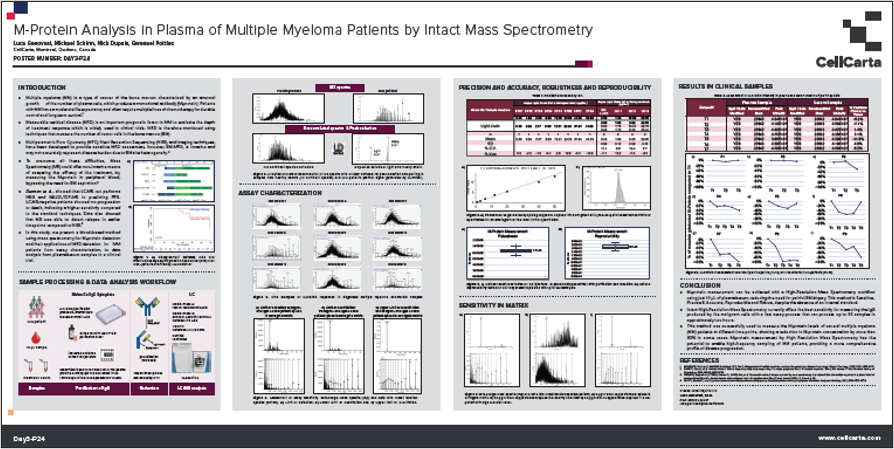
CellCarta’s poster on M-Protein analysis in plasma of multiple myeloma (MM) patients highlights the use of intact mass spectrometry for monitoring disease progression. This non-invasive method, requiring only a small volume of plasma or serum, measures M-Protein levels with high sensitivity, precision, and reproducibility.
The study demonstrated that mass spectrometry could detect significant reductions in M-Protein concentration, providing an effective alternative to bone marrow biopsies for evaluating treatment response and measurable residual disease (MRD). The workflow supports high-frequency sampling, offering a comprehensive profile of disease progression and treatment efficacy in MM patients.
View the poster
M-Protein Analysis in Plasma of Multiple Myeloma Patients by Intact Mass Spectrometry
M-Protein Analysis in Myeloma via Mass Spectrometry
May 4, 2024
Luca Genovesi, Michael Schirm, Nick Dupuis, Gwenael Pottiez
CellCarta’s poster on M-Protein analysis in plasma of multiple myeloma (MM) patients highlights the use of intact mass spectrometry for monitoring disease progression. This non-invasive method, requiring only a small volume of plasma or serum, measures M-Protein levels with high sensitivity, precision, and reproducibility.
The study demonstrated that mass spectrometry could detect significant reductions in M-Protein concentration, providing an effective alternative to bone marrow biopsies for evaluating treatment response and measurable residual disease (MRD). The workflow supports high-frequency sampling, offering a comprehensive profile of disease progression and treatment efficacy in MM patients.
View the poster
M-Protein Analysis in Plasma of Multiple Myeloma Patients by Intact Mass Spectrometry
Enumerating Large Oncosomes with RareCyte CTC Platform
April 8, 2024
Eszter Papp, Jo Vandesompele, Peter B. Vermeulen, Luc Y. Dirix, Mark Kockx
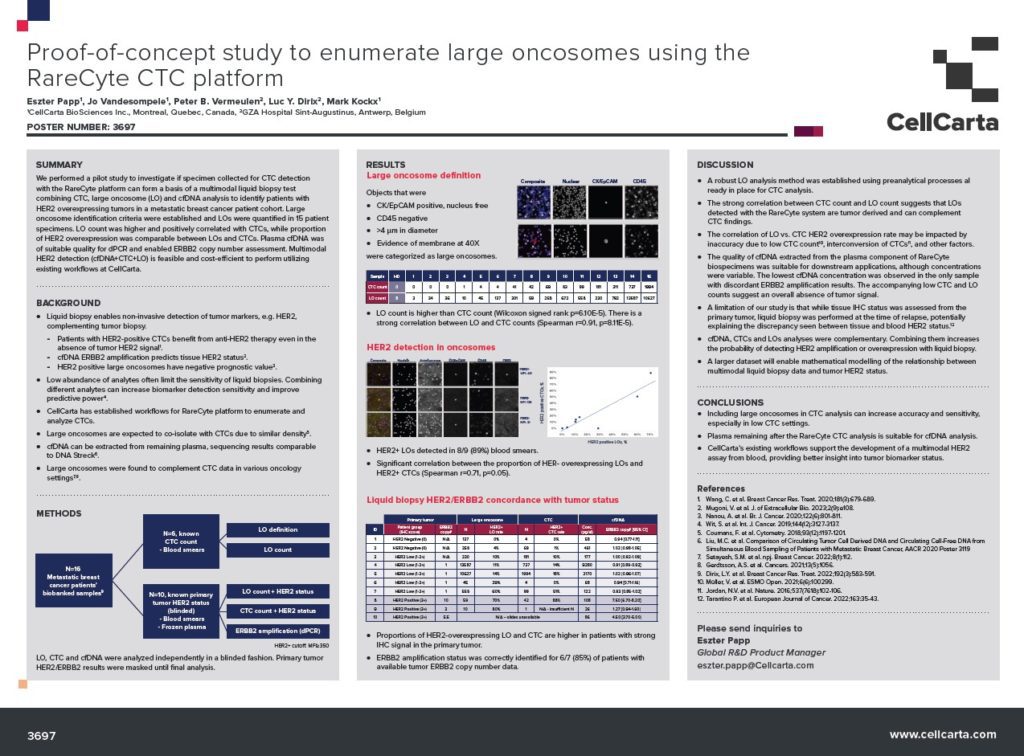
CellCarta’s proof-of-concept study utilizes the RareCyte CTC platform to enumerate large oncosomes (LOs) in patients with HER2 overexpressing tumors.
The study demonstrates that combining circulating tumor cells (CTCs), LOs, and circulating cell-free DNA (cfDNA) in a multimodal liquid biopsy analysis enhances the detection and monitoring of HER2 amplification in metastatic breast cancer.
The results showed a strong correlation between LO count and CTC count, and the combined analysis improved the accuracy of HER2 status assessment. This approach offers a cost-efficient and non-invasive method to monitor tumor biomarkers, providing valuable insights into tumor progression and treatment response.
View the poster:
Proof-of-concept study to enumerate large oncosomes using the RareCyte CTC platform
Enumerating Large Oncosomes with RareCyte CTC Platform
April 8, 2024
Eszter Papp, Jo Vandesompele, Peter B. Vermeulen, Luc Y. Dirix, Mark Kockx
CellCarta’s proof-of-concept study utilizes the RareCyte CTC platform to enumerate large oncosomes (LOs) in patients with HER2 overexpressing tumors.
The study demonstrates that combining circulating tumor cells (CTCs), LOs, and circulating cell-free DNA (cfDNA) in a multimodal liquid biopsy analysis enhances the detection and monitoring of HER2 amplification in metastatic breast cancer.
The results showed a strong correlation between LO count and CTC count, and the combined analysis improved the accuracy of HER2 status assessment. This approach offers a cost-efficient and non-invasive method to monitor tumor biomarkers, providing valuable insights into tumor progression and treatment response.
View the poster:
Proof-of-concept study to enumerate large oncosomes using the RareCyte CTC platform
Predicting Immune Checkpoint Response with Tumor RNA-Seq Dat
April 8, 2024
Frederick De Baene, Carolina Fierro, Emmanuel Rivière, Reindert Van Cauwenberghe, Pieter-Jan Van Dam, Jo Vandesompele, Elise Van Hoof, Pieter Mestdagh
CellCarta’s study utilizes tumor RNA-sequencing data to predict immune checkpoint inhibition (ICI) response in cancer patients. The developed RNA-Seq Bio-IT model integrates features like tumor mutational burden (TMB), microsatellite instability (MSI), tumor infiltrating lymphocytes (TILs), and immune gene expression signatures to enhance the prediction of clinical responses to ICI therapy.
This model reduces the complexity and cost associated with multi-omics approaches and provides a more accurate prediction of therapy outcomes, potentially improving patient selection for ICI treatment.
View the poster:
Exploiting tumor RNA-sequencing data for prediction of immune checkpoint inhibition response
Predicting Immune Checkpoint Response with Tumor RNA-Seq Dat
April 8, 2024
Frederick De Baene, Carolina Fierro, Emmanuel Rivière, Reindert Van Cauwenberghe, Pieter-Jan Van Dam, Jo Vandesompele, Elise Van Hoof, Pieter Mestdagh
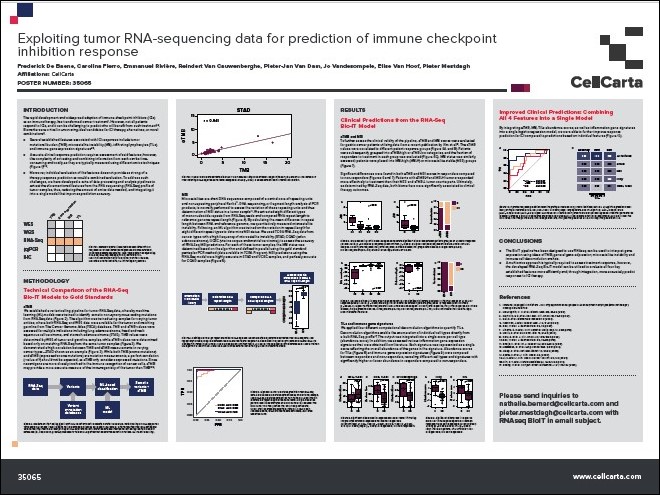
CellCarta’s study utilizes tumor RNA-sequencing data to predict immune checkpoint inhibition (ICI) response in cancer patients. The developed RNA-Seq Bio-IT model integrates features like tumor mutational burden (TMB), microsatellite instability (MSI), tumor infiltrating lymphocytes (TILs), and immune gene expression signatures to enhance the prediction of clinical responses to ICI therapy.
This model reduces the complexity and cost associated with multi-omics approaches and provides a more accurate prediction of therapy outcomes, potentially improving patient selection for ICI treatment.
View the poster:
Exploiting tumor RNA-sequencing data for prediction of immune checkpoint inhibition response
CellCarta’s CellEngine Visualization Tool for Clinical Cytometry
April 8, 2024
Damien Montamat-Sicotte, Zach Bjornson, Dean Franckaert, Eustache Paramithioti, Nick Dupuis
CellCarta’s CellEngine Visualization Tool for Clinical Cytometry
April 8, 2024
Damien Montamat-Sicotte, Zach Bjornson, Dean Franckaert, Eustache Paramithioti, Nick Dupuis