M-Protein Analysis in Myeloma via Mass Spectrometry

May 4, 2024

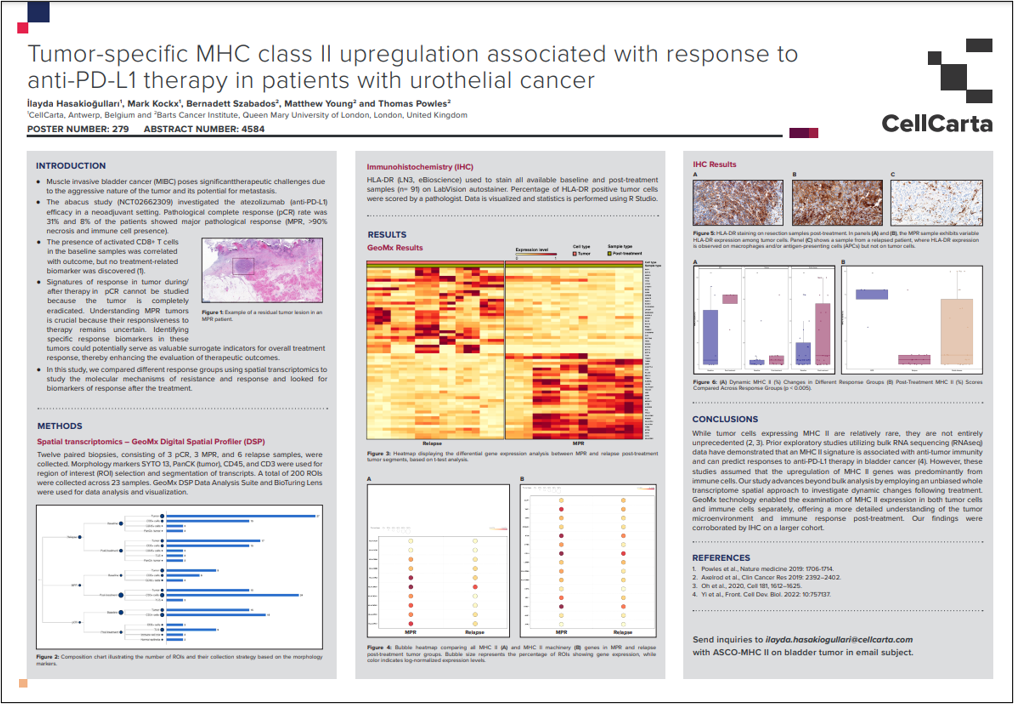
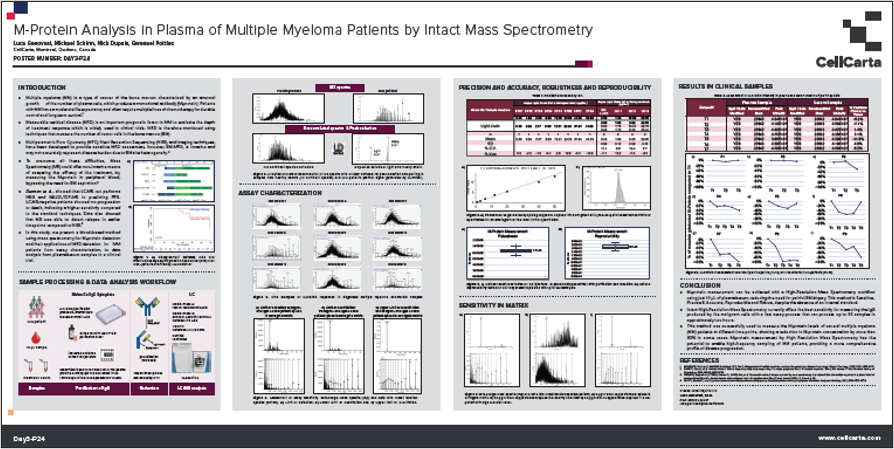
CellCarta’s poster on M-Protein analysis in plasma of multiple myeloma (MM) patients highlights the use of intact mass spectrometry for monitoring disease progression. This non-invasive method, requiring only a small volume of plasma or serum, measures M-Protein levels with high sensitivity, precision, and reproducibility.

The study demonstrated that mass spectrometry could detect significant reductions in M-Protein concentration, providing an effective alternative to bone marrow biopsies for evaluating treatment response and measurable residual disease (MRD). The workflow supports high-frequency sampling, offering a comprehensive profile of disease progression and treatment efficacy in MM patients.

View the poster

M-Protein Analysis in Plasma of Multiple Myeloma Patients by Intact Mass Spectrometry
M-Protein Analysis in Plasma of Multiple Myeloma Patients by Intact Mass Spectrometry

M-Protein Analysis in Myeloma via Mass Spectrometry

May 4, 2024

CellCarta’s poster on M-Protein analysis in plasma of multiple myeloma (MM) patients highlights the use of intact mass spectrometry for monitoring disease progression. This non-invasive method, requiring only a small volume of plasma or serum, measures M-Protein levels with high sensitivity, precision, and reproducibility.

The study demonstrated that mass spectrometry could detect significant reductions in M-Protein concentration, providing an effective alternative to bone marrow biopsies for evaluating treatment response and measurable residual disease (MRD). The workflow supports high-frequency sampling, offering a comprehensive profile of disease progression and treatment efficacy in MM patients.

View the poster

M-Protein Analysis in Plasma of Multiple Myeloma Patients by Intact Mass Spectrometry

M-Protein Analysis in Plasma of Multiple Myeloma Patients by Intact Mass Spectrometry

Enumerating Large Oncosomes with RareCyte CTC Platform

April 8, 2024

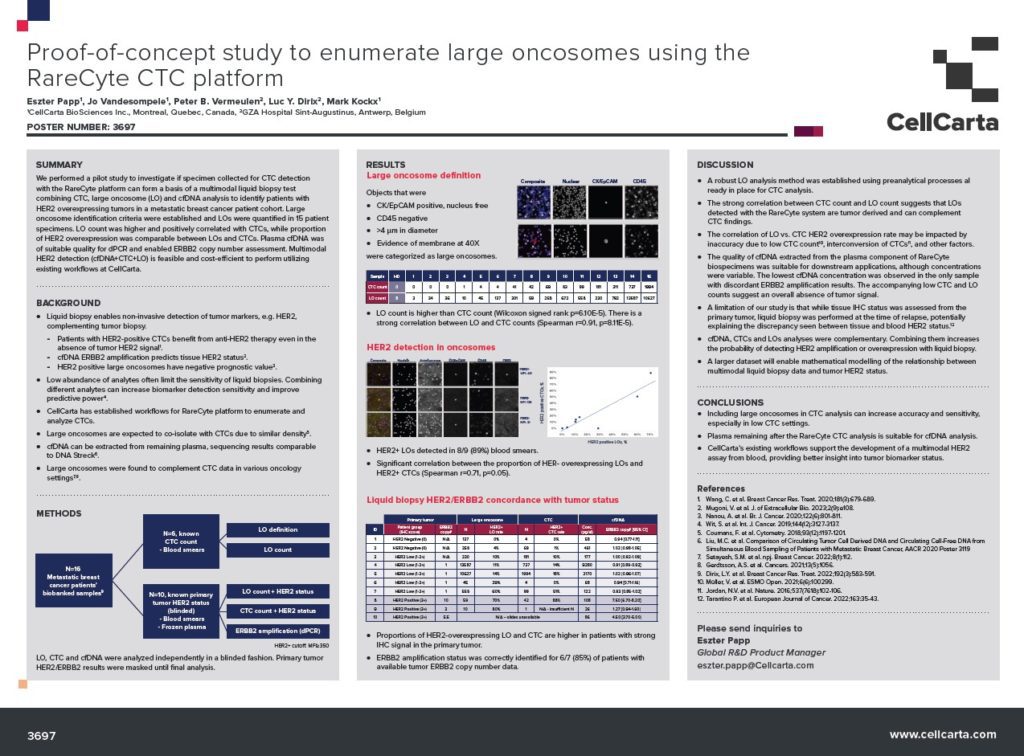
CellCarta’s proof-of-concept study utilizes the RareCyte CTC platform to enumerate large oncosomes (LOs) in patients with HER2 overexpressing tumors.

The study demonstrates that combining circulating tumor cells (CTCs), LOs, and circulating cell-free DNA (cfDNA) in a multimodal liquid biopsy analysis enhances the detection and monitoring of HER2 amplification in metastatic breast cancer.

The results showed a strong correlation between LO count and CTC count, and the combined analysis improved the accuracy of HER2 status assessment. This approach offers a cost-efficient and non-invasive method to monitor tumor biomarkers, providing valuable insights into tumor progression and treatment response.

View the poster:

Proof-of-concept study to enumerate large oncosomes using the RareCyte CTC platform
Proof-of-concept study to enumerate large oncosomes using the (visual)


Enumerating Large Oncosomes with RareCyte CTC Platform

April 8, 2024

CellCarta’s proof-of-concept study utilizes the RareCyte CTC platform to enumerate large oncosomes (LOs) in patients with HER2 overexpressing tumors.

The study demonstrates that combining circulating tumor cells (CTCs), LOs, and circulating cell-free DNA (cfDNA) in a multimodal liquid biopsy analysis enhances the detection and monitoring of HER2 amplification in metastatic breast cancer.

The results showed a strong correlation between LO count and CTC count, and the combined analysis improved the accuracy of HER2 status assessment. This approach offers a cost-efficient and non-invasive method to monitor tumor biomarkers, providing valuable insights into tumor progression and treatment response.

View the poster:

Proof-of-concept study to enumerate large oncosomes using the RareCyte CTC platform

Proof-of-concept study to enumerate large oncosomes using the (visual)


Let's Talk: A Conversation with CAR T-cell Therapy Pioneer Dr. Carl June

February 22, 2024

Immunotherapies such as CAR T-cell therapy hold a lot of promise in treating illnesses like cancer. However, key challenges remain in their development, in particular the need to address adverse events and patient resistance.

In this webcast, Dr. Carl June, a pioneer in the field of CAR T-cell therapy, joins Christopher Ung, our Chief Scientific Business Officer, for an in-depth conversation on developing immuno and CAR T-cell therapies.

Key topics discussed in this cell therapy focused webcast: 

  • Academic and Industry Partnership in CAR-T Development 
  • CAR-T Development in US and China 
  • Biomarkers from vein to vein: Mechanism, Selection, and Resistance 
  • Facing the Challenges: Adverse Events and Patient Resistance 
  • New Frontiers: Solid Tumors, Evolutionary and Revolutionary CAR models 
author photo

Dr. Carl June

Dr. June is a member of CellCarta’s Scientific Advisory Board and the Richard W. Vague Professor in Immunotherapy in the Perelman School of Medicine at the University of Pennsylvania.

In 2011, his research team published a paper on the first CAR-T therapy treating leukemia patients with their own genetically modified T-cells.

author photo

Mr. Christopher Ung

Mr. Ung is CellCarta’s Chief Scientific Business Officer and has served in the companion diagnostics field since its inception. He is one of the original pioneers of the personalized medicine field.

Mr. Ung currently leads the development and execution of CellCarta’s strategic and business initiatives, leveraging the company’s solid tumour and anatomic pathology services.

Let's Talk: A Conversation with CAR T-cell Therapy Pioneer Dr. Carl June

February 22, 2024

Immunotherapies such as CAR T-cell therapy hold a lot of promise in treating illnesses like cancer. However, key challenges remain in their development, in particular the need to address adverse events and patient resistance.

In this webcast, Dr. Carl June, a pioneer in the field of CAR T-cell therapy, joins Christopher Ung, our Chief Scientific Business Officer, for an in-depth conversation on developing immuno and CAR T-cell therapies.

Key topics discussed in this cell therapy focused webcast: 

  • Academic and Industry Partnership in CAR-T Development 
  • CAR-T Development in US and China 
  • Biomarkers from vein to vein: Mechanism, Selection, and Resistance 
  • Facing the Challenges: Adverse Events and Patient Resistance 
  • New Frontiers: Solid Tumors, Evolutionary and Revolutionary CAR models 
author photo

Dr. Carl June

Dr. June is a member of CellCarta’s Scientific Advisory Board and the Richard W. Vague Professor in Immunotherapy in the Perelman School of Medicine at the University of Pennsylvania.

In 2011, his research team published a paper on the first CAR-T therapy treating leukemia patients with their own genetically modified T-cells.

author photo

Mr. Christopher Ung

Mr. Ung is CellCarta’s Chief Scientific Business Officer and has served in the companion diagnostics field since its inception. He is one of the original pioneers of the personalized medicine field.

Mr. Ung currently leads the development and execution of CellCarta’s strategic and business initiatives, leveraging the company’s solid tumour and anatomic pathology services.

How HLA Typing Improves Immunotherapy Precision

December 6, 2023

How can HLA typing drive better immunotherapy development and selection

Immunotherapies hold enormous potential for cancer treatment, but understanding tumor–immune interactions is needed to successfully develop new therapies and identify suitable patients.

Human leucocyte antigen (HLA) typing gives deeper insights into the relationship between the immune system and cancer cells, helping scientists improve immunotherapy administration precision and develop new immunotherapeutic approaches. But what is it?

A deeper dive into HLA typing

HLAs are a combination of different single nucleotide polymorphisms (SNPs) across multiple exons. The HLA system helps the immune system distinguish between self and non-self cells by presenting antigens derived from pathogens, cancer cells, or other foreign entities to immune cells, triggering a response. HLAs are therefore pivotal in cancer immunotherapy — cancer-specific antigens are presented on HLA molecules, which T cells recognize, attack, and kill.

HLA allele and antigen composition varies significantly between individuals, however, so determining their HLA profile — HLA typing — is essential to understand disease onset, progression, and treatment.

How is HLA typing performed?

Most researchers use Sanger sequencing for HLA typing, which detects SNPs. But since both copies of the genes are sequenced together in one reaction, researchers struggle to identify whether the SNPs come from the same (cis) or the opposite (trans) chromosome, making establishing the correct HLA type difficult. Next-generation sequencing (NGS) overcomes cis/trans polymorphism ambiguities by independently identifying and amplifying individual DNA fragments for more accurate typing.

HLA typing in action

Three recent publications highlight the impact of HLA profiling in immunotherapy development:

1.    Immunotherapy in oncology

HLA type affects an individual’s susceptibility to infections or autoimmune diseases, or their oncological immunotherapy response. A 2019 publication discussed how understanding a patient’s HLA profile is vital to effectively tailor immunotherapeutic treatments. Particularly, researchers should match the HLA types of cancer patients with potential donor HLA types to improve the success of treatments like adoptive cell therapy or stem cell therapy.

HLA typing is essential in CAR T-cell therapy, where it helps in the engineering of T cells to target tumor antigens, expanding immunotherapy applications beyond standard treatments.

2.    Precision medicine

HLA genotyping can help researchers to predict the survival of HLA alleles among cancers, based on an underlying cytolytic activity (CYT) mechanism. A recent study showed that a strong HLA allele, in combination with a high tumor mutation burden, could stimulate intensive immune CYT and lead to extended HLA survival. As HLA profiles differ between patients, typing can therefore support oncologists in selecting the most appropriate immunotherapy for an individual.

3.    Viral associated cancer

The 2019 article also highlighted that carcinogenic viruses activate genes that allow cancer cells to escape immune surveillance and proliferate uncontrolled. A patient’s HLA profile plays a significant role in these immune escape mechanisms, leading to the initiation of such cancers and influencing immunotherapy response. Understanding HLA profiles can therefore help effective cancer vaccine design, improving patient outcomes.

Immunotherapy is a promising approach to treat cancers — and HLA typing is key to unlocking its potential. With HLA typing, researchers can better tailor therapies, select the right treatment, and design more effective cancer vaccines.

NGS is critical to getting clearer results from your HLA typing.

Future of HLA Typing: Artificial Intelligence and Predictive Algorithms

As HLA typing evolves, the integration of AI and machine learning is becoming key to advancing immunotherapy.

These technologies are being used to develop predictive models that combine HLA typing with tumor mutational burden (TMB), and other biomarkers, to forecast patient responses to immune checkpoint inhibitors.

This multidisciplinary approach is expected to revolutionize the personalization of cancer treatments.

At CellCarta we developed our own data analysis pipeline to evaluate immune checkpoint biomarkers by looking at RNA sequencing data.

Discover CellCarta’s genomics services.


About the author: 

Author photo

Nathalie Bernard (PhD) is the scientific business director for the Genomics Services unit within CellCarta. Her background is in molecular biology, and she has many years of experience in PCR and sequencing, technologies used to discover or identify DNA and RNA biomarkers of clinical utility. At CellCarta, Nathalie is using her expertise to guide our customers in finding the best solution to their genomic questions.

How HLA Typing Improves Immunotherapy Precision

December 6, 2023

How can HLA typing drive better immunotherapy development and selection

Immunotherapies hold enormous potential for cancer treatment, but understanding tumor–immune interactions is needed to successfully develop new therapies and identify suitable patients.

Human leucocyte antigen (HLA) typing gives deeper insights into the relationship between the immune system and cancer cells, helping scientists improve immunotherapy administration precision and develop new immunotherapeutic approaches. But what is it?

A deeper dive into HLA typing

HLAs are a combination of different single nucleotide polymorphisms (SNPs) across multiple exons. The HLA system helps the immune system distinguish between self and non-self cells by presenting antigens derived from pathogens, cancer cells, or other foreign entities to immune cells, triggering a response. HLAs are therefore pivotal in cancer immunotherapy — cancer-specific antigens are presented on HLA molecules, which T cells recognize, attack, and kill.

HLA allele and antigen composition varies significantly between individuals, however, so determining their HLA profile — HLA typing — is essential to understand disease onset, progression, and treatment.

How is HLA typing performed?

Most researchers use Sanger sequencing for HLA typing, which detects SNPs. But since both copies of the genes are sequenced together in one reaction, researchers struggle to identify whether the SNPs come from the same (cis) or the opposite (trans) chromosome, making establishing the correct HLA type difficult. Next-generation sequencing (NGS) overcomes cis/trans polymorphism ambiguities by independently identifying and amplifying individual DNA fragments for more accurate typing.

HLA typing in action

Three recent publications highlight the impact of HLA profiling in immunotherapy development:

1.    Immunotherapy in oncology

HLA type affects an individual’s susceptibility to infections or autoimmune diseases, or their oncological immunotherapy response. A 2019 publication discussed how understanding a patient’s HLA profile is vital to effectively tailor immunotherapeutic treatments. Particularly, researchers should match the HLA types of cancer patients with potential donor HLA types to improve the success of treatments like adoptive cell therapy or stem cell therapy.

HLA typing is essential in CAR T-cell therapy, where it helps in the engineering of T cells to target tumor antigens, expanding immunotherapy applications beyond standard treatments.

2.    Precision medicine

HLA genotyping can help researchers to predict the survival of HLA alleles among cancers, based on an underlying cytolytic activity (CYT) mechanism. A recent study showed that a strong HLA allele, in combination with a high tumor mutation burden, could stimulate intensive immune CYT and lead to extended HLA survival. As HLA profiles differ between patients, typing can therefore support oncologists in selecting the most appropriate immunotherapy for an individual.

3.    Viral associated cancer

The 2019 article also highlighted that carcinogenic viruses activate genes that allow cancer cells to escape immune surveillance and proliferate uncontrolled. A patient’s HLA profile plays a significant role in these immune escape mechanisms, leading to the initiation of such cancers and influencing immunotherapy response. Understanding HLA profiles can therefore help effective cancer vaccine design, improving patient outcomes.

Immunotherapy is a promising approach to treat cancers — and HLA typing is key to unlocking its potential. With HLA typing, researchers can better tailor therapies, select the right treatment, and design more effective cancer vaccines.

NGS is critical to getting clearer results from your HLA typing.

Future of HLA Typing: Artificial Intelligence and Predictive Algorithms

As HLA typing evolves, the integration of AI and machine learning is becoming key to advancing immunotherapy.

These technologies are being used to develop predictive models that combine HLA typing with tumor mutational burden (TMB), and other biomarkers, to forecast patient responses to immune checkpoint inhibitors.

This multidisciplinary approach is expected to revolutionize the personalization of cancer treatments.

At CellCarta we developed our own data analysis pipeline to evaluate immune checkpoint biomarkers by looking at RNA sequencing data.

Discover CellCarta’s genomics services.


About the author: 

Author photo

Nathalie Bernard (PhD) is the scientific business director for the Genomics Services unit within CellCarta. Her background is in molecular biology, and she has many years of experience in PCR and sequencing, technologies used to discover or identify DNA and RNA biomarkers of clinical utility. At CellCarta, Nathalie is using her expertise to guide our customers in finding the best solution to their genomic questions.

Multiplex Assay for Measuring 45 Cytokines in NSCLC Plasma

November 7, 2023

CellCarta’s poster showcases the analytical performance of a 45-analyte panel using proximity extension assay (PEA) to measure cytokines in plasma from subjects with non-small cell lung cancer (NSCLC).

The study highlights the panel’s sensitivity and precision, demonstrating its ability to detect cytokine levels and identify differentially expressed cytokines between normal and NSCLC samples. The use of this multiplex panel provides insights into cytokine profiles, aiding in the characterization of pharmacodynamic and mechanistic effects of investigational therapies.

Contact us for more insights on advanced cytokine measurement techniques in cancer research.

View the full poster:

Analytical characterization of a multiplex proximity extension assay panel measuring 45 cytokines in plasma from subjects with NSCLC

As presented at SITC 2023 and AACR 2023

CellCarta Olink SITC Poster

Multiplex Assay for Measuring 45 Cytokines in NSCLC Plasma

November 7, 2023

CellCarta’s poster showcases the analytical performance of a 45-analyte panel using proximity extension assay (PEA) to measure cytokines in plasma from subjects with non-small cell lung cancer (NSCLC).

The study highlights the panel’s sensitivity and precision, demonstrating its ability to detect cytokine levels and identify differentially expressed cytokines between normal and NSCLC samples. The use of this multiplex panel provides insights into cytokine profiles, aiding in the characterization of pharmacodynamic and mechanistic effects of investigational therapies.

Contact us for more insights on advanced cytokine measurement techniques in cancer research.

View the full poster:

Analytical characterization of a multiplex proximity extension assay panel measuring 45 cytokines in plasma from subjects with NSCLC

As presented at SITC 2023 and AACR 2023

CellCarta Olink SITC Poster