Multiplexed Mass Spec for Immunotherapy Protein Measurement

October 13, 2023

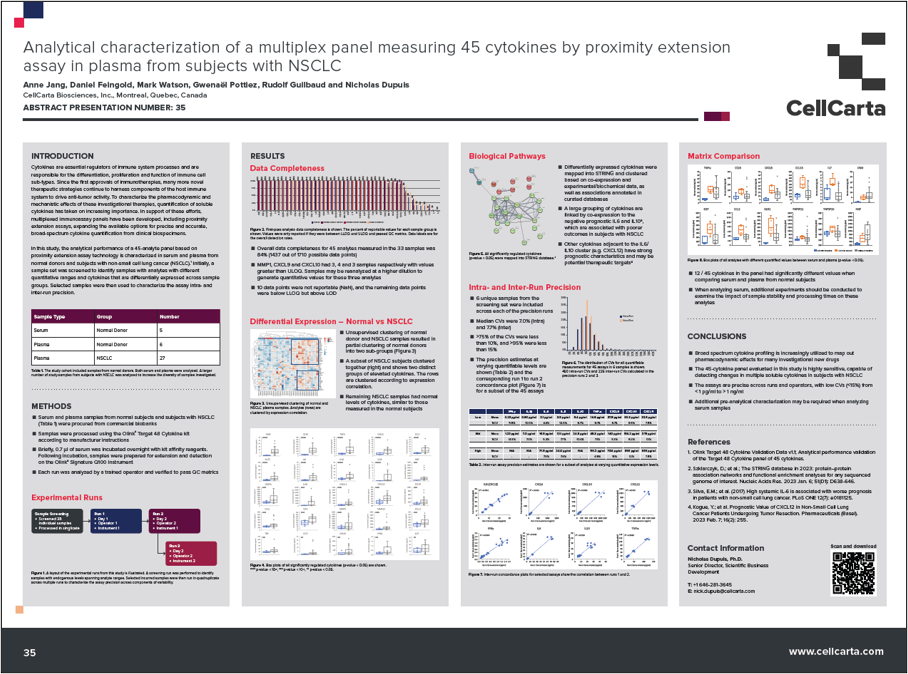
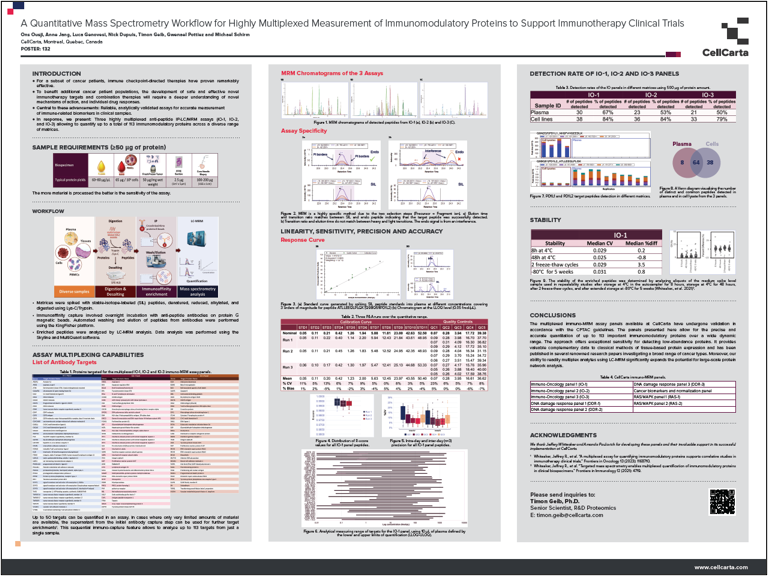
CellCarta’s poster presents a quantitative mass spectrometry workflow designed for the highly multiplexed measurement of immunomodulatory proteins to support immunotherapy clinical trials.

The workflow utilizes immuno-MRM assay panels to quantify up to 113 proteins with high sensitivity and precision, providing valuable data on immune-related biomarkers. This approach enhances the understanding of drug responses and mechanisms of action, crucial for developing new immunotherapies and combination treatments.

The method involves the use of stable-isotope-labeled peptides and immunoaffinity capture, followed by LC-MRM analysis for accurate protein quantification.

Contact us  to gain insights on advanced proteomics solutions.

View the full poster:

A Quantitative Mass Spectrometry Workflow for Highly Multiplexed Measurement of Immunomodulatory Proteins to Support Immunotherapy Clinical Trials

As presented at SITC 2023 AND EORTC 2023

Multiplexed Mass Spec for Immunotherapy Protein Measurement

October 13, 2023

CellCarta’s poster presents a quantitative mass spectrometry workflow designed for the highly multiplexed measurement of immunomodulatory proteins to support immunotherapy clinical trials.

The workflow utilizes immuno-MRM assay panels to quantify up to 113 proteins with high sensitivity and precision, providing valuable data on immune-related biomarkers. This approach enhances the understanding of drug responses and mechanisms of action, crucial for developing new immunotherapies and combination treatments.

The method involves the use of stable-isotope-labeled peptides and immunoaffinity capture, followed by LC-MRM analysis for accurate protein quantification.

Contact us  to gain insights on advanced proteomics solutions.

View the full poster:

A Quantitative Mass Spectrometry Workflow for Highly Multiplexed Measurement of Immunomodulatory Proteins to Support Immunotherapy Clinical Trials

As presented at SITC 2023 AND EORTC 2023

Accurately Predict Immune Checkpoint Inhibition Response Using Only RNA-Seq Data

June 27, 2023

  • Discover how we have improved response predictions for immune checkpoint inhibitor (ICI) therapies.
  • Explore our unique computational pipeline that defines multiple characteristics (eTMB, MSI, and more) directly from the RNA-sequencing profile of a tumor.

Accurately Predict Immune Checkpoint Inhibition Response Using Only RNA-Seq Data

June 27, 2023

  • Discover how we have improved response predictions for immune checkpoint inhibitor (ICI) therapies.
  • Explore our unique computational pipeline that defines multiple characteristics (eTMB, MSI, and more) directly from the RNA-sequencing profile of a tumor.

Predicting Immune Checkpoint Inhibitor Response via RNA-Seq CellCarta

June 6, 2023

Various biomarkers, such as PD-L1 expression, tumor mutation burden (TMB), cytotoxic T-cell infiltration, Microsatellite Instability (MSI), and immune gene signatures, have been proposed to predict immune checkpoint inhibitor response.

However, individual biomarkers have limited accuracy. To overcome this, a computational pipeline has been developed to quantify biomarkers including expressed mutation burden (eTMB), MSI status, infiltrating immune cells, and immune gene expression signatures from tumor RNA-sequencing data.

Machine learning and computational deconvolution algorithms enhance performance, validated on large cohorts.

Integration of these biomarkers improves the prediction of checkpoint inhibition therapy response.

Viewers will gain insights into:

  • A unique computational pipeline that defines several characteristics directly from the RNA-sequencing profile of a tumor such as:
    • Expressed mutation burden (eTMB)
    • Fraction of infiltrating immune cells
    • Various immune gene expression signatures
  • How this analysis is compatible with formalin-fixed paraffin-embedded (FFPE) tumor samples and does not require a matched germline DNA sample

Pieter Mestdagh, Computational Biology Manager, CellCarta

Pieter Mestdagh is a Computational Biology Manager at CellCarta, and Professor at Ghent University, Belgium. He holds master’s degrees in industrial engineering (2004) and in bioscience engineering (2006) and obtained a PhD in biomedical sciences (2011).

He is the author of more than 100 scientific articles in international journals and co-inventor on several European patents.

Predicting Immune Checkpoint Inhibitor Response via RNA-Seq CellCarta

June 6, 2023

Various biomarkers, such as PD-L1 expression, tumor mutation burden (TMB), cytotoxic T-cell infiltration, Microsatellite Instability (MSI), and immune gene signatures, have been proposed to predict immune checkpoint inhibitor response.

However, individual biomarkers have limited accuracy. To overcome this, a computational pipeline has been developed to quantify biomarkers including expressed mutation burden (eTMB), MSI status, infiltrating immune cells, and immune gene expression signatures from tumor RNA-sequencing data.

Machine learning and computational deconvolution algorithms enhance performance, validated on large cohorts.

Integration of these biomarkers improves the prediction of checkpoint inhibition therapy response.

Viewers will gain insights into:

  • A unique computational pipeline that defines several characteristics directly from the RNA-sequencing profile of a tumor such as:
    • Expressed mutation burden (eTMB)
    • Fraction of infiltrating immune cells
    • Various immune gene expression signatures
  • How this analysis is compatible with formalin-fixed paraffin-embedded (FFPE) tumor samples and does not require a matched germline DNA sample

Pieter Mestdagh, Computational Biology Manager, CellCarta

Pieter Mestdagh is a Computational Biology Manager at CellCarta, and Professor at Ghent University, Belgium. He holds master’s degrees in industrial engineering (2004) and in bioscience engineering (2006) and obtained a PhD in biomedical sciences (2011).

He is the author of more than 100 scientific articles in international journals and co-inventor on several European patents.

HER2-Low Breast Cancer: New Insights from Enhertu Clinical Trials

June 23, 2022

CellTalk_HER2-MRM

Recent results presented during the keynote address at the 2022 American Society of Clinical Oncology (ASCO) annual meeting highlighted the emergence of a new era for breast cancer treatment. The landmark study on the HER2-directed therapy, Enhertu, found that patients with HER2-negative breast cancer may soon have the opportunity to receive this new treatment based on exceptional outcomes in a Phase 3 clinical trial.

In this pivotal trial, patients with HER2-low metastatic breast cancer treated with Enhertu had a 49% lower risk of disease progression or death vs. patients treated with chemotherapy alone.1, 2 In most subgroups the progression free survival (PFS) was nearly doubled in the Enhertu arm vs. chemotherapy. HER2-positive tumors are routinely identified by pathologists using a combination of immunohistochemistry (IHC) tests and in situ hybridization (ISH). However, the trial results clearly demonstrated that  HER2-low tumors (HER 1+ and 2+) also need clear identification, especially since they are more difficult to distinguish from HER2-negative with traditional methods. 2

Meeting the need for a more quantitative methodology

The Enhertu trial has identified a clear unmet need for more quantitative methodologies for HER2 detection, specifically the ability to distinguish low HER2, and potentially even “ultra low-HER2”, expressing populations, who will likely benefit from Enhertu treatment, from those that are truly negative.

To overcome the challenges of antibody-based IHC in detecting HER2-low metastatic breast cancer, CellCarta has developed a precision measurement approach leveraging mass spectrometry based Multiple Reaction Monitoring (MRM). The MRM platform has exceptional sensitivity, specificity, and quantitative precision to measure protein analytes, providing one of the most specific assays for protein measurement.

When it comes to measuring HER2, CellCarta has demonstrated that MRM can provide valuable information to quantitatively characterize HER2 expression in a patient’s tumor biopsy. Our method has the potential to improve patient selection and ultimately expand the population of patients who will likely benefit from novel therapies such as Enhertu.

Exceptional specificity for detection of single or multiplexed cancer protein biomarkers

MRM offers absolute quantification and even provides accurate multiplexed quantitation of clinically relevant biomarkers such as HER2. CellCarta offers off-the-shelf multiplexed panels, including our MRM assay for HER2, or rapid development and validation of custom assays, depending on your study needs. We design and validate multiplexes of cancer protein biomarker panels of up to 15 proteins. All of our assays are validated for clinical use under CAP/CLIA and GCLP environments.


About the author:

author photo

Nick Dupuis is a Senior Director of Scientific Business Development at CellCarta, specialized in proteomics and biophysical measurement. He has held various roles in industry including as a scientist in LDT/IVD product and applications development, and business development for emerging analytical platforms.

References

  1. Modi S, Jacot W, Yamashita T, et al. Trastuzumab Deruxtecan in Previously Treated HER2-Low Advanced Breast Cancer. NEJM 2022;doi:10.1056/NEJMoa2203690.
  2. Liu A. Fierce Biotech. ASCO: HER2 diagnostics need a revolution as AstraZeneca, Daiichi’s Enhertu looks to redefine breast cancer. June 13, 2022. https://www.fiercebiotech.com/medtech/asco-her2-diagnostics-need-revolution-astrazeneca-daiichis-enhertu-looks-redefine-breast

HER2-Low Breast Cancer: New Insights from Enhertu Clinical Trials

June 23, 2022

CellTalk_HER2-MRM

Recent results presented during the keynote address at the 2022 American Society of Clinical Oncology (ASCO) annual meeting highlighted the emergence of a new era for breast cancer treatment. The landmark study on the HER2-directed therapy, Enhertu, found that patients with HER2-negative breast cancer may soon have the opportunity to receive this new treatment based on exceptional outcomes in a Phase 3 clinical trial.

In this pivotal trial, patients with HER2-low metastatic breast cancer treated with Enhertu had a 49% lower risk of disease progression or death vs. patients treated with chemotherapy alone.1, 2 In most subgroups the progression free survival (PFS) was nearly doubled in the Enhertu arm vs. chemotherapy. HER2-positive tumors are routinely identified by pathologists using a combination of immunohistochemistry (IHC) tests and in situ hybridization (ISH). However, the trial results clearly demonstrated that  HER2-low tumors (HER 1+ and 2+) also need clear identification, especially since they are more difficult to distinguish from HER2-negative with traditional methods. 2

Meeting the need for a more quantitative methodology

The Enhertu trial has identified a clear unmet need for more quantitative methodologies for HER2 detection, specifically the ability to distinguish low HER2, and potentially even “ultra low-HER2”, expressing populations, who will likely benefit from Enhertu treatment, from those that are truly negative.

To overcome the challenges of antibody-based IHC in detecting HER2-low metastatic breast cancer, CellCarta has developed a precision measurement approach leveraging mass spectrometry based Multiple Reaction Monitoring (MRM). The MRM platform has exceptional sensitivity, specificity, and quantitative precision to measure protein analytes, providing one of the most specific assays for protein measurement.

When it comes to measuring HER2, CellCarta has demonstrated that MRM can provide valuable information to quantitatively characterize HER2 expression in a patient’s tumor biopsy. Our method has the potential to improve patient selection and ultimately expand the population of patients who will likely benefit from novel therapies such as Enhertu.

Exceptional specificity for detection of single or multiplexed cancer protein biomarkers

MRM offers absolute quantification and even provides accurate multiplexed quantitation of clinically relevant biomarkers such as HER2. CellCarta offers off-the-shelf multiplexed panels, including our MRM assay for HER2, or rapid development and validation of custom assays, depending on your study needs. We design and validate multiplexes of cancer protein biomarker panels of up to 15 proteins. All of our assays are validated for clinical use under CAP/CLIA and GCLP environments.


About the author:

author photo

Nick Dupuis is a Senior Director of Scientific Business Development at CellCarta, specialized in proteomics and biophysical measurement. He has held various roles in industry including as a scientist in LDT/IVD product and applications development, and business development for emerging analytical platforms.

References

  1. Modi S, Jacot W, Yamashita T, et al. Trastuzumab Deruxtecan in Previously Treated HER2-Low Advanced Breast Cancer. NEJM 2022;doi:10.1056/NEJMoa2203690.
  2. Liu A. Fierce Biotech. ASCO: HER2 diagnostics need a revolution as AstraZeneca, Daiichi’s Enhertu looks to redefine breast cancer. June 13, 2022. https://www.fiercebiotech.com/medtech/asco-her2-diagnostics-need-revolution-astrazeneca-daiichis-enhertu-looks-redefine-breast

Oncology & Immuno-Oncology Expertise

November 5, 2021

DOWNLOAD OUR BROCHURE

OncologyExpertise-cover

Harnessing the power of biomarkers from discovery to late-stage clinical development and companion diagnostics (CDx)

Oncology & Immuno-Oncology Expertise

November 5, 2021

DOWNLOAD OUR BROCHURE

OncologyExpertise-cover

Harnessing the power of biomarkers from discovery to late-stage clinical development and companion diagnostics (CDx)