The technology of choice for large-scale proteomic monitoring and targeted quantitative bioanalytical analysis.

Our extensive experience in (MS) enables end-to-end proteomics support, from sample processing to data analysis.
From single biomarker monitoring to large multiplex assays for industrial applications, we adapt our MS workflow to your study’s specifications, all while applying GCLP principles and rigorous QA/QC.
Our MS services are powered by liquid chromatography coupled with multiple reaction monitoring (MRM), providing highly specific quantitative insights into your biomarkers of interest. MRM’s targeted approach provides highly specific quantitative insights into your biomarkers of interest.
MRM-based analysis can be performed on any species or matrices, including:
CellCarta offers a vast selection of off-the-shelf MS assays that can be rapidly implemented for proteomic analysis. Furthermore, custom panels can be developed and tailored to suit your study’s specifications, no matter the complexity.
Whether your program requires a research-grade assay for rapid biomarker evaluation or a clinically validated assay for regulatory submission, we can develop panels of any scale for all clinical endpoints.
All panels are run using our suite of cross-validated triple quadrupole and high-resolution MS platforms for sensitive biomarker and post-translational modification analysis.
Our advanced automation platforms support diverse workflows across sample preparation and processing, improving efficiency, reproducibility, and throughput while maintaining analytical quality.
When studies require multiplex protein biomarker analysis, our LC-MS platforms can confidently quantify multiple analytes in a single run from a variety of complex biological matrices.
Regardless of your study’s scale, our flexible protein quantification panels can range from a few targets to large multiplex assays, supporting absolute, relative, or hybrid quantification.
Our MS services are powered by liquid chromatography coupled with multiple reaction monitoring (MRM), providing highly specific quantitative insights into your biomarkers of interest. MRM’s targeted approach provides highly specific quantitative insights into your biomarkers of interest.
MRM-based analysis can be performed on any species or matrices, including:

CellCarta offers a vast selection of off-the-shelf MS assays that can be rapidly implemented for proteomic analysis. Furthermore, custom panels can be developed and tailored to suit your study’s specifications, no matter the complexity.
Whether your program requires a research-grade assay for rapid biomarker evaluation or a clinically validated assay for regulatory submission, we can develop panels of any scale for all clinical endpoints.
All panels are run using our suite of cross-validated triple quadrupole and high-resolution MS platforms for sensitive biomarker and post-translational modification analysis.
Our advanced automation platforms support diverse workflows across sample preparation and processing, improving efficiency, reproducibility, and throughput while maintaining analytical quality.
When studies require multiplex protein biomarker analysis, our LC-MS platforms can confidently quantify multiple analytes in a single run from a variety of complex biological matrices.
Regardless of your study’s scale, our flexible protein quantification panels can range from a few targets to large multiplex assays, supporting absolute, relative, or hybrid quantification.

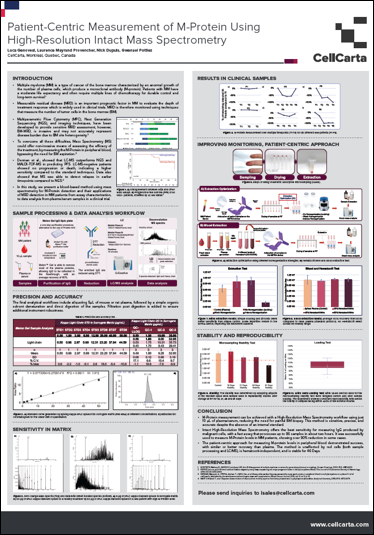
Mass spectrometry has several key clinical applications, including monitoring of hundreds of protein targets, absolute or relative quantification of individual biomarkers, unbiased discovery, drug product measurements, and determining ratios of post-translational modifications.
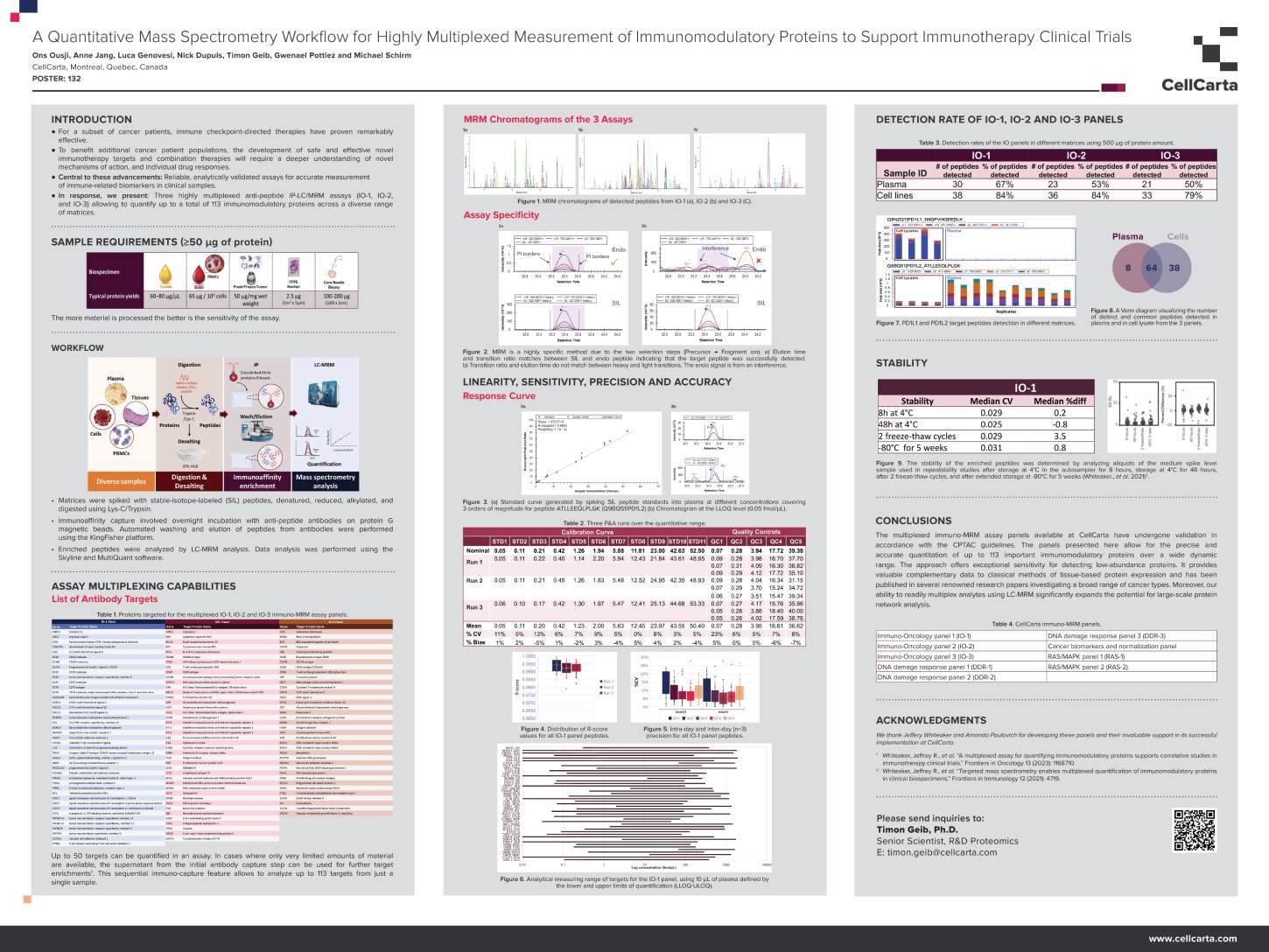
CellCarta designed a quantitative MS workflow for the highly multiplexed measurement of immunomodulatory proteins in clinical trials. Our workflow uses the immune-MRM assay panel to quantify ≤113 proteins to better understand drug responses, crucial for immune and combinational therapy development.
Expert mass spectrometry proteomic services with 25+ years of experience.
Clinical Implementation
Multi-Modal Capabilities
Scalable, Flexible Workflows
Biomarker Expertise
Regulatory-Ready
Explore CellCarta’s mass spectrometry-based services and related platforms for in-depth proteomic screening.
Multiplexed biomarker quantification using LC-MS and immunoassays across a vast range of clinically relevant sample types.

LC-MS/MS for novel biomarker identification.

Quantify protein biomarkers using just 1µL of blood with high sensitivity and specificity.

 Posters
 Blog
Blog
 Brochure

Mass spectrometry (MS) enables sensitive and accurate quantification of protein biomarkers in biological samples. At CellCarta, bioanalytical mass spectrometry is centered on the MRM platform, which provides targeted, quantitative insights into biomarkers of interest. The MRM platform uses triple quadrupole or hybrid triple quadrupole/linear ion trap mass spectrometers coupled to liquid chromatography, offering superior specificity, sensitivity, and quantification of analytes across clinical samples.
One of the main benefits of the MS platform is its flexibility and versatility, accommodating a vast array of sample types and conditions. This makes MS the ideal candidate for processing both common and uncommon biological matrices, including plasma, serum, cells, fresh tissue, frozen tissue, formalin-fixed paraffin-embedded (FFPE) tissue, urine, cerebrospinal fluid (CSF), sputum, vitreous humor, and aqueous humor.
CellCarta’s mass spectrometry assays are performed under Good Clinical Laboratory Practice (GCLP) and CAP/CLIA environments. For Immuno-MRM specifically, assay validation follows CPTAC guidelines, an internationally recognized standard for quantitative proteomics. All assay parameters, including specificity, interference, carryover, precision and accuracy, and matrix effects, are comprehensively characterized within CAP-accredited and CLIA-certified laboratory environments.
CellCarta’s mass spectrometry assays are designed to support all phases of clinical trials. The MRM platform accommodates multiple approaches depending on program stage, including exploratory research, multiplexed relative quantification for rapid biomarker candidate screening in early phases, and fully validated absolute quantification for clinical applications and regulatory submission in later phases. Both custom and off-the-shelf options are available that can match the timeline of each stage.