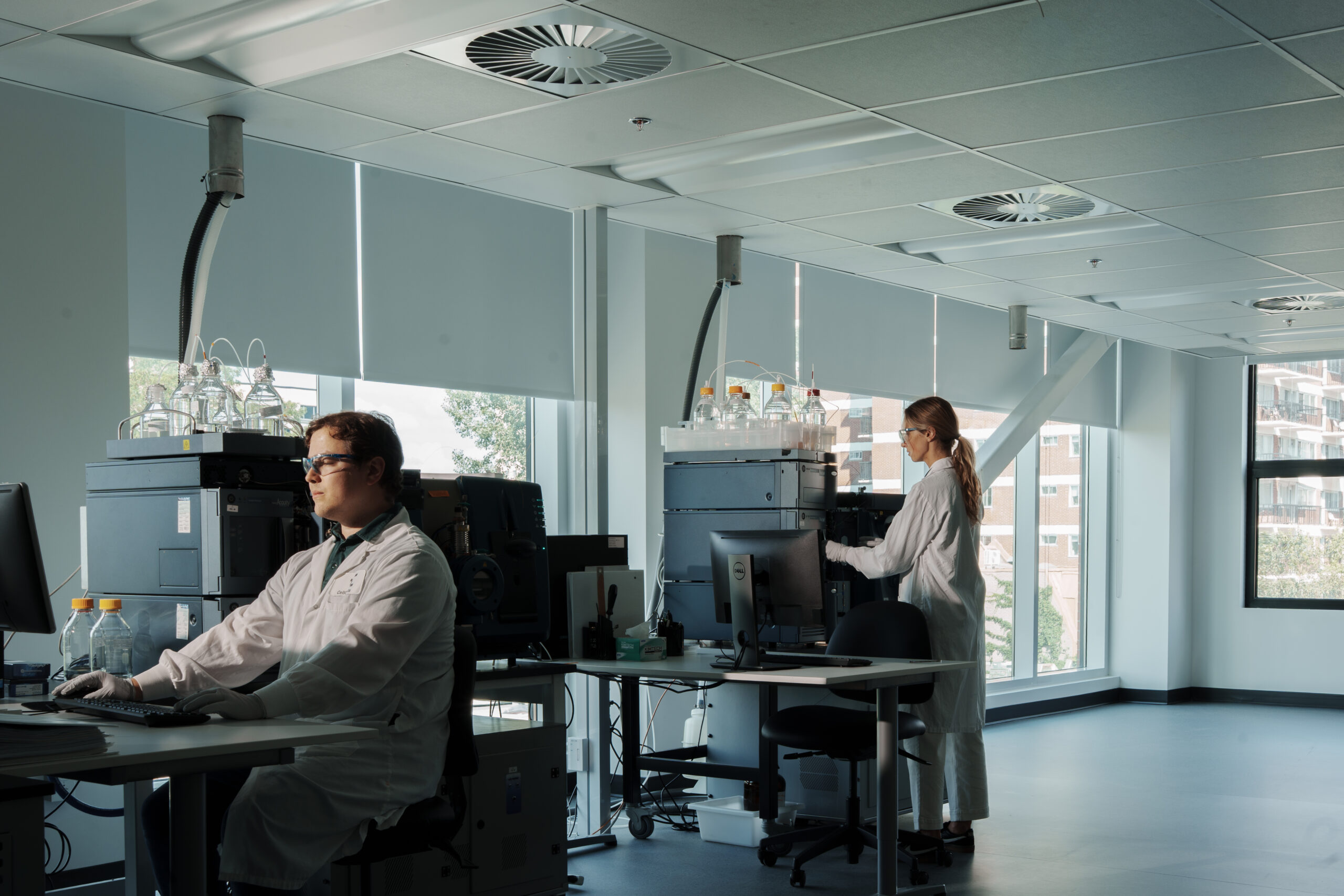
Combine the sensitivity of ligand binding assays (LBA) with the specificity of mass spectrometry (MS) to go beyond traditional ELISA analysis.

When challenges such as antibody specificity, protein complexity, or epitope accessibility limit the performance of conventional protein immunoprecipitation, mass spectrometry can pivot to peptide affinity enrichment, enabling a workflow that’s not possible with LBAs alone.
CellCarta can take a highly flexible hybrid LBA/LC-MS approach that enables multiplexed quantification of multiple peptides per target, or multiple protein targets, within a single assay. These capabilities enable the development of fully customized workflows tailored to your program's specific requirements.
Hybrid LBA/LC-MS approaches enable absolute quantification and PK characterization of complex biologics and drug products across a wide range of preclinical and clinical matrices.
CellCarta develops, qualifies, and validates hybrid assays under GCLP principles, enabling seamless transition from preclinical models to human sample analysis, accelerating timelines for regulatory-ready PK data.
Hybrid LBA/LC-MS enables absolute and relative biomarker quantification, supporting flexible assay strategies. These approaches extend analysis to low-abundance targets in clinically complex matrices, allowing for biological pathway tracking throughout disease progression and therapeutic response.
Hybrid LBA/LC-MS can quantify post-translational modifications (PTMs) directly in patient samples, providing a more complete picture of in vivo pharmacology.
Hybrid LBA/LC-MS has greater matrix flexibility and enables reduced dependency on antibody performance, which extends biomarker characterization to low-volume and rare matrices, including vitreous humor, aqueous humor, and cerebrospinal fluid.
Hybrid LBA/LC-MS extends anti-drug antibody (ADA) assessment beyond standalone LBAs by supporting ADA quantification and isotype characterization in a single analytical workflow.
Hybrid LBA/LC-MS approaches enable absolute quantification and PK characterization of complex biologics and drug products across a wide range of preclinical and clinical matrices.
CellCarta develops, qualifies, and validates hybrid assays under GCLP principles, enabling seamless transition from preclinical models to human sample analysis, accelerating timelines for regulatory-ready PK data.

Hybrid LBA/LC-MS enables absolute and relative biomarker quantification, supporting flexible assay strategies. These approaches extend analysis to low-abundance targets in clinically complex matrices, allowing for biological pathway tracking throughout disease progression and therapeutic response.
Hybrid LBA/LC-MS can quantify post-translational modifications (PTMs) directly in patient samples, providing a more complete picture of in vivo pharmacology.
Hybrid LBA/LC-MS has greater matrix flexibility and enables reduced dependency on antibody performance, which extends biomarker characterization to low-volume and rare matrices, including vitreous humor, aqueous humor, and cerebrospinal fluid.
Hybrid LBA/LC-MS extends anti-drug antibody (ADA) assessment beyond standalone LBAs by supporting ADA quantification and isotype characterization in a single analytical workflow.

Selecting the right platforms suited to your study’s specifications can be a complex process. With decades of proteomics expertise, CellCarta’s scientific team can help guide the setup and execution of your protein biomarker workflow, whether that requires a hybrid or multi-modal approach.
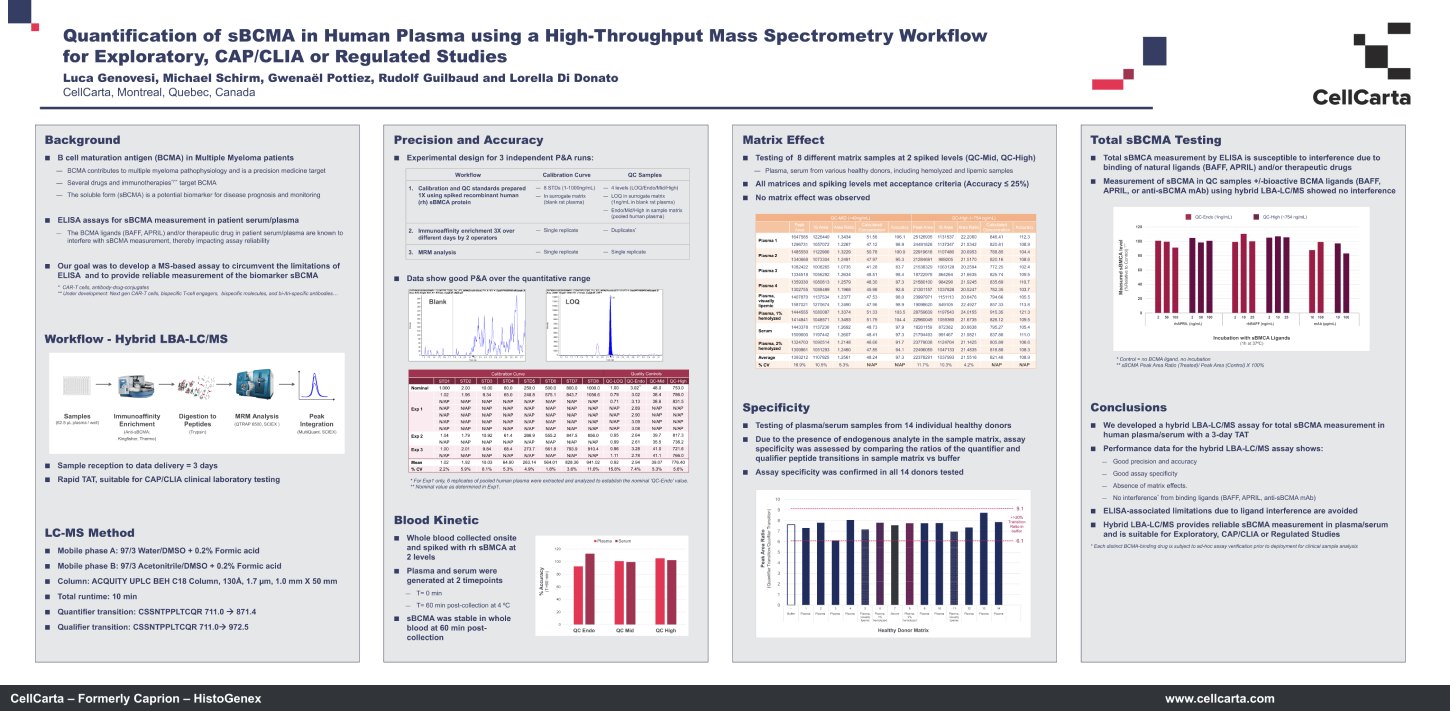
CellCarta developed a hybrid LBA/LC-MS assay for total sBCMA quantification in plasma samples from multiple myeloma patients. With only a 3-day turnaround time, our hybrid assay demonstrated strong precision, accuracy, and specificity, and is suitable for exploratory and regulated studies.
Proteomics depth and hybrid assay rigor, built for regulatory-ready programs.
Highly Flexible Workflow
Integrated Capabilities
Cross-Validated Protocols
Low-Abundance Detection
High-Touch Collaboration
CellCarta provides a range of related services to complement and expand upon your proteomic dataset.
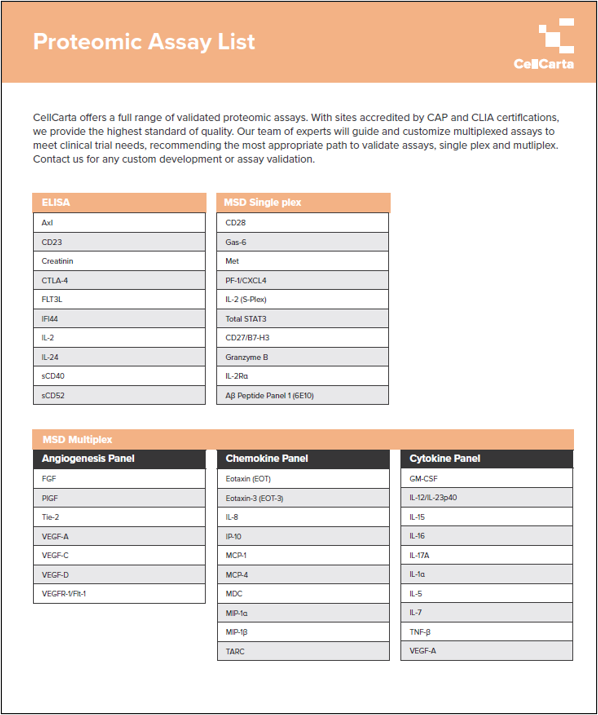
Quantify specific biomarkers with a well-established single-analyte assay at high throughput.

Measure up to ten analytes in each plate well using serum or plasma samples as small as 25 μL.
Precision assays for target engagement, pharmacokinetics, and TME profiling.
 Brochure
 Posters
 Webinar

Hybrid LBA/LC-MS combines ligand binding assays with liquid chromatography-mass spectrometry physical detection. The result is a highly flexible assay that achieves the sensitivity of an immunoassay with the specificity and absolute quantification capability of mass spectrometry, within a single analytical workflow.
The hybrid approach has been applied to monoclonal antibodies, antibody-drug conjugates, vaccines, blood products, and therapeutic proteins. It can also quantify endogenous protein counterparts simultaneously with the biotherapeutic drug in the same run, which is relevant for programs where the endogenous protein shares structural features with the recombinant therapeutic. Matrix-matched calibrators support accurate quantification across both species.
Standard ligand binding assays can be affected by matrix interference, anti-drug antibody cross-reactivity, and limited selectivity for closely related protein species. The hybrid approach adds an LC-MS/MS detection step after immunoaffinity capture, providing a dual-selection mechanism that improves specificity and reduces false signal. It also enables absolute quantification and characterization of post-translational modifications, which LBA alone cannot provide.