T-cell Engagers (TCEs): Data-Driven Development Insights

May 27, 2025

TCEs: Expanding the scope of precision immunotherapies  

T-cell engagers (TCEs) are typically bispecific antibodies that bind to both a disease-associated antigen and the CD3 protein on T cells, physically linking T cells to pathogenic cells and activating cytotoxic responses irrespectively of the patient’s HLA status.

Unlike personalized cell therapies, TCEs are off-the-shelf biologics that can be manufactured at scale, rapidly deployed, and administered in standard clinical settings without lymphodepletion. Combined with their ability to engage native T cells without genetic modification, TCEs also carry a favorable safety profile, with lower rates and severity of cytokine release syndrome (CRS), and lower risk of long-term T-cell malignancy as compared to cell-based therapies.

Since the first approval of TCE therapy in 2014, the number of TCEs entering the market has steeply increased over the past 3 years (Figure 1), and their use is expanding into new clinical areas, including autoimmune diseases, solid tumors, and infectious diseases, with both novel and repurposed targets.
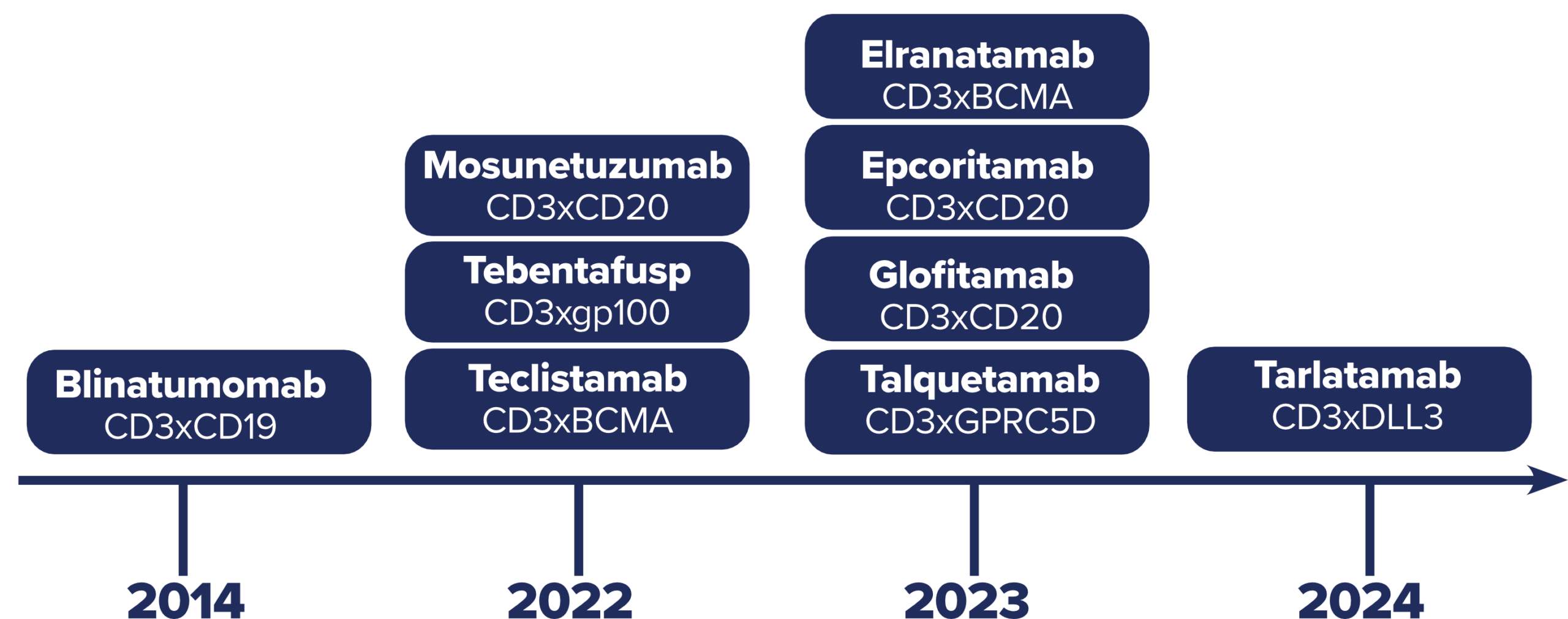
 

Figure 1: Timeline of TCE FDA approvals

As TCEs expand into new indications and patient populations, they offer a valuable opportunity for developers. But to successfully bring a TCE through clinical development and into regulatory approval, developers must generate a detailed understanding of the complex dynamics that shape TCE patient responses.

Generating the data you need to advance TCE development

Successful TCE development requires a clear understanding of specific aspects of therapeutic behavior, through detailed, targeted analysis. Selecting the appropriate parameters to measure is essential to generate meaningful insights that can guide clinical decision-making and development strategy.

1- Confirming target expression

Confirmation of target expression is essential to determine the potential of drug engagement—a prerequisite for efficacy. Developing precise target expression data is also critical for patient selection and stratification, companion diagnostic development, and evaluating off-target effects.

To generate this data, developers may assess expression in solid tumors using immunohistochemistry or immunofluorescence, or in peripheral or biopsy samples using flow cytometry. These approaches provide reliable data on whether the intended antigen is sufficiently present.

2- Assessing long-term efficacy

The success of TCEs depends on creating sustained immune activity. Demonstrating the long-term efficacy and curative potential of TCEs requires extended follow-ups—particularly for newer indications such as solid tumors or autoimmune diseases.

To get these insights, developers must monitor pathogenic cell populations over time, using flow cytometry for liquid samples or immunohistochemistry or immunofluorescence for tissue, and correlate these findings with longitudinal clinical data.

3- Understanding the mechanisms of primary resistance

Not all patients respond to TCE therapy, and understanding pre-existing T-cell landscapes is critical to predicting which patients will benefit most from treatment. Developers must establish baseline composition of the T-cell compartment early in development to identify immune signatures that predict response or resistance.

To do so, developers can apply high-dimensional spectral flow cytometry phenotyping panels to characterize surface markers and immune subsets in detail. Additionally, single-cell resolution assays that combine transcriptomic, proteomic, and T cell repertoire data can provide a more integrated view of T-cell status to help predict clinical response.

4- Tracking acquired resistance

Even in patients who respond to TCE treatment initially, T cells may lose function over time due to sustained activation, imposing major constraints on the drug’s therapeutic efficacy. Detecting this shift in response throughout treatment requires the assessment of T-cell activation and exhaustion markers.

This can be achieved using standardized flow cytometry panels with widely used markers for exhaustion (e.g., PD-1, TIM-3, LAG3, CD39), and activation (e.g., CD69, CD38, HLA-DR). In parallel, enumeration panels can be used to track pathogenic cell counts and help correlate changes in T-cell state with therapeutic efficacy—providing the data needed to inform treatment adjustments.

5- Assessing safety risks

While TCEs generally offer a favorable safety profile compared to cell-based therapies, there are still risks of adverse effects, like CRS and immune effector cell-associated neurotoxicity syndrome (ICANS), that must be assessed.

To support this, developers can deploy cytokine profiling during early clinical phases to capture broad inflammatory responses. Several immunoassay platforms, including Olink®, MSD®, and ELLA™, can be used to enable sensitive, multiplexed measurement of cytokine levels and understand the risk of adverse effects.

Building a strong foundation for successful TCE development

TCEs offer clear advantages as a scalable and versatile immunotherapy platform, but their successful development depends on a deep understanding of how these therapies perform. Monitoring key parameters such as target expression, immune activation, and resistance over time is essential to generate the evidence required to advance confidently through development.

As TCEs expand into new indications, developers who can integrate these insights early will be best positioned to navigate complexity, reduce uncertainty, and make informed decisions that move their therapies forward.

CellCarta can support your TCE program with the capabilities and expertise needed to drive confident development. Get in touch with our experts to find out more.

About the author:

author photo

Céline Vandamme is a Scientific Business Director at CellCarta, specializing in the flow cytometry platform. With a PhD in immunology, and a broad expertise gained through her work at various academic and pharmaceutical institutions, Céline has profuse experience in designing flow cytometry assays to support immune monitoring activities in clinical trials.
T-cell Engagers (TCEs): Data-Driven Development Insights

May 27, 2025

TCEs: Expanding the scope of precision immunotherapies  

T-cell engagers (TCEs) are typically bispecific antibodies that bind to both a disease-associated antigen and the CD3 protein on T cells, physically linking T cells to pathogenic cells and activating cytotoxic responses irrespectively of the patient’s HLA status.

Unlike personalized cell therapies, TCEs are off-the-shelf biologics that can be manufactured at scale, rapidly deployed, and administered in standard clinical settings without lymphodepletion. Combined with their ability to engage native T cells without genetic modification, TCEs also carry a favorable safety profile, with lower rates and severity of cytokine release syndrome (CRS), and lower risk of long-term T-cell malignancy as compared to cell-based therapies.

Since the first approval of TCE therapy in 2014, the number of TCEs entering the market has steeply increased over the past 3 years (Figure 1), and their use is expanding into new clinical areas, including autoimmune diseases, solid tumors, and infectious diseases, with both novel and repurposed targets.


Figure 1: Timeline of TCE FDA approvals

As TCEs expand into new indications and patient populations, they offer a valuable opportunity for developers. But to successfully bring a TCE through clinical development and into regulatory approval, developers must generate a detailed understanding of the complex dynamics that shape TCE patient responses.

Generating the data you need to advance TCE development

Successful TCE development requires a clear understanding of specific aspects of therapeutic behavior, through detailed, targeted analysis. Selecting the appropriate parameters to measure is essential to generate meaningful insights that can guide clinical decision-making and development strategy.

1- Confirming target expression

Confirmation of target expression is essential to determine the potential of drug engagement—a prerequisite for efficacy. Developing precise target expression data is also critical for patient selection and stratification, companion diagnostic development, and evaluating off-target effects.

To generate this data, developers may assess expression in solid tumors using immunohistochemistry or immunofluorescence, or in peripheral or biopsy samples using flow cytometry. These approaches provide reliable data on whether the intended antigen is sufficiently present.

2- Assessing long-term efficacy

The success of TCEs depends on creating sustained immune activity. Demonstrating the long-term efficacy and curative potential of TCEs requires extended follow-ups—particularly for newer indications such as solid tumors or autoimmune diseases.

To get these insights, developers must monitor pathogenic cell populations over time, using flow cytometry for liquid samples or immunohistochemistry or immunofluorescence for tissue, and correlate these findings with longitudinal clinical data.

3- Understanding the mechanisms of primary resistance

Not all patients respond to TCE therapy, and understanding pre-existing T-cell landscapes is critical to predicting which patients will benefit most from treatment. Developers must establish baseline composition of the T-cell compartment early in development to identify immune signatures that predict response or resistance.

To do so, developers can apply high-dimensional spectral flow cytometry phenotyping panels to characterize surface markers and immune subsets in detail. Additionally, single-cell resolution assays that combine transcriptomic, proteomic, and T cell repertoire data can provide a more integrated view of T-cell status to help predict clinical response.

4- Tracking acquired resistance

Even in patients who respond to TCE treatment initially, T cells may lose function over time due to sustained activation, imposing major constraints on the drug’s therapeutic efficacy. Detecting this shift in response throughout treatment requires the assessment of T-cell activation and exhaustion markers.

This can be achieved using standardized flow cytometry panels with widely used markers for exhaustion (e.g., PD-1, TIM-3, LAG3, CD39), and activation (e.g., CD69, CD38, HLA-DR). In parallel, enumeration panels can be used to track pathogenic cell counts and help correlate changes in T-cell state with therapeutic efficacy—providing the data needed to inform treatment adjustments.

5- Assessing safety risks

While TCEs generally offer a favorable safety profile compared to cell-based therapies, there are still risks of adverse effects, like CRS and immune effector cell-associated neurotoxicity syndrome (ICANS), that must be assessed.

To support this, developers can deploy cytokine profiling during early clinical phases to capture broad inflammatory responses. Several immunoassay platforms, including Olink®, MSD®, and ELLA™, can be used to enable sensitive, multiplexed measurement of cytokine levels and understand the risk of adverse effects.

Building a strong foundation for successful TCE development

TCEs offer clear advantages as a scalable and versatile immunotherapy platform, but their successful development depends on a deep understanding of how these therapies perform. Monitoring key parameters such as target expression, immune activation, and resistance over time is essential to generate the evidence required to advance confidently through development.

As TCEs expand into new indications, developers who can integrate these insights early will be best positioned to navigate complexity, reduce uncertainty, and make informed decisions that move their therapies forward.

CellCarta can support your TCE program with the capabilities and expertise needed to drive confident development. Get in touch with our experts to find out more.

About the author:

author photo

Céline Vandamme is a Scientific Business Director at CellCarta, specializing in the flow cytometry platform. With a PhD in immunology, and a broad expertise gained through her work at various academic and pharmaceutical institutions, Céline has profuse experience in designing flow cytometry assays to support immune monitoring activities in clinical trials.

Solutions for T cell engager (TCE) programs

May 16, 2025

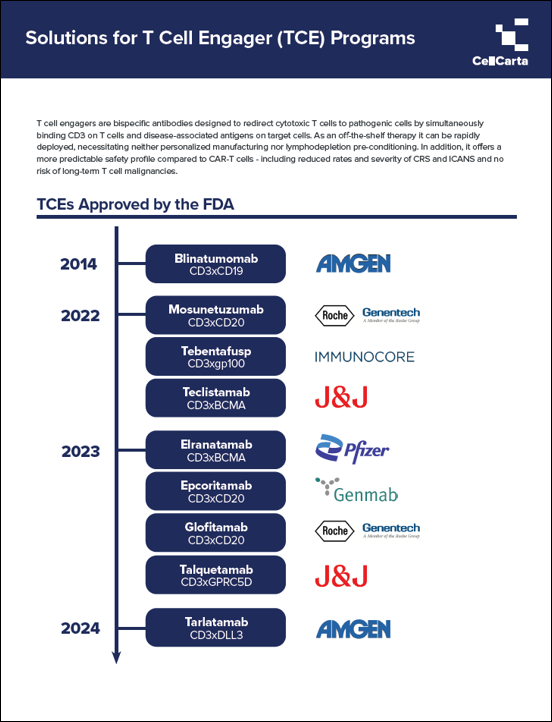
T cell engagers (TCEs) are bispecific antibodies designed to redirect cytotoxic T cells to pathogenic cells by simultaneously binding CD3 on T cells and disease-associated antigens on target cells.

Key limitations of T cell engager therapies include an incomplete understanding of primary resistance to treatment, which is influenced by the baseline composition of the T cell compartment and acquired resistance that is driven by T cell exhaustion.

In addition to supporting the assessment of safety and efficacy, CellCarta can also help you unravel the mechanisms at play behind primary and acquired resistance to TCE therapies. 

Link to brochure

Solutions for T cell engager (TCE) programs

May 16, 2025

T cell engagers (TCEs) are bispecific antibodies designed to redirect cytotoxic T cells to pathogenic cells by simultaneously binding CD3 on T cells and disease-associated antigens on target cells.

Key limitations of T cell engager therapies include an incomplete understanding of primary resistance to treatment, which is influenced by the baseline composition of the T cell compartment and acquired resistance that is driven by T cell exhaustion.

In addition to supporting the assessment of safety and efficacy, CellCarta can also help you unravel the mechanisms at play behind primary and acquired resistance to TCE therapies. 

Link to brochure

Biomarker Strategies for Cell Therapy in Autoimmune Diseases

October 16, 2024

Biomarker Strategies for Cell Therapy in Autoimmune Diseases Measuring the B Cell Reset

Biomarker Strategies for Cell Therapy in Autoimmune Diseases

October 16, 2024

Biomarker Strategies for Cell Therapy in Autoimmune Diseases Measuring the B Cell Reset

Single-Cell Analysis: A Key to Cell Therapy Testing

October 11, 2024

The landscape of cell therapy targets and approaches is rapidly expanding and diversifying. As a result, clinical testing is evolving. Testing programs must characterize increasingly complex and varied cell products in a quest to usher novel treatments from development through clinical approval.

Our Cell Therapy Trends Report explores this adaptation to accurately evaluate next-generation cell therapies while meeting budget and time constraints. With sights on emerging methods, it describes the notable role of single-cell analysis in unlocking efficacy and adverse events prediction. Here, we describe the recent progression of single-cell analyses and why they are needed to advance cell therapies.

“Single-cell” comes into its own

For 400 years, since the birth of the microscope, scientists have been studying the behavior of individual cells to understand how organisms function. In recent years, technology for single-cell analysis has exploded.

Fluorescence microscopy was pioneered in 1904, flow-based coulter counting in 1954, and fluorescent flow cytometry in 1968. While just two fluorescent dyes were available in the 1970s, by the early 2000s dozens of dyes enabled measurement of 20 proteins per cell over millions of cells.

The next two decades brought mass cytometry, followed by spectral flow cytometry, expanding to 40+ proteins per cell. With the debut of single-cell RNA sequencing in 2009 and CITE-seq in 2017, 1000s of transcripts alongside 100+ proteins can now be measured in each cell of a biological sample.

As single-cell analysis has advanced, human biology has proven ever more complex. Many groups are developing comprehensive single-cell atlases, which have defined 100s of different cell types across diverse tissues and diseases. Within each cell type, an array of dynamic cellular states are exhibited as cells respond to events like infection, injury, or drug treatment. This ever-growing appreciation of just how heterogeneous human biology is has made high plex single-cell analysis critical for understanding human health.

Single-cell analytics for cell therapies

As a living drug product, cell therapies are intrinsically more heterogeneous than conventional small molecules and biologics. The starting material used to manufacture a cell therapy product varies from person to person with age, genetic background, lifestyle, comorbidities, and pathogen exposure history.

Immune cells – both before and after their transformation into a cell product – can now be characterized in detail at the single-cell level, not with bulk methods that average heterogeneity and obscure rare subpopulations. Such data can help pinpoint specific immune features to use as predictive biomarkers of therapeutic efficacy or toxicity.

Additionally, next-generation cell therapies increasingly contain multiple engineered components, each with a mode of action designed to improve the overall therapeutic index. The multiplexed, multi-omic nature of today’s single-cell techniques allows each component to be characterized and linked to clinical outcomes.

Navigate single-cell insights with certainty

With various single-cell techniques at your disposal, the pressing question is how to use them efficiently. Measurements are highly specialized and costly. Deep data analysis is time-consuming. The following are a few steps to optimally use single-cell analyses in the evaluation of cell therapies:

  • Use high plex, multi-omic analyses in early-phase clinical studies to help develop a focused, lower plex biomarker strategy for late-phase trials
  • Leverage the breadth of single-cell analyses to generate hypotheses about the mechanistic behavior of therapeutic cells or for retrospective analysis of key clinical trial subgroups
  • Stay abreast of advances in large data analytics as they shift from pattern identification in single datasets to biological interpretation and cross-study comparability

Our Cell Therapy Trends Report delves deeper into the developments we anticipate in single-cell analysis and how it fits into a broader program for cell therapy clinical testing. Download the full report or speak to our team about your cell therapy.


About the Author:

author photo

Matt Clutter (PhD) is the Global Director of CellCarta’s R&D group. With a strong background in the discovery and translational immunology space, Matt has powered innovation in our flow and mass cytometry assays and data analysis approaches. With his expertise in single-cell analysis, he guides our customers in finding the best solution to their immunology questions.


Single-Cell Analysis: A Key to Cell Therapy Testing

October 11, 2024

The landscape of cell therapy targets and approaches is rapidly expanding and diversifying. As a result, clinical testing is evolving. Testing programs must characterize increasingly complex and varied cell products in a quest to usher novel treatments from development through clinical approval.

Our Cell Therapy Trends Report explores this adaptation to accurately evaluate next-generation cell therapies while meeting budget and time constraints. With sights on emerging methods, it describes the notable role of single-cell analysis in unlocking efficacy and adverse events prediction. Here, we describe the recent progression of single-cell analyses and why they are needed to advance cell therapies.

“Single-cell” comes into its own

For 400 years, since the birth of the microscope, scientists have been studying the behavior of individual cells to understand how organisms function. In recent years, technology for single-cell analysis has exploded.

Fluorescence microscopy was pioneered in 1904, flow-based coulter counting in 1954, and fluorescent flow cytometry in 1968. While just two fluorescent dyes were available in the 1970s, by the early 2000s dozens of dyes enabled measurement of 20 proteins per cell over millions of cells.

The next two decades brought mass cytometry, followed by spectral flow cytometry, expanding to 40+ proteins per cell. With the debut of single-cell RNA sequencing in 2009 and CITE-seq in 2017, 1000s of transcripts alongside 100+ proteins can now be measured in each cell of a biological sample.

As single-cell analysis has advanced, human biology has proven ever more complex. Many groups are developing comprehensive single-cell atlases, which have defined 100s of different cell types across diverse tissues and diseases. Within each cell type, an array of dynamic cellular states are exhibited as cells respond to events like infection, injury, or drug treatment. This ever-growing appreciation of just how heterogeneous human biology is has made high plex single-cell analysis critical for understanding human health.

Single-cell analytics for cell therapies

As a living drug product, cell therapies are intrinsically more heterogeneous than conventional small molecules and biologics. The starting material used to manufacture a cell therapy product varies from person to person with age, genetic background, lifestyle, comorbidities, and pathogen exposure history.

Immune cells – both before and after their transformation into a cell product – can now be characterized in detail at the single-cell level, not with bulk methods that average heterogeneity and obscure rare subpopulations. Such data can help pinpoint specific immune features to use as predictive biomarkers of therapeutic efficacy or toxicity.

Additionally, next-generation cell therapies increasingly contain multiple engineered components, each with a mode of action designed to improve the overall therapeutic index. The multiplexed, multi-omic nature of today’s single-cell techniques allows each component to be characterized and linked to clinical outcomes.

Navigate single-cell insights with certainty

With various single-cell techniques at your disposal, the pressing question is how to use them efficiently. Measurements are highly specialized and costly. Deep data analysis is time-consuming. The following are a few steps to optimally use single-cell analyses in the evaluation of cell therapies:

  • Use high plex, multi-omic analyses in early-phase clinical studies to help develop a focused, lower plex biomarker strategy for late-phase trials
  • Leverage the breadth of single-cell analyses to generate hypotheses about the mechanistic behavior of therapeutic cells or for retrospective analysis of key clinical trial subgroups
  • Stay abreast of advances in large data analytics as they shift from pattern identification in single datasets to biological interpretation and cross-study comparability

Our Cell Therapy Trends Report delves deeper into the developments we anticipate in single-cell analysis and how it fits into a broader program for cell therapy clinical testing. Download the full report or speak to our team about your cell therapy.


About the Author:

author photo

Matt Clutter (PhD) is the Global Director of CellCarta’s R&D group. With a strong background in the discovery and translational immunology space, Matt has powered innovation in our flow and mass cytometry assays and data analysis approaches. With his expertise in single-cell analysis, he guides our customers in finding the best solution to their immunology questions.


Let's Talk: A Conversation with Dr. Scott Gottlieb

September 10, 2024

The drug development landscape is rapidly evolving, with new regulatory guidance, novel therapy types, and exciting AI-powered technologies altering the face of clinical testing.

In this webcast, Scott Gottlieb, former FDA commissioner, joins Christopher Ung, our Chief Scientific Business Officer, for an in-depth conversation on the latest in regulatory and biomarker development.

Key topics discussed in this webcast:

  • The history and future of cell therapies
  • The FDA’s final rule to regulate lab-developed IVDs as medical devices
  • How to navigate the FDA’s new oncology IVD pilot program
  • T cell health in immune oncology and metabolic drug development
  • How AI-powered digital pathology is revolutionizing cell therapy development
author photo

Dr. Gottlieb is a physician and served as the 23rd Commissioner of the U.S. Food and Drug Administration. Dr. Gottlieb’s work focuses on advancing public health through developing and implementing innovative approaches to improve medical outcomes, reshape healthcare delivery, and expand consumer choice and safety. He is currently a partner at the venture capital firm New Enterprise Associates; a resident fellow at the American Enterprise Institute; a contributor to CNBC; and a board member to Pfizer, Inc. and Illumina, Inc.

author photo

Christopher Ung is CellCarta’s Chief Scientific Business Officer and has served in the companion diagnostics field since its inception. He is one of the original pioneers of the personalized medicine field. Mr. Ung currently leads the development and execution of CellCarta’s strategic and business initiatives, leveraging the company’s solid tumor and anatomic pathology services.

Let's Talk: A Conversation with Dr. Scott Gottlieb

September 10, 2024

The drug development landscape is rapidly evolving, with new regulatory guidance, novel therapy types, and exciting AI-powered technologies altering the face of clinical testing.

In this webcast, Scott Gottlieb, former FDA commissioner, joins Christopher Ung, our Chief Scientific Business Officer, for an in-depth conversation on the latest in regulatory and biomarker development.

Key topics discussed in this webcast:

  • The history and future of cell therapies
  • The FDA’s final rule to regulate lab-developed IVDs as medical devices
  • How to navigate the FDA’s new oncology IVD pilot program
  • T cell health in immune oncology and metabolic drug development
  • How AI-powered digital pathology is revolutionizing cell therapy development
author photo

Dr. Gottlieb is a physician and served as the 23rd Commissioner of the U.S. Food and Drug Administration. Dr. Gottlieb’s work focuses on advancing public health through developing and implementing innovative approaches to improve medical outcomes, reshape healthcare delivery, and expand consumer choice and safety. He is currently a partner at the venture capital firm New Enterprise Associates; a resident fellow at the American Enterprise Institute; a contributor to CNBC; and a board member to Pfizer, Inc. and Illumina, Inc.

author photo

Christopher Ung is CellCarta’s Chief Scientific Business Officer and has served in the companion diagnostics field since its inception. He is one of the original pioneers of the personalized medicine field. Mr. Ung currently leads the development and execution of CellCarta’s strategic and business initiatives, leveraging the company’s solid tumor and anatomic pathology services.