Optimizing Cell Therapy with Advanced VCN and Cell Counting

July 16, 2024
Optimizing Cell Therapy Clinical Testing

Cell therapy targets, constructs, and agents are expanding and diversifying — fast. Clinical testing must now comprehensively characterize an ever-broader number and array of therapies, while continuing to prioritize urgency and efficiency in their development and approval.

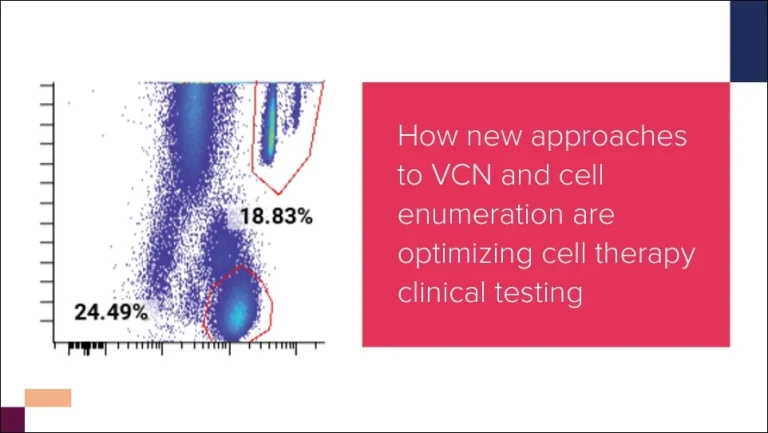
We delve into how clinical testing is evolving to meet demand in this rapidly changing landscape in our Cell Therapy Trends Report, and examine a few key areas where cell therapy testing programs are changing. One of these is cell enumeration and vector copy number (VCN) determination, which provide insights on how a given therapeutic construct is behaving in the body.

Below, we explore how techniques for cell enumeration and VCN determination are being adapted to assess greater numbers of increasingly complex and diversified therapy candidates, and discuss what the future holds for this key area of clinical testing.

Understanding cell enumeration and VCN in clinical testing

Cell enumeration and VCN determination methods assess cell number (via flow cytometric detection of surface proteins) and the number of constructs transduced into a cell (via PCR-based quantification of DNA), respectively. Together, the two measure cell therapy expansion and determine the abundance and persistence of therapeutic cells — crucial to ascertain how various cell types are responding to a therapy.

As cell therapies and sample types diversify, clinical testing for cell enumeration and VCN determination must assess a broader array of targets, requiring more specialized means of analysis. However, developers must also keep speed in mind, and balance specialization with efficiency to ensure that therapies are evaluated in a timely way.

So, what does the future hold for this realm of clinical testing?

Complementary methods

Cell enumeration and VCN determination techniques take complementary measurements from different angles, using different methods and analytes to evaluate cell therapies.

By utilizing both approaches in early-phase trials, cell therapy developers can gain high confidence in how they are interpreting their data, thereby producing a more reliable and robust picture of therapy expansion, and also lending confidence to each individual assay.

Alignment can also streamline testing. Cell enumeration via flow cytometry, despite providing additional phenotyping information on expanded cells, can be difficult to scale up, and so is often limited in later-stage use due to the challenges of collecting and transporting samples off-site. But, if aligned with cell enumeration in early-phase testing, VCN can act as a proxy measure of cell number during later-stage testing, simplifying logistics.

Increasing customization

As more diverse cell therapies reach clinical stages, cell enumeration and VCN determination methods need increasing customization — to track proprietary constructs as patients become more likely to receive multiple therapies, for instance. Additionally, new therapeutic cells such as CAR-macrophages may require novel antigen targets to be monitored in various tissues other than circulating blood, requiring new protocols for collection and analysis.

Enhancing modularity

Although customized assays are valuable, they are time- and resource-consuming to develop and validate. Modularization can minimize the timeline impact of assay customization. Testing programs for cell enumeration and VCN determination can be made quicker and easier to deploy by identifying generic analytes; and by utilizing modular data analytics to streamline readouts, and accelerate data processing.

Cell enumeration and VCN in the ever-changing cell therapy landscape

With the accelerating pace and increasing diversity of cell therapy development, clinical testing must become more responsive and adaptive, leveraging different approaches to deliver readouts that provide meaningful insights into cell therapy action and host response.

We dig deeper into emerging testing approaches for cell enumeration and VCN determination, and explore the future of cell therapy clinical testing more generally, in our Cell Therapy Trends Report. Download the report now, or contact our team to speak to an expert about your cell therapy needs.

About the author:

author photo

Laïla-Aïcha Hanafi is the Director of Scientific Laboratory Operations in flow cytometry at CellCarta. She supplemented her PhD in immuno-oncology with post-doctoral studies in translational biomarkers for cell therapies at the Fred Hutchinson Cancer Center. Laïla has combined scientific knowledge and operational efficiency to address biomarker needs in clinical trial and prioritizing high quality data to move therapies to the next stage of clinical deployment.
Optimizing Cell Therapy with Advanced VCN and Cell Counting

July 16, 2024

Optimizing Cell Therapy Clinical Testing

Cell therapy targets, constructs, and agents are expanding and diversifying — fast. Clinical testing must now comprehensively characterize an ever-broader number and array of therapies, while continuing to prioritize urgency and efficiency in their development and approval.

We delve into how clinical testing is evolving to meet demand in this rapidly changing landscape in our Cell Therapy Trends Report, and examine a few key areas where cell therapy testing programs are changing. One of these is cell enumeration and vector copy number (VCN) determination, which provide insights on how a given therapeutic construct is behaving in the body.

Below, we explore how techniques for cell enumeration and VCN determination are being adapted to assess greater numbers of increasingly complex and diversified therapy candidates, and discuss what the future holds for this key area of clinical testing.

Understanding cell enumeration and VCN in clinical testing

Cell enumeration and VCN determination methods assess cell number (via flow cytometric detection of surface proteins) and the number of constructs transduced into a cell (via PCR-based quantification of DNA), respectively. Together, the two measure cell therapy expansion and determine the abundance and persistence of therapeutic cells — crucial to ascertain how various cell types are responding to a therapy.

As cell therapies and sample types diversify, clinical testing for cell enumeration and VCN determination must assess a broader array of targets, requiring more specialized means of analysis. However, developers must also keep speed in mind, and balance specialization with efficiency to ensure that therapies are evaluated in a timely way.

So, what does the future hold for this realm of clinical testing?

Complementary methods

Cell enumeration and VCN determination techniques take complementary measurements from different angles, using different methods and analytes to evaluate cell therapies.

By utilizing both approaches in early-phase trials, cell therapy developers can gain high confidence in how they are interpreting their data, thereby producing a more reliable and robust picture of therapy expansion, and also lending confidence to each individual assay.

Alignment can also streamline testing. Cell enumeration via flow cytometry, despite providing additional phenotyping information on expanded cells, can be difficult to scale up, and so is often limited in later-stage use due to the challenges of collecting and transporting samples off-site. But, if aligned with cell enumeration in early-phase testing, VCN can act as a proxy measure of cell number during later-stage testing, simplifying logistics.

Increasing customization

As more diverse cell therapies reach clinical stages, cell enumeration and VCN determination methods need increasing customization — to track proprietary constructs as patients become more likely to receive multiple therapies, for instance. Additionally, new therapeutic cells such as CAR-macrophages may require novel antigen targets to be monitored in various tissues other than circulating blood, requiring new protocols for collection and analysis.

Enhancing modularity

Although customized assays are valuable, they are time- and resource-consuming to develop and validate. Modularization can minimize the timeline impact of assay customization. Testing programs for cell enumeration and VCN determination can be made quicker and easier to deploy by identifying generic analytes; and by utilizing modular data analytics to streamline readouts, and accelerate data processing.

Cell enumeration and VCN in the ever-changing cell therapy landscape

With the accelerating pace and increasing diversity of cell therapy development, clinical testing must become more responsive and adaptive, leveraging different approaches to deliver readouts that provide meaningful insights into cell therapy action and host response.

We dig deeper into emerging testing approaches for cell enumeration and VCN determination, and explore the future of cell therapy clinical testing more generally, in our Cell Therapy Trends Report. Download the report now, or contact our team to speak to an expert about your cell therapy needs.

About the author:

author photo

Laïla-Aïcha Hanafi is the Director of Scientific Laboratory Operations in flow cytometry at CellCarta. She supplemented her PhD in immuno-oncology with post-doctoral studies in translational biomarkers for cell therapies at the Fred Hutchinson Cancer Center. Laïla has combined scientific knowledge and operational efficiency to address biomarker needs in clinical trial and prioritizing high quality data to move therapies to the next stage of clinical deployment.

Cell Therapy Trends Report | Insights from CellCarta

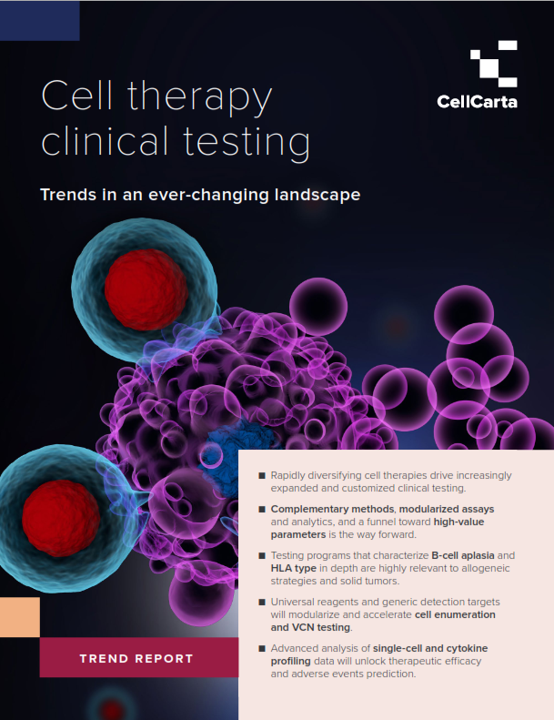
Cell therapy clinical testing: trends in an ever-changing landscape

As cell therapies become increasingly diverse and pressure mounts to accelerate approvals, clinical testing programs face new and complex challenges.

But how are clinical testing programs adapting? And what could the future hold?

In our new report, five cell therapy experts describe how clinical testing programs are accommodating diverse therapeutic approaches, as well as anticipated changes in key testing areas, including:

The cell therapy landscape is evolving fast. Discover what that means for clinical testing programs in this trends report from industry experts.

Download the resource

Cell Therapy Clinical Testing Trend Report - cover

As a global CRO, we prioritize your study goals and clinical trial needs above all else. We aim to provide you with easy, accessible, and comprehensive technologies spanning a multitude of therapeutic areas.

Discover our range of services in immunology, proteomics, genomics, as well as related ML/AI and sample logistics services.

Cell Therapy Trends Report | Insights from CellCarta

Cell therapy clinical testing: trends in an ever-changing landscape

As cell therapies become increasingly diverse and pressure mounts to accelerate approvals, clinical testing programs face new and complex challenges.

But how are clinical testing programs adapting? And what could the future hold?

In our new report, five cell therapy experts describe how clinical testing programs are accommodating diverse therapeutic approaches, as well as anticipated changes in key testing areas, including:

The cell therapy landscape is evolving fast. Discover what that means for clinical testing programs in this trends report from industry experts.

Download the resource

Cell Therapy Clinical Testing Trend Report - cover

As a global CRO, we prioritize your study goals and clinical trial needs above all else. We aim to provide you with easy, accessible, and comprehensive technologies spanning a multitude of therapeutic areas.

Discover our range of services in immunology, proteomics, genomics, as well as related ML/AI and sample logistics services.

Let's Talk: A Conversation with CAR T-cell Therapy Pioneer Dr. Carl June

February 22, 2024

Immunotherapies such as CAR T-cell therapy hold a lot of promise in treating illnesses like cancer. However, key challenges remain in their development, in particular the need to address adverse events and patient resistance.

In this webcast, Dr. Carl June, a pioneer in the field of CAR T-cell therapy, joins Christopher Ung, our Chief Scientific Business Officer, for an in-depth conversation on developing immuno and CAR T-cell therapies.

Key topics discussed in this cell therapy focused webcast: 

  • Academic and Industry Partnership in CAR-T Development 
  • CAR-T Development in US and China 
  • Biomarkers from vein to vein: Mechanism, Selection, and Resistance 
  • Facing the Challenges: Adverse Events and Patient Resistance 
  • New Frontiers: Solid Tumors, Evolutionary and Revolutionary CAR models 
author photo

Dr. Carl June

Dr. June is a member of CellCarta’s Scientific Advisory Board and the Richard W. Vague Professor in Immunotherapy in the Perelman School of Medicine at the University of Pennsylvania.

In 2011, his research team published a paper on the first CAR-T therapy treating leukemia patients with their own genetically modified T-cells.

author photo

Mr. Christopher Ung

Mr. Ung is CellCarta’s Chief Scientific Business Officer and has served in the companion diagnostics field since its inception. He is one of the original pioneers of the personalized medicine field.

Mr. Ung currently leads the development and execution of CellCarta’s strategic and business initiatives, leveraging the company’s solid tumour and anatomic pathology services.

Let's Talk: A Conversation with CAR T-cell Therapy Pioneer Dr. Carl June

February 22, 2024

Immunotherapies such as CAR T-cell therapy hold a lot of promise in treating illnesses like cancer. However, key challenges remain in their development, in particular the need to address adverse events and patient resistance.

In this webcast, Dr. Carl June, a pioneer in the field of CAR T-cell therapy, joins Christopher Ung, our Chief Scientific Business Officer, for an in-depth conversation on developing immuno and CAR T-cell therapies.

Key topics discussed in this cell therapy focused webcast: 

  • Academic and Industry Partnership in CAR-T Development 
  • CAR-T Development in US and China 
  • Biomarkers from vein to vein: Mechanism, Selection, and Resistance 
  • Facing the Challenges: Adverse Events and Patient Resistance 
  • New Frontiers: Solid Tumors, Evolutionary and Revolutionary CAR models 
author photo

Dr. Carl June

Dr. June is a member of CellCarta’s Scientific Advisory Board and the Richard W. Vague Professor in Immunotherapy in the Perelman School of Medicine at the University of Pennsylvania.

In 2011, his research team published a paper on the first CAR-T therapy treating leukemia patients with their own genetically modified T-cells.

author photo

Mr. Christopher Ung

Mr. Ung is CellCarta’s Chief Scientific Business Officer and has served in the companion diagnostics field since its inception. He is one of the original pioneers of the personalized medicine field.

Mr. Ung currently leads the development and execution of CellCarta’s strategic and business initiatives, leveraging the company’s solid tumour and anatomic pathology services.

Cell Therapy Brochure | Cell Therapy

December 15, 2023

DOWNLOAD OUR BROCHURE

Cell Therapy Brochure Header Image

ACCELERATE THE DEVELOPMENT AND APPROVAL OF YOUR CELL THERAPY PROGRAM

Cell Therapy Brochure | Cell Therapy

December 15, 2023

DOWNLOAD OUR BROCHURE

Cell Therapy Brochure Header Image

ACCELERATE THE DEVELOPMENT AND APPROVAL OF YOUR CELL THERAPY PROGRAM

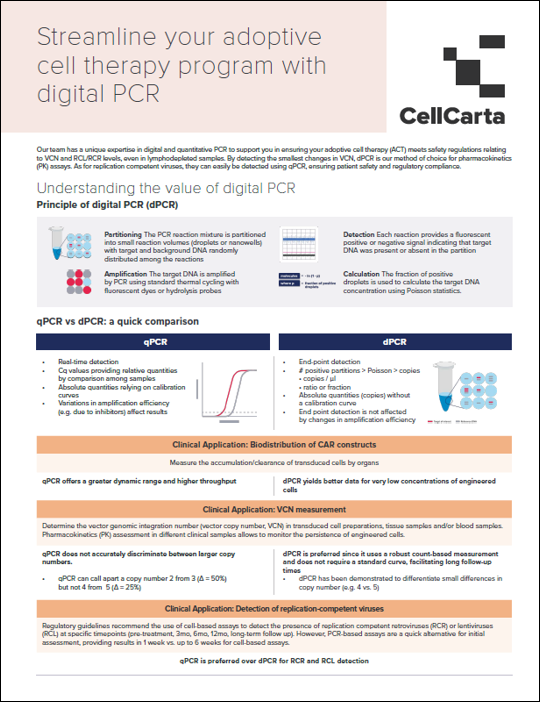
Case Study: Streamline Your Adoptive Cell Therapy Program With Digital PCR (dPCR)

October 19, 2022


CellCarta is your one partner for your adoptive cell therapy program by offering a complete suite of services with complementary platforms:

Download our case study on digital PCR.

Our team has unique expertise in digital PCR to support you in ensuring your adoptive cell therapy meets safety regulations relating to vector copy number (VCN).

Download the case study for an overview on dPCR:

  • How it works
  • How dPCR compares to quantitative PCR
  • Key clinical applications including VCN measurement and RCR/RCL detection under regulatory standards
  • Data on measuring VCN using dPCR in a phase 1 clinical trial

Partners in Laboratory Testing

As a global Contract Research Organization Laboratory (CRO) to the biopharmaceutical industry, CellCarta provides access to a broad offering of biomarker platforms and services. We partner with you to address the most complex laboratory testing needs, delivering customized biomarker testing solutions to further the limitless potential of precision medicine.

Contact us to get your project started.

Case Study: Streamline Your Adoptive Cell Therapy Program With Digital PCR (dPCR)

October 19, 2022


CellCarta is your one partner for your adoptive cell therapy program by offering a complete suite of services with complementary platforms:

Download our case study on digital PCR.

Our team has unique expertise in digital PCR to support you in ensuring your adoptive cell therapy meets safety regulations relating to vector copy number (VCN).

Download the case study for an overview on dPCR:

  • How it works
  • How dPCR compares to quantitative PCR
  • Key clinical applications including VCN measurement and RCR/RCL detection under regulatory standards
  • Data on measuring VCN using dPCR in a phase 1 clinical trial

Partners in Laboratory Testing

As a global Contract Research Organization Laboratory (CRO) to the biopharmaceutical industry, CellCarta provides access to a broad offering of biomarker platforms and services. We partner with you to address the most complex laboratory testing needs, delivering customized biomarker testing solutions to further the limitless potential of precision medicine.

Contact us to get your project started.