Multiplexed Mass Spec for Immunotherapy Protein Measurement

October 13, 2023

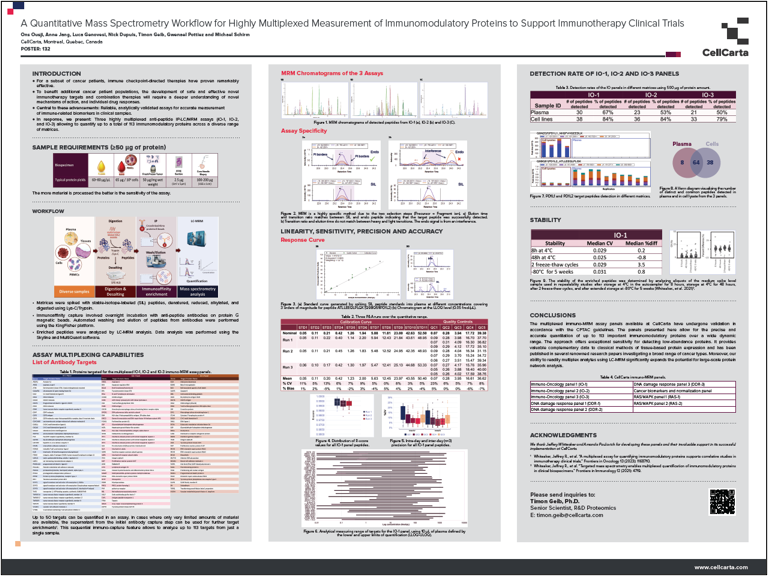
CellCarta’s poster presents a quantitative mass spectrometry workflow designed for the highly multiplexed measurement of immunomodulatory proteins to support immunotherapy clinical trials.

The workflow utilizes immuno-MRM assay panels to quantify up to 113 proteins with high sensitivity and precision, providing valuable data on immune-related biomarkers. This approach enhances the understanding of drug responses and mechanisms of action, crucial for developing new immunotherapies and combination treatments.

The method involves the use of stable-isotope-labeled peptides and immunoaffinity capture, followed by LC-MRM analysis for accurate protein quantification.

Contact us  to gain insights on advanced proteomics solutions.

View the full poster:

A Quantitative Mass Spectrometry Workflow for Highly Multiplexed Measurement of Immunomodulatory Proteins to Support Immunotherapy Clinical Trials

As presented at SITC 2023 AND EORTC 2023

Multiplexed Mass Spec for Immunotherapy Protein Measurement

October 13, 2023

CellCarta’s poster presents a quantitative mass spectrometry workflow designed for the highly multiplexed measurement of immunomodulatory proteins to support immunotherapy clinical trials.

The workflow utilizes immuno-MRM assay panels to quantify up to 113 proteins with high sensitivity and precision, providing valuable data on immune-related biomarkers. This approach enhances the understanding of drug responses and mechanisms of action, crucial for developing new immunotherapies and combination treatments.

The method involves the use of stable-isotope-labeled peptides and immunoaffinity capture, followed by LC-MRM analysis for accurate protein quantification.

Contact us  to gain insights on advanced proteomics solutions.

View the full poster:

A Quantitative Mass Spectrometry Workflow for Highly Multiplexed Measurement of Immunomodulatory Proteins to Support Immunotherapy Clinical Trials

As presented at SITC 2023 AND EORTC 2023

Immuno-MRM Assays

August 4, 2023

DOWNLOAD OUR BROCHURE

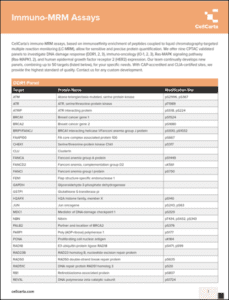
CellCarta’s immuno-MRM assays, based on immunoaffinity enrichment of peptides coupled to liquid chromatography-targeted multiple reaction monitoring (LC-MRM), allow for sensitive and precise protein quantification. We offer nine CPTAC validated panels to investigate DNA damage response (DDR1, 2, 3), immuno-oncology (IO-1, 2, 3), Ras-MAPK signaling pathway (Ras-MAPK1, 2), and human epidermal growth factor receptor 2 (HER2) expression. Our team continually develops new panels, combining up to 50 targets (listed below), for your specific needs. With CAP-accredited and CLIA-certified sites, we provide the highest standard of quality.

Contact us for any custom development.

Immuno-MRM

Immuno-MRM Assays

August 4, 2023

DOWNLOAD OUR BROCHURE

CellCarta’s immuno-MRM assays, based on immunoaffinity enrichment of peptides coupled to liquid chromatography-targeted multiple reaction monitoring (LC-MRM), allow for sensitive and precise protein quantification. We offer nine CPTAC validated panels to investigate DNA damage response (DDR1, 2, 3), immuno-oncology (IO-1, 2, 3), Ras-MAPK signaling pathway (Ras-MAPK1, 2), and human epidermal growth factor receptor 2 (HER2) expression. Our team continually develops new panels, combining up to 50 targets (listed below), for your specific needs. With CAP-accredited and CLIA-certified sites, we provide the highest standard of quality.

Contact us for any custom development.

Immuno-MRM

NextGen Oncology: Precision Proteomics in Diagnostic Solutions

May 2, 2023

Personalized oncology aims to match each patient to a specific therapy based on the molecular characteristics of their tumor.

Currently, tumor DNA is sequenced, and genomics reports are given to physicians to help select targeted therapies for patients.

While this genome-centric approach to precision oncology has extended the lives of subsets of patients, many patients do not respond to the selected therapy and many whose tumors initially respond have a high chance of recurrence with resistant disease.

New approaches are required to capture complex clinical phenotypes and better match patients to efficacious therapies.

Viewers will gain insights into:

  • An understanding of state-of-the-art proteomic analyses
  • Application of proteogenomic approaches to identifying novel biomarkers
  • How to develop multiplex, targeted proteomic assays to support preclinical and clinical studies

Dr. Amanda Paulovich, MD, PhD, Professor and Aven Foundation Endowed Chair, Director, CLIA Targeted Proteomic Laboratory, Clinical Research Division, Fred Hutchinson Cancer Center

As an oncologist, Dr. Amanda Paulovich was struck by the paucity of quantitative assays for measuring clinically relevant phenotypes in her patients, and the limitations that this put on her ability to practice “personalized medicine.” Through these experiences, she became passionate about developing technologies and strategies for the translation of NextGen diagnostics and therapeutics to enable precision medicine.

Over the past 19 years, Dr. Paulovich’s interdisciplinary laboratory has focused on proteogenomic approaches to understanding cancer biology and laying the groundwork for the clinical translation of NextGen diagnostics incorporating targeted, multiple reaction monitoring (MRM) mass spectrometry.

Dr. Paulovich completed a residency in internal medicine at Massachusetts General Hospital and a fellowship in oncology at Dana-Farber Cancer Institute. She completed her PhD training in genetics with Dr. Lee Hartwell at the University of Washington and postdoctoral training in genomics at the Massachusetts Institute of Technology with Dr. Eric Lander.

NextGen Oncology: Precision Proteomics in Diagnostic Solutions

May 2, 2023

Personalized oncology aims to match each patient to a specific therapy based on the molecular characteristics of their tumor.

Currently, tumor DNA is sequenced, and genomics reports are given to physicians to help select targeted therapies for patients.

While this genome-centric approach to precision oncology has extended the lives of subsets of patients, many patients do not respond to the selected therapy and many whose tumors initially respond have a high chance of recurrence with resistant disease.

New approaches are required to capture complex clinical phenotypes and better match patients to efficacious therapies.

Viewers will gain insights into:

  • An understanding of state-of-the-art proteomic analyses
  • Application of proteogenomic approaches to identifying novel biomarkers
  • How to develop multiplex, targeted proteomic assays to support preclinical and clinical studies

Dr. Amanda Paulovich, MD, PhD, Professor and Aven Foundation Endowed Chair, Director, CLIA Targeted Proteomic Laboratory, Clinical Research Division, Fred Hutchinson Cancer Center

As an oncologist, Dr. Amanda Paulovich was struck by the paucity of quantitative assays for measuring clinically relevant phenotypes in her patients, and the limitations that this put on her ability to practice “personalized medicine.” Through these experiences, she became passionate about developing technologies and strategies for the translation of NextGen diagnostics and therapeutics to enable precision medicine.

Over the past 19 years, Dr. Paulovich’s interdisciplinary laboratory has focused on proteogenomic approaches to understanding cancer biology and laying the groundwork for the clinical translation of NextGen diagnostics incorporating targeted, multiple reaction monitoring (MRM) mass spectrometry.

Dr. Paulovich completed a residency in internal medicine at Massachusetts General Hospital and a fellowship in oncology at Dana-Farber Cancer Institute. She completed her PhD training in genetics with Dr. Lee Hartwell at the University of Washington and postdoctoral training in genomics at the Massachusetts Institute of Technology with Dr. Eric Lander.

sBCMA Plasma Quantification via Hybrid Mass Spectrometry

July 27, 2021

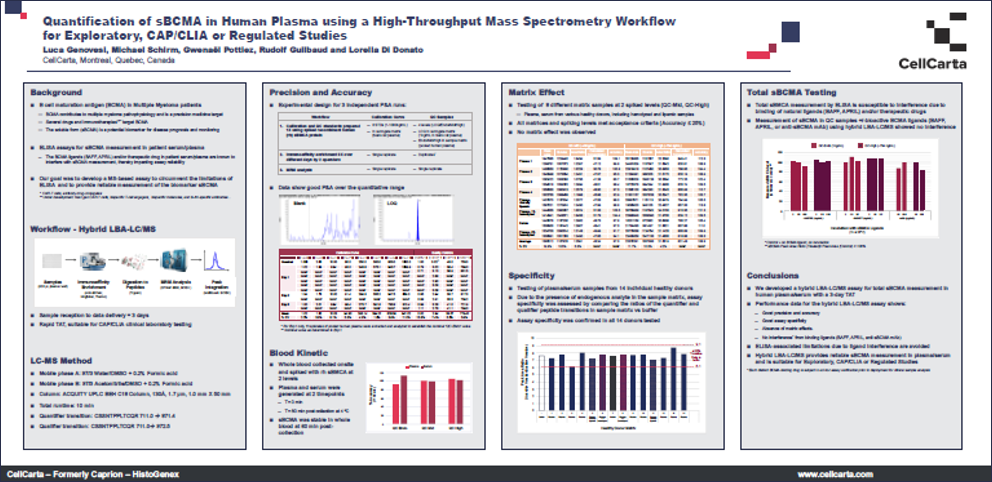
CellCarta’s poster presents a high-throughput hybrid immunoaffinity LC-MRM based method for quantifying soluble BCMA (sBCMA) in human plasma.

The study demonstrates that sBCMA, a marker for multiple myeloma, can be precisely measured using this method, which overcomes interferences from ligands and therapeutic antibodies. The assay shows high sensitivity, a broad linear range, and robustness against interferences, making it suitable for clinical studies and monitoring treatment response in multiple myeloma patients

Quantification of sBCMA in Human Plasma using a High-ThroughputHybrid IP-MRM Based Mass Spectrometry Workflow, As presented at ASMS 2022
sBCMA Plasma Quantification via Hybrid Mass Spectrometry

July 27, 2021

CellCarta’s poster presents a high-throughput hybrid immunoaffinity LC-MRM based method for quantifying soluble BCMA (sBCMA) in human plasma.

The study demonstrates that sBCMA, a marker for multiple myeloma, can be precisely measured using this method, which overcomes interferences from ligands and therapeutic antibodies. The assay shows high sensitivity, a broad linear range, and robustness against interferences, making it suitable for clinical studies and monitoring treatment response in multiple myeloma patients

Quantification of sBCMA in Human Plasma using a High-ThroughputHybrid IP-MRM Based Mass Spectrometry Workflow, As presented at ASMS 2022

Proteomics: MRM Assays for HER2 in FFPE Tissues

November 9, 2020

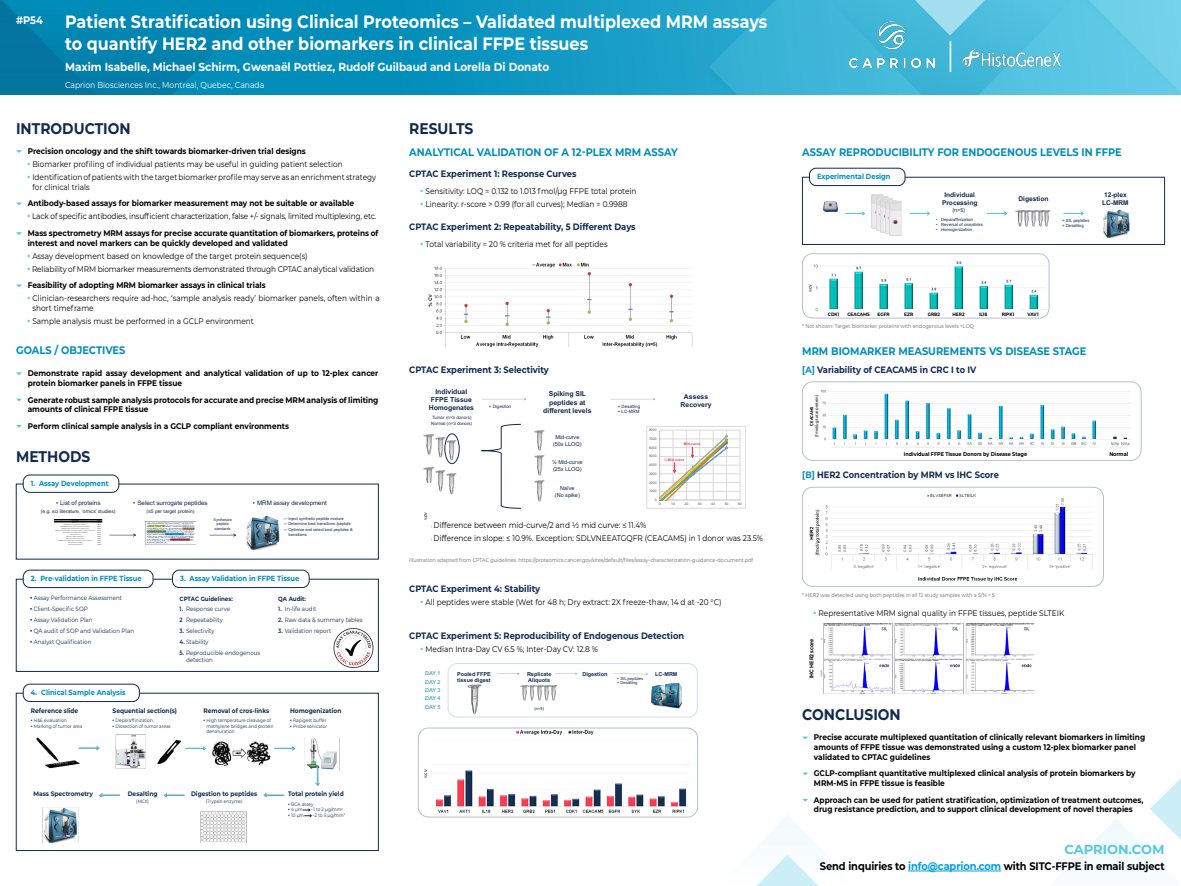
CellCarta’s poster highlights the development and validation of multiplexed MRM assays for precise quantitation of clinically relevant biomarkers in FFPE tissue.

The study demonstrates the feasibility of using these assays for clinical proteomics, supporting patient stratification, treatment optimization, and drug resistance prediction. The 12-plex biomarker panel includes key proteins such as HER2, EGFR, and CEACAM5, validated to CPTAC guidelines.

The approach is suitable for GCLP-compliant quantitative clinical analysis, providing robust and reliable biomarker measurements to aid in the clinical development of novel therapies.

Patient Stratification using Clinical Proteomics – Validated multiplexed MRM assays to quantify HER2 and other biomarkers in clinical FFPE tissues,

As presented in SITC 2020
Capion_Poster_SITC_FFPE

Proteomics: MRM Assays for HER2 in FFPE Tissues

November 9, 2020

CellCarta’s poster highlights the development and validation of multiplexed MRM assays for precise quantitation of clinically relevant biomarkers in FFPE tissue.

The study demonstrates the feasibility of using these assays for clinical proteomics, supporting patient stratification, treatment optimization, and drug resistance prediction. The 12-plex biomarker panel includes key proteins such as HER2, EGFR, and CEACAM5, validated to CPTAC guidelines.

The approach is suitable for GCLP-compliant quantitative clinical analysis, providing robust and reliable biomarker measurements to aid in the clinical development of novel therapies.

Patient Stratification using Clinical Proteomics – Validated multiplexed MRM assays to quantify HER2 and other biomarkers in clinical FFPE tissues,

As presented in SITC 2020
Capion_Poster_SITC_FFPE