Analyzing CITE-seq data like an immunologist with a hybrid hierarchical gating approach in CellEngine software
October 29, 2024
Matt Clutter
October 29, 2024
Matt Clutter
October 29, 2024
Matt Clutter
October 11, 2024
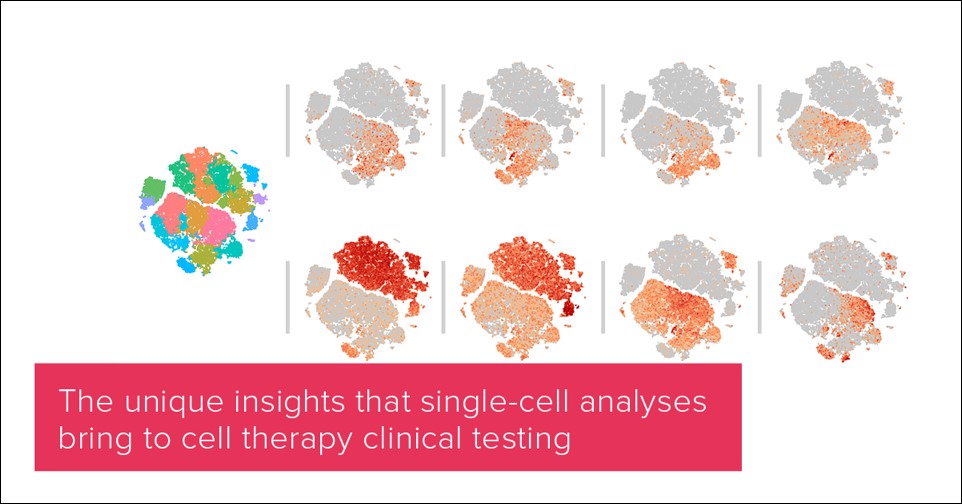
The landscape of cell therapy targets and approaches is rapidly expanding and diversifying. As a result, clinical testing is evolving. Testing programs must characterize increasingly complex and varied cell products in a quest to usher novel treatments from development through clinical approval.
Our Cell Therapy Trends Report explores this adaptation to accurately evaluate next-generation cell therapies while meeting budget and time constraints. With sights on emerging methods, it describes the notable role of single-cell analysis in unlocking efficacy and adverse events prediction. Here, we describe the recent progression of single-cell analyses and why they are needed to advance cell therapies.
For 400 years, since the birth of the microscope, scientists have been studying the behavior of individual cells to understand how organisms function. In recent years, technology for single-cell analysis has exploded.
Fluorescence microscopy was pioneered in 1904, flow-based coulter counting in 1954, and fluorescent flow cytometry in 1968. While just two fluorescent dyes were available in the 1970s, by the early 2000s dozens of dyes enabled measurement of 20 proteins per cell over millions of cells.
The next two decades brought mass cytometry, followed by spectral flow cytometry, expanding to 40+ proteins per cell. With the debut of single-cell RNA sequencing in 2009 and CITE-seq in 2017, 1000s of transcripts alongside 100+ proteins can now be measured in each cell of a biological sample.
As single-cell analysis has advanced, human biology has proven ever more complex. Many groups are developing comprehensive single-cell atlases, which have defined 100s of different cell types across diverse tissues and diseases. Within each cell type, an array of dynamic cellular states are exhibited as cells respond to events like infection, injury, or drug treatment. This ever-growing appreciation of just how heterogeneous human biology is has made high plex single-cell analysis critical for understanding human health.
As a living drug product, cell therapies are intrinsically more heterogeneous than conventional small molecules and biologics. The starting material used to manufacture a cell therapy product varies from person to person with age, genetic background, lifestyle, comorbidities, and pathogen exposure history.
Immune cells – both before and after their transformation into a cell product – can now be characterized in detail at the single-cell level, not with bulk methods that average heterogeneity and obscure rare subpopulations. Such data can help pinpoint specific immune features to use as predictive biomarkers of therapeutic efficacy or toxicity.
Additionally, next-generation cell therapies increasingly contain multiple engineered components, each with a mode of action designed to improve the overall therapeutic index. The multiplexed, multi-omic nature of today’s single-cell techniques allows each component to be characterized and linked to clinical outcomes.
With various single-cell techniques at your disposal, the pressing question is how to use them efficiently. Measurements are highly specialized and costly. Deep data analysis is time-consuming. The following are a few steps to optimally use single-cell analyses in the evaluation of cell therapies:
Our Cell Therapy Trends Report delves deeper into the developments we anticipate in single-cell analysis and how it fits into a broader program for cell therapy clinical testing. Download the full report or speak to our team about your cell therapy.
About the Author:

Matt Clutter (PhD) is the Global Director of CellCarta’s R&D group. With a strong background in the discovery and translational immunology space, Matt has powered innovation in our flow and mass cytometry assays and data analysis approaches. With his expertise in single-cell analysis, he guides our customers in finding the best solution to their immunology questions.
October 11, 2024
The landscape of cell therapy targets and approaches is rapidly expanding and diversifying. As a result, clinical testing is evolving. Testing programs must characterize increasingly complex and varied cell products in a quest to usher novel treatments from development through clinical approval.
Our Cell Therapy Trends Report explores this adaptation to accurately evaluate next-generation cell therapies while meeting budget and time constraints. With sights on emerging methods, it describes the notable role of single-cell analysis in unlocking efficacy and adverse events prediction. Here, we describe the recent progression of single-cell analyses and why they are needed to advance cell therapies.
For 400 years, since the birth of the microscope, scientists have been studying the behavior of individual cells to understand how organisms function. In recent years, technology for single-cell analysis has exploded.
Fluorescence microscopy was pioneered in 1904, flow-based coulter counting in 1954, and fluorescent flow cytometry in 1968. While just two fluorescent dyes were available in the 1970s, by the early 2000s dozens of dyes enabled measurement of 20 proteins per cell over millions of cells.
The next two decades brought mass cytometry, followed by spectral flow cytometry, expanding to 40+ proteins per cell. With the debut of single-cell RNA sequencing in 2009 and CITE-seq in 2017, 1000s of transcripts alongside 100+ proteins can now be measured in each cell of a biological sample.
As single-cell analysis has advanced, human biology has proven ever more complex. Many groups are developing comprehensive single-cell atlases, which have defined 100s of different cell types across diverse tissues and diseases. Within each cell type, an array of dynamic cellular states are exhibited as cells respond to events like infection, injury, or drug treatment. This ever-growing appreciation of just how heterogeneous human biology is has made high plex single-cell analysis critical for understanding human health.
As a living drug product, cell therapies are intrinsically more heterogeneous than conventional small molecules and biologics. The starting material used to manufacture a cell therapy product varies from person to person with age, genetic background, lifestyle, comorbidities, and pathogen exposure history.
Immune cells – both before and after their transformation into a cell product – can now be characterized in detail at the single-cell level, not with bulk methods that average heterogeneity and obscure rare subpopulations. Such data can help pinpoint specific immune features to use as predictive biomarkers of therapeutic efficacy or toxicity.
Additionally, next-generation cell therapies increasingly contain multiple engineered components, each with a mode of action designed to improve the overall therapeutic index. The multiplexed, multi-omic nature of today’s single-cell techniques allows each component to be characterized and linked to clinical outcomes.
With various single-cell techniques at your disposal, the pressing question is how to use them efficiently. Measurements are highly specialized and costly. Deep data analysis is time-consuming. The following are a few steps to optimally use single-cell analyses in the evaluation of cell therapies:
Our Cell Therapy Trends Report delves deeper into the developments we anticipate in single-cell analysis and how it fits into a broader program for cell therapy clinical testing. Download the full report or speak to our team about your cell therapy.
About the Author:
Matt Clutter (PhD) is the Global Director of CellCarta’s R&D group. With a strong background in the discovery and translational immunology space, Matt has powered innovation in our flow and mass cytometry assays and data analysis approaches. With his expertise in single-cell analysis, he guides our customers in finding the best solution to their immunology questions.
July 23, 2024

As cell therapies grow in number, diversity, and complexity, clinical testing programs are seeking new ways to comprehensively characterize candidates while accelerating development — no easy task.
Advances in clinical testing are especially evident in several key areas across the cell therapy space, as detailed in our Cell Therapy Trends Report. At a glance, these areas comprise B-cell aplasia, cytokine profiling, cell enumeration and vector copy number determination, single-cell analytics, and — the focus of this post — human leucocyte antigen (HLA) typing.
All are hugely valuable areas of clinical testing. Together, they paint a fuller picture of cell therapy action and efficacy, helping new, diversified therapies advance within this ever-changing landscape.
Our HLA genes code for cell surface proteins that identify which cells belong in the body and which do not, helping identify and raise the alarm towards a foreign cell or invading pathogen. For organ, blood, tissue or stem cell transplantation, it is crucial that both donor and recipient possess closely matching HLA markers to reduce the chances of a transplant being rejected or triggering an immune response. Donor-recipient compatibility is ascertained via HLA typing assays.
However, HLA typing assays have evolved and widened in scope since they were first developed and validated for this purpose. Newer techniques offer a finer degree of detail thanks to next-generation sequencing (NGS). Unlike other sequencing methods, NGS can more readily define whether HLAs originate from the same or opposite chromosome (cis or trans, respectively), leading to more accurate typing with less ambiguity.
Such in-depth HLA profiling stands to advance the clinical assessment of cancer-targeting cell therapies based on T-cell receptors (TCRs). It can reveal more about how the immune system interacts with cancer cells, enabling the development of new and more tailored immunotherapies to treat various cancers more effectively.
HLA profiling also holds promise in the assessment of patients in clinical trials. Trial participants can be stratified by HLA profile to ensure that an engineered TCR is the right fit for a given HLA-peptide complex, in turn making it more likely that a therapy will achieve its desired effect and progress smoothly to approval.
Cell therapies are becoming more diverse, complex, and numerous. We are seeing new biomarkers, mechanisms, agents, constructs, and targets in emerging therapies, all of which require an expansion in testing strategies for comprehensive yet rapid characterization.
In this ever-changing landscape, HLA typing assays must be adapted if they are to effectively support clinical testing and trials, and become relevant for broader therapy evaluation. Assays must become more efficient and adaptable, and innovation must keep pace with the shifting regulatory environment.
Overall, HLA typing assays will need to be:
In the future, we anticipate that novel therapies will emerge faster than they can be evaluated by existing clinical testing programs. To address this, therapy developers are considering how to leverage both new and existing approaches to HLA profiling to achieve optimal results efficiently.
Download CellCarta’s full Cell Therapy Trends Report to dig deeper into what the changing cell therapy landscape means for HLA typing and other areas of clinical testing, or contact our team to speak to an expert about your cell therapy clinical testing needs.
About the author:

Nathalie Bernard (PhD) is the scientific business director for the Genomic Services unit within CellCarta. Her background is in molecular biology, and she has many years of experience in PCR and sequencing, technologies used to discover or identify DNA and RNA biomarkers of clinical utility. At CellCarta, Nathalie is using her expertise to guide our customers in finding the best solution to their genomic questions.
July 23, 2024
As cell therapies grow in number, diversity, and complexity, clinical testing programs are seeking new ways to comprehensively characterize candidates while accelerating development — no easy task.
Advances in clinical testing are especially evident in several key areas across the cell therapy space, as detailed in our Cell Therapy Trends Report. At a glance, these areas comprise B-cell aplasia, cytokine profiling, cell enumeration and vector copy number determination, single-cell analytics, and — the focus of this post — human leucocyte antigen (HLA) typing.
All are hugely valuable areas of clinical testing. Together, they paint a fuller picture of cell therapy action and efficacy, helping new, diversified therapies advance within this ever-changing landscape.
Our HLA genes code for cell surface proteins that identify which cells belong in the body and which do not, helping identify and raise the alarm towards a foreign cell or invading pathogen. For organ, blood, tissue or stem cell transplantation, it is crucial that both donor and recipient possess closely matching HLA markers to reduce the chances of a transplant being rejected or triggering an immune response. Donor-recipient compatibility is ascertained via HLA typing assays.
However, HLA typing assays have evolved and widened in scope since they were first developed and validated for this purpose. Newer techniques offer a finer degree of detail thanks to next-generation sequencing (NGS). Unlike other sequencing methods, NGS can more readily define whether HLAs originate from the same or opposite chromosome (cis or trans, respectively), leading to more accurate typing with less ambiguity.
Such in-depth HLA profiling stands to advance the clinical assessment of cancer-targeting cell therapies based on T-cell receptors (TCRs). It can reveal more about how the immune system interacts with cancer cells, enabling the development of new and more tailored immunotherapies to treat various cancers more effectively.
HLA profiling also holds promise in the assessment of patients in clinical trials. Trial participants can be stratified by HLA profile to ensure that an engineered TCR is the right fit for a given HLA-peptide complex, in turn making it more likely that a therapy will achieve its desired effect and progress smoothly to approval.
Cell therapies are becoming more diverse, complex, and numerous. We are seeing new biomarkers, mechanisms, agents, constructs, and targets in emerging therapies, all of which require an expansion in testing strategies for comprehensive yet rapid characterization.
In this ever-changing landscape, HLA typing assays must be adapted if they are to effectively support clinical testing and trials, and become relevant for broader therapy evaluation. Assays must become more efficient and adaptable, and innovation must keep pace with the shifting regulatory environment.
Overall, HLA typing assays will need to be:
In the future, we anticipate that novel therapies will emerge faster than they can be evaluated by existing clinical testing programs. To address this, therapy developers are considering how to leverage both new and existing approaches to HLA profiling to achieve optimal results efficiently.
Download CellCarta’s full Cell Therapy Trends Report to dig deeper into what the changing cell therapy landscape means for HLA typing and other areas of clinical testing, or contact our team to speak to an expert about your cell therapy clinical testing needs.
About the author:
Nathalie Bernard (PhD) is the scientific business director for the Genomic Services unit within CellCarta. Her background is in molecular biology, and she has many years of experience in PCR and sequencing, technologies used to discover or identify DNA and RNA biomarkers of clinical utility. At CellCarta, Nathalie is using her expertise to guide our customers in finding the best solution to their genomic questions.
May 4, 2024
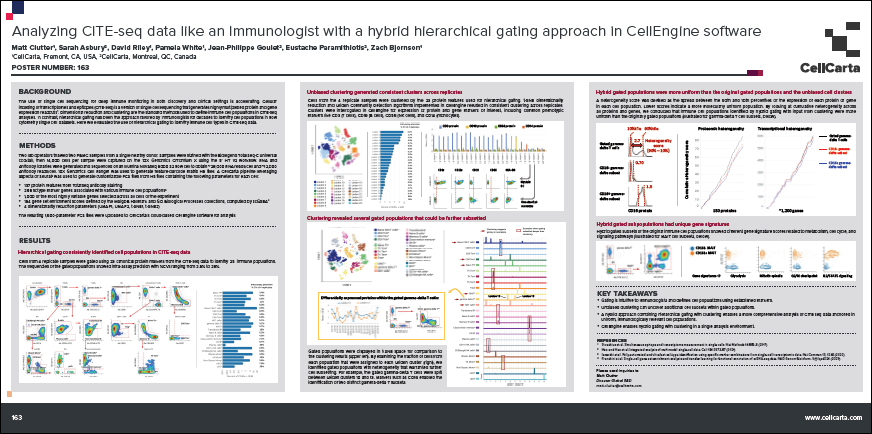
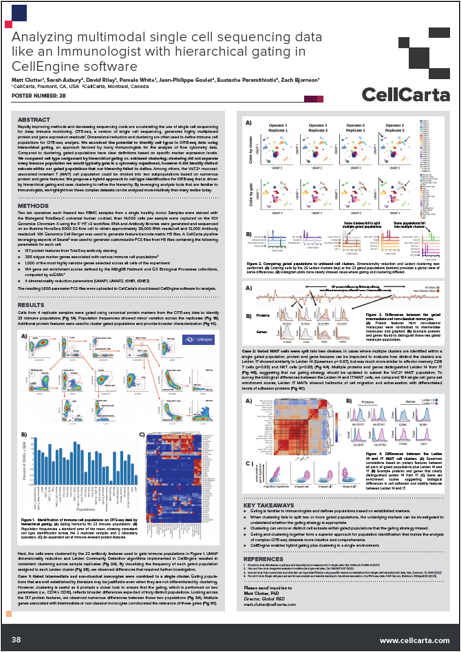
CellCarta’s poster details the analysis of multimodal single cell sequencing data using CellEngine software.
The study leverages CITE-seq, a technique that combines protein and gene expression analysis, to investigate immune cell populations. By comparing hierarchical gating—a method familiar to immunologists—with unbiased clustering, the research identifies clear definitions based on marker expression levels. The hybrid approach of using both gating and clustering enhances the identification and characterization of cell types, providing a more intuitive analysis of complex datasets.
The study specifically examines populations such as MAIT cells, highlighting differences in gene and protein expression to refine gating strategies.
View the full poster:
May 4, 2024
CellCarta’s poster details the analysis of multimodal single cell sequencing data using CellEngine software.
The study leverages CITE-seq, a technique that combines protein and gene expression analysis, to investigate immune cell populations. By comparing hierarchical gating—a method familiar to immunologists—with unbiased clustering, the research identifies clear definitions based on marker expression levels. The hybrid approach of using both gating and clustering enhances the identification and characterization of cell types, providing a more intuitive analysis of complex datasets.
The study specifically examines populations such as MAIT cells, highlighting differences in gene and protein expression to refine gating strategies.
View the full poster:
April 8, 2024
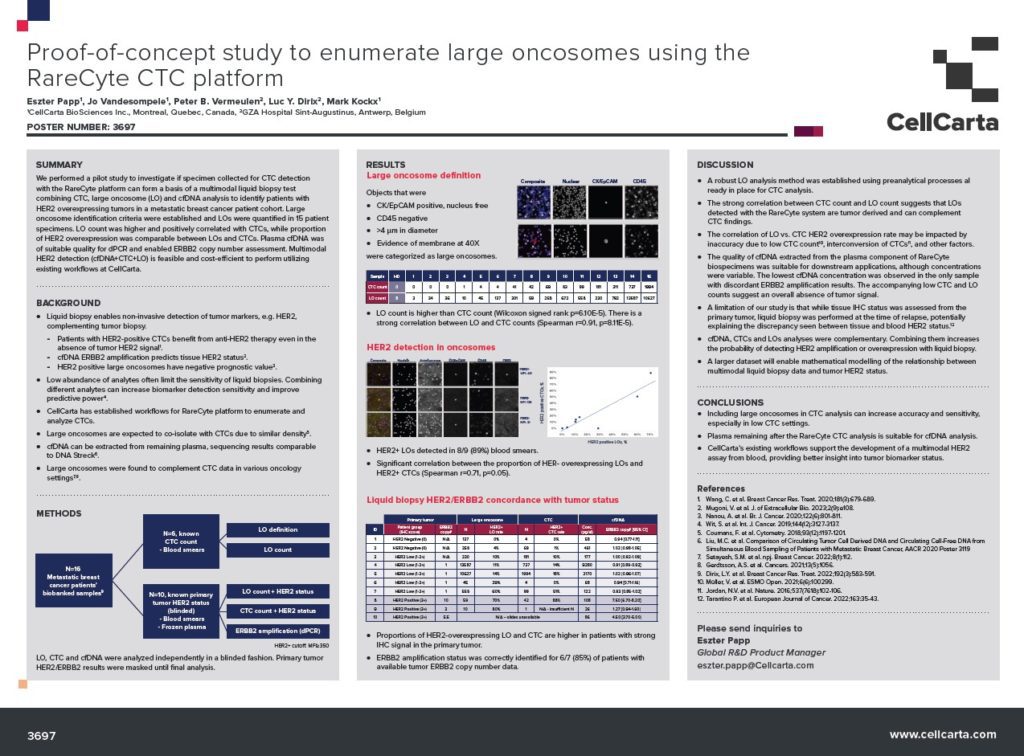
CellCarta’s proof-of-concept study utilizes the RareCyte CTC platform to enumerate large oncosomes (LOs) in patients with HER2 overexpressing tumors.
The study demonstrates that combining circulating tumor cells (CTCs), LOs, and circulating cell-free DNA (cfDNA) in a multimodal liquid biopsy analysis enhances the detection and monitoring of HER2 amplification in metastatic breast cancer.
The results showed a strong correlation between LO count and CTC count, and the combined analysis improved the accuracy of HER2 status assessment. This approach offers a cost-efficient and non-invasive method to monitor tumor biomarkers, providing valuable insights into tumor progression and treatment response.
View the poster:
Proof-of-concept study to enumerate large oncosomes using the RareCyte CTC platform
April 8, 2024
CellCarta’s proof-of-concept study utilizes the RareCyte CTC platform to enumerate large oncosomes (LOs) in patients with HER2 overexpressing tumors.
The study demonstrates that combining circulating tumor cells (CTCs), LOs, and circulating cell-free DNA (cfDNA) in a multimodal liquid biopsy analysis enhances the detection and monitoring of HER2 amplification in metastatic breast cancer.
The results showed a strong correlation between LO count and CTC count, and the combined analysis improved the accuracy of HER2 status assessment. This approach offers a cost-efficient and non-invasive method to monitor tumor biomarkers, providing valuable insights into tumor progression and treatment response.
View the poster:
Proof-of-concept study to enumerate large oncosomes using the RareCyte CTC platform