PD-L1 IHC and Digital Pathology: Insights and Future Directions

December 19, 2023
PD-L1 IHC & Digital Pathology: BluePrint & Beyond

HOW IT STARTED

In October 2017, The BluePrint Phase 2 (BP2) committee presented to the International Association for the Study of Lung Cancer (IASLC) 18th World Conference on Lung Cancer. Together, they presented the data from the comparison of five PD-L1 immunohistochemistry (IHC) assays, that each utilize a different PD-L1 antibody clone: 22C3, 28-8, SP142, SP263, and 73-10. The data was published in the Journal of Thoracic Oncology.1 The goal was to validate the BP1 results using real-world clinical lung cancer samples.

The IHC staining for this BP2 comparison was performed in CellCarta’s CAP-accredited laboratory in Belgium. The company was then known as HistoGeneX. Whole slide images (WSIs) were prepared for the study and the scans were uploaded to PathoTrainer™.

Characteristics of PD-L1 Assays: Staining Performance
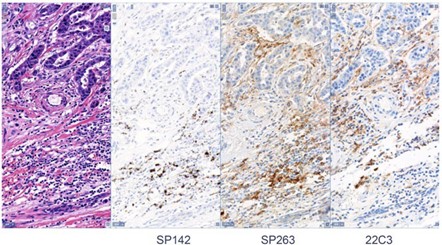
IHC PD-L1 stainings

This software allowed for on-site and remote pathologist training in PD-L1 scoring, since the study also aimed to assess WSI analysis by a pathologist versus traditional light  microscopic  analysis.  Mark Kockx, MD, PhD, a pathologist and founder of CellCarta HistoGeneX, participated in the study as a trainer and in slide scoring. Ultimately, the study confirmed the reliability of PD-L1 scoring of digital images. Since BP2 was published, the number of PD-1/L1 monoclonal antibody clinical trials has exploded.

The Cancer Research Institute created a dashboard of active interventional trials, with PD-1/-L1 agents and targets used in combo therapy trials. The graphs paint a colorful picture of the clinical trial landscape back in 2017 and again in 2021. In every category the number of clinical trials has increased. Pembrolizumab trials grew from 557 in 2017 to 1,481 in 2021, and the “Other PDx” category grew from 90 trials in 2017 to 1,631 in 2021.2 CRI counted 5,683 interventional trials as of December 2021.

HOW IT’S GOING

Let’s fast forward now to the end of 2023.

CellCarta is performing PD-L1 IHC in Phase III trials more than any other biomarker, with all of the commercially available clones. PathoTrainer™ is still regularly used at CellCarta for in person and remote pathologist training,  since it is an ideal tool for collaboration and for pathologist proficiency testing.

Scoring of PD-L1 is performed by trained pathologists for all established scoring algorithms including tumor proportion score (TPS), combined positive score (CPS), and tumor-infiltrating immune cell (IC) staining assessments. The turn- around time for this testing is as short as 3 business days.

As of 2022, CellCarta participated in more than 40 companion diagnostic (CDx) studies totaling over 70,000 slides. These numbers continue to increase.

There have also been many changes and advances in the field of digital pathology since BP2 was published. The outbreak of SARS-CoV-2 created a public health emergency that accelerated the need for policies to help reduce exposure of healthcare personnel. One way to do  this was to expand the availability of remote digital pathology devices. CAP updated the original 2013 WSI guidelines in 2021 and these were published in The Archives of Pathology & Laboratory Medicine.3

The 2023 IASCL World Conference on Lung Cancer was in Singapore in September. Dr. Ming-Sound Tsao who is the globally recognized leader in molecular testing in lung cancer, and the lead author of the BP2 study, presented.

WHAT’S NEXT?

CellCarta has grown and evolved since BP2. Our compliant digital pathology-based workflows are now in use in our newer labs in the United States and China. Our  global team of pathologists has grown to nearly 30. More companies are testing combination regimens like Antibody Drug Conjugates with Immunotherapy and Chemotherapy. As this field of drug development evolves, CellCarta will continue to provide leadership, and participate in the industry’s most significant targeted and immunotherapy biomarker programs.


About the author:

author photo

Sharron Webster, BS, MS, HTL(ASCP) is a Scientific Business Director for the Histopathology Services unit within CellCarta. As an ASCP certified histotechnologist, she has 20+ years of experience in histopathology laboratories, with a focus on immunohistochemistry development and validation. At CellCarta, Shar is using her expertise to help our clients find the best scientific and technical solutions for FFPE tissue and CTC analyses.

References & Additional Reading:

  1. PD-L1 Immunohistochemistry Comparability Study in Real-Life
    Clinical Samples: Results of Blueprint Phase 2 Project (jto.org)
  2. 2019-09 PD-1/L1 trial landscape dashboard | Tableau Public
  3. Validating Whole Slide Imaging Systems for Diagnostic
    Purposes in Pathology | Archives of Pathology & Laboratory
    Medicine (allenpress.com)

PD-L1 IHC and Digital Pathology: Insights and Future Directions

December 19, 2023

PD-L1 IHC & Digital Pathology: BluePrint & Beyond

HOW IT STARTED

In October 2017, The BluePrint Phase 2 (BP2) committee presented to the International Association for the Study of Lung Cancer (IASLC) 18th World Conference on Lung Cancer. Together, they presented the data from the comparison of five PD-L1 immunohistochemistry (IHC) assays, that each utilize a different PD-L1 antibody clone: 22C3, 28-8, SP142, SP263, and 73-10. The data was published in the Journal of Thoracic Oncology.1 The goal was to validate the BP1 results using real-world clinical lung cancer samples.

The IHC staining for this BP2 comparison was performed in CellCarta’s CAP-accredited laboratory in Belgium. The company was then known as HistoGeneX. Whole slide images (WSIs) were prepared for the study and the scans were uploaded to PathoTrainer™.

Characteristics of PD-L1 Assays: Staining Performance

IHC PD-L1 stainings

This software allowed for on-site and remote pathologist training in PD-L1 scoring, since the study also aimed to assess WSI analysis by a pathologist versus traditional light  microscopic  analysis.  Mark Kockx, MD, PhD, a pathologist and founder of CellCarta HistoGeneX, participated in the study as a trainer and in slide scoring. Ultimately, the study confirmed the reliability of PD-L1 scoring of digital images. Since BP2 was published, the number of PD-1/L1 monoclonal antibody clinical trials has exploded.

The Cancer Research Institute created a dashboard of active interventional trials, with PD-1/-L1 agents and targets used in combo therapy trials. The graphs paint a colorful picture of the clinical trial landscape back in 2017 and again in 2021. In every category the number of clinical trials has increased. Pembrolizumab trials grew from 557 in 2017 to 1,481 in 2021, and the “Other PDx” category grew from 90 trials in 2017 to 1,631 in 2021.2 CRI counted 5,683 interventional trials as of December 2021.

HOW IT’S GOING

Let’s fast forward now to the end of 2023.

CellCarta is performing PD-L1 IHC in Phase III trials more than any other biomarker, with all of the commercially available clones. PathoTrainer™ is still regularly used at CellCarta for in person and remote pathologist training,  since it is an ideal tool for collaboration and for pathologist proficiency testing.

Scoring of PD-L1 is performed by trained pathologists for all established scoring algorithms including tumor proportion score (TPS), combined positive score (CPS), and tumor-infiltrating immune cell (IC) staining assessments. The turn- around time for this testing is as short as 3 business days.

As of 2022, CellCarta participated in more than 40 companion diagnostic (CDx) studies totaling over 70,000 slides. These numbers continue to increase.

There have also been many changes and advances in the field of digital pathology since BP2 was published. The outbreak of SARS-CoV-2 created a public health emergency that accelerated the need for policies to help reduce exposure of healthcare personnel. One way to do  this was to expand the availability of remote digital pathology devices. CAP updated the original 2013 WSI guidelines in 2021 and these were published in The Archives of Pathology & Laboratory Medicine.3

The 2023 IASCL World Conference on Lung Cancer was in Singapore in September. Dr. Ming-Sound Tsao who is the globally recognized leader in molecular testing in lung cancer, and the lead author of the BP2 study, presented.

WHAT’S NEXT?

CellCarta has grown and evolved since BP2. Our compliant digital pathology-based workflows are now in use in our newer labs in the United States and China. Our  global team of pathologists has grown to nearly 30. More companies are testing combination regimens like Antibody Drug Conjugates with Immunotherapy and Chemotherapy. As this field of drug development evolves, CellCarta will continue to provide leadership, and participate in the industry’s most significant targeted and immunotherapy biomarker programs.


About the author:

author photo

Sharron Webster, BS, MS, HTL(ASCP) is a Scientific Business Director for the Histopathology Services unit within CellCarta. As an ASCP certified histotechnologist, she has 20+ years of experience in histopathology laboratories, with a focus on immunohistochemistry development and validation. At CellCarta, Shar is using her expertise to help our clients find the best scientific and technical solutions for FFPE tissue and CTC analyses.

References & Additional Reading:

  1. PD-L1 Immunohistochemistry Comparability Study in Real-Life
    Clinical Samples: Results of Blueprint Phase 2 Project (jto.org)
  2. 2019-09 PD-1/L1 trial landscape dashboard | Tableau Public
  3. Validating Whole Slide Imaging Systems for Diagnostic
    Purposes in Pathology | Archives of Pathology & Laboratory
    Medicine (allenpress.com)

Comprehensive Histology and Pathology Services by CellCarta

November 22, 2022

Explore Our Advanced Histopathology Laboratories!

As a leading contract research organization (CRO), we offer a wide array of histopathology services.

Our histopathology facilities have trained in-house pathologists and multiple platforms to partner with you and provide integrated solutions for your specific clinical trial needs.

We deliver preclinical and clinical histology support to pharmaceutical and biotech sponsors worldwide.

Discover how CellCarta advances histopathology research and services.

We offer testing services for all phases of clinical trials including:

As a CAP/CLIA-certified CRO Lab, we support clinical studies for diagnostic and pharmaceutical partners in preparation for FDA, EU, and other global submissions.

Our digital pathology services and AI powered workflows provide scalable solutions for high-throughput histology testing across disease areas.

Histology CRO and Pathology CRO Services

Building on our comprehensive services, CellCarta’s Histology CRO capabilities extend to custom assay development and validation, supporting a wide range of clinical and research applications. 

Our expert team provides histology support for CROs, offering tailored solutions to meet the specific requirements of each study. This includes detailed consultation on sample preparation, staining protocols, and data interpretation.

We offers both off-the-shelf and customized  routine and advanced digital histology services, with an expert team ensuring reproducibility, scalability, and regulatory readiness.

Advanced Molecular and Digital Pathology Services

In addition to our core services, we provide advanced molecular pathology services, including in situ hybridization (ISH) and fluorescence in situ hybridization (FISH). 

These techniques enable the detection of specific biomarkers and genetic materials within tissue samples, aiding in the identification and characterization of diseases.

Our digital pathology platforms, featuring whole slide imaging and automated image analysis, allows for accurate, reproducible data generation and efficient workflow management.

Collaborations and Software Solutions

We collaborate with industry leaders to enhance our service offerings and stay at the forefront of histopathology innovations. 

Our histopathology software, including advanced AI-driven platforms, streamline data analysis and provide deeper insights into your samples.

This integration of cutting-edge technology ensures that our clients receive the most reliable and insightful data possible, ensuring CellCarta provides top CRO pathology services for your oncology, immunology, and biomarker programs regardless of disease area.

Quality Assurance and Global Compliance

Our commitment to quality goes beyond our technical capabilities. As a CAP/CLIA certified lab, we adhere to stringent quality control measures and global standards. 

This ensures that our data and analyses are robust, reproducible, and ready for regulatory submissions worldwide, including FDA and EU approvals. 

Our comprehensive quality assurance program includes regular proficiency testing and adherence to best practices in laboratory operations.

Why Choose CellCarta?

CellCarta offers unparalleled expertise in histopathology CRO services, making us a trusted partner for pharmaceutical companies and research institutions.

Whether you require IHC CRO services, digital pathology support, or full-service histopathology assay development, our team is equipped to deliver high-quality data.

Our comprehensive range of services, from routine histology to advanced molecular analyses, combined with our commitment to quality and innovation, ensures that we deliver accurate, high-quality data tailored to your specific needs.

Comprehensive Histology and Pathology Services by CellCarta

November 22, 2022

Explore Our Advanced Histopathology Laboratories!

As a leading contract research organization (CRO), we offer a wide array of histopathology services.

Our histopathology facilities have trained in-house pathologists and multiple platforms to partner with you and provide integrated solutions for your specific clinical trial needs.

We deliver preclinical and clinical histology support to pharmaceutical and biotech sponsors worldwide.

Discover how CellCarta advances histopathology research and services.

We offer testing services for all phases of clinical trials including:

As a CAP/CLIA-certified CRO Lab, we support clinical studies for diagnostic and pharmaceutical partners in preparation for FDA, EU, and other global submissions.

Our digital pathology services and AI powered workflows provide scalable solutions for high-throughput histology testing across disease areas.

Histology CRO and Pathology CRO Services

Building on our comprehensive services, CellCarta’s Histology CRO capabilities extend to custom assay development and validation, supporting a wide range of clinical and research applications. 

Our expert team provides histology support for CROs, offering tailored solutions to meet the specific requirements of each study. This includes detailed consultation on sample preparation, staining protocols, and data interpretation.

We offers both off-the-shelf and customized  routine and advanced digital histology services, with an expert team ensuring reproducibility, scalability, and regulatory readiness.

Advanced Molecular and Digital Pathology Services

In addition to our core services, we provide advanced molecular pathology services, including in situ hybridization (ISH) and fluorescence in situ hybridization (FISH). 

These techniques enable the detection of specific biomarkers and genetic materials within tissue samples, aiding in the identification and characterization of diseases.

Our digital pathology platforms, featuring whole slide imaging and automated image analysis, allows for accurate, reproducible data generation and efficient workflow management.

Collaborations and Software Solutions

We collaborate with industry leaders to enhance our service offerings and stay at the forefront of histopathology innovations. 

Our histopathology software, including advanced AI-driven platforms, streamline data analysis and provide deeper insights into your samples.

This integration of cutting-edge technology ensures that our clients receive the most reliable and insightful data possible, ensuring CellCarta provides top CRO pathology services for your oncology, immunology, and biomarker programs regardless of disease area.

Quality Assurance and Global Compliance

Our commitment to quality goes beyond our technical capabilities. As a CAP/CLIA certified lab, we adhere to stringent quality control measures and global standards. 

This ensures that our data and analyses are robust, reproducible, and ready for regulatory submissions worldwide, including FDA and EU approvals. 

Our comprehensive quality assurance program includes regular proficiency testing and adherence to best practices in laboratory operations.

Why Choose CellCarta?

CellCarta offers unparalleled expertise in histopathology CRO services, making us a trusted partner for pharmaceutical companies and research institutions.

Whether you require IHC CRO services, digital pathology support, or full-service histopathology assay development, our team is equipped to deliver high-quality data.

Our comprehensive range of services, from routine histology to advanced molecular analyses, combined with our commitment to quality and innovation, ensures that we deliver accurate, high-quality data tailored to your specific needs.

CellCarta Naperville Lab | Genomic and Histopathology Services

October 12, 2022

Step Into Our Naperville Facility!

In 2022, we proudly announced the grand opening of our Naperville, Chicago location!

Our new facility is only 30 minutes from the Chicago O’Hare airport and encompasses over 3,000m2 (29,283 sq ft) of innovative scientific equipment and highly trained staff.

As part of CellCarta’s global CRO infrastructure, this lab strengthens our clinical trial support capabilities across North America.

Join us for a tour and see how CellCarta is dedicated to advancing scientific research.

At Naperville, we offer testing services for all phases of clinical trials. As a CRO with multiomics capabilities, we support:

Genomics

Our Naperville facility is designed to provide comprehensive testing services across various phases of clinical trials. Our advanced genomic capabilities include-

  • RT-PCR

These techniques are essential for precise genetic analysis and biomarker discovery, aiding in the development of targeted therapies and personalized medicine.

We support both preclinical and clinical studies across oncology and immunology, as well as specialized therapeutic development such as ADC programs.

Histopathology

In addition to our robust genomic services, we offer state-of-the-art histopathology services.

  • Software platforms include: Indica Labs’ HALO®, Visiopharm®,  Akoya’s inForm®, CyteHub®, SoloWeb, and navify® by Roche.

As a CAP/CLIA certified lab, we support clinical studies for diagnostic and pharmaceutical partners in preparation for FDA, EU and other global submissions.

Our histology CRO services are integrated into our multiomic CRO offerings, enabling scalable analysis pipelines for high-volume biomarker testing across platforms and therapeutic areas.

We support both preclinical and clinical studies across oncology, immunology, and more, with specialized support for ADC development programs.

Commitment to Quality and Compliance

As a CAP accredited and CLIA certified laboratory, we adhere to the highest standards of quality and compliance.

Our rigorous quality control measures ensure the reliability and accuracy of our data, supporting clinical studies for regulatory submissions worldwide, including FDA and EU approvals.

Our quality management system (QMS) drives harmonization of specific testing services and related activities and is implemented at all levels of the organization.

Strategic Location and Accessibility

Located just 30 minutes from Chicago O’Hare airport, our Naperville facility is easily accessible for local and international clients. The facility spans over 3,000m² (29,283 sq ft) and is equipped with the latest scientific equipment, operated by a team of highly trained professionals dedicated to advancing scientific research.

Why Choose CellCarta?

CellCarta is committed to delivering high-quality, reliable data through our extensive range of testing services and advanced technologies. Our new Naperville facility exemplifies our dedication to supporting clinical trials and research initiatives with state-of-the-art resources and expert staff.

As a global CRO, our Naperville site provides key clinical trial services in genomics, histopathology, and biomarker programs.

Backed by our expert scientific teams and cutting-edge platforms, we help biopharma clients accelerate drug development with data they can trust.

CellCarta Naperville Lab | Genomic and Histopathology Services

October 12, 2022

Step Into Our Naperville Facility!

In 2022, we proudly announced the grand opening of our Naperville, Chicago location!

Our new facility is only 30 minutes from the Chicago O’Hare airport and encompasses over 3,000m2 (29,283 sq ft) of innovative scientific equipment and highly trained staff.

As part of CellCarta’s global CRO infrastructure, this lab strengthens our clinical trial support capabilities across North America.

Join us for a tour and see how CellCarta is dedicated to advancing scientific research.

At Naperville, we offer testing services for all phases of clinical trials. As a CRO with multiomics capabilities, we support:

Genomics

Our Naperville facility is designed to provide comprehensive testing services across various phases of clinical trials. Our advanced genomic capabilities include-

  • RT-PCR

These techniques are essential for precise genetic analysis and biomarker discovery, aiding in the development of targeted therapies and personalized medicine.

We support both preclinical and clinical studies across oncology and immunology, as well as specialized therapeutic development such as ADC programs.

Histopathology

In addition to our robust genomic services, we offer state-of-the-art histopathology services.

  • Software platforms include: Indica Labs’ HALO®, Visiopharm®,  Akoya’s inForm®, CyteHub®, SoloWeb, and navify® by Roche.

As a CAP/CLIA certified lab, we support clinical studies for diagnostic and pharmaceutical partners in preparation for FDA, EU and other global submissions.

Our histology CRO services are integrated into our multiomic CRO offerings, enabling scalable analysis pipelines for high-volume biomarker testing across platforms and therapeutic areas.

We support both preclinical and clinical studies across oncology, immunology, and more, with specialized support for ADC development programs.

Commitment to Quality and Compliance

As a CAP accredited and CLIA certified laboratory, we adhere to the highest standards of quality and compliance.

Our rigorous quality control measures ensure the reliability and accuracy of our data, supporting clinical studies for regulatory submissions worldwide, including FDA and EU approvals.

Our quality management system (QMS) drives harmonization of specific testing services and related activities and is implemented at all levels of the organization.

Strategic Location and Accessibility

Located just 30 minutes from Chicago O’Hare airport, our Naperville facility is easily accessible for local and international clients. The facility spans over 3,000m² (29,283 sq ft) and is equipped with the latest scientific equipment, operated by a team of highly trained professionals dedicated to advancing scientific research.

Why Choose CellCarta?

CellCarta is committed to delivering high-quality, reliable data through our extensive range of testing services and advanced technologies. Our new Naperville facility exemplifies our dedication to supporting clinical trials and research initiatives with state-of-the-art resources and expert staff.

As a global CRO, our Naperville site provides key clinical trial services in genomics, histopathology, and biomarker programs.

Backed by our expert scientific teams and cutting-edge platforms, we help biopharma clients accelerate drug development with data they can trust.

HER2-Low Breast Cancer: New Insights from Enhertu Clinical Trials

June 23, 2022

CellTalk_HER2-MRM

Recent results presented during the keynote address at the 2022 American Society of Clinical Oncology (ASCO) annual meeting highlighted the emergence of a new era for breast cancer treatment. The landmark study on the HER2-directed therapy, Enhertu, found that patients with HER2-negative breast cancer may soon have the opportunity to receive this new treatment based on exceptional outcomes in a Phase 3 clinical trial.

In this pivotal trial, patients with HER2-low metastatic breast cancer treated with Enhertu had a 49% lower risk of disease progression or death vs. patients treated with chemotherapy alone.1, 2 In most subgroups the progression free survival (PFS) was nearly doubled in the Enhertu arm vs. chemotherapy. HER2-positive tumors are routinely identified by pathologists using a combination of immunohistochemistry (IHC) tests and in situ hybridization (ISH). However, the trial results clearly demonstrated that  HER2-low tumors (HER 1+ and 2+) also need clear identification, especially since they are more difficult to distinguish from HER2-negative with traditional methods. 2

Meeting the need for a more quantitative methodology

The Enhertu trial has identified a clear unmet need for more quantitative methodologies for HER2 detection, specifically the ability to distinguish low HER2, and potentially even “ultra low-HER2”, expressing populations, who will likely benefit from Enhertu treatment, from those that are truly negative.

To overcome the challenges of antibody-based IHC in detecting HER2-low metastatic breast cancer, CellCarta has developed a precision measurement approach leveraging mass spectrometry based Multiple Reaction Monitoring (MRM). The MRM platform has exceptional sensitivity, specificity, and quantitative precision to measure protein analytes, providing one of the most specific assays for protein measurement.

When it comes to measuring HER2, CellCarta has demonstrated that MRM can provide valuable information to quantitatively characterize HER2 expression in a patient’s tumor biopsy. Our method has the potential to improve patient selection and ultimately expand the population of patients who will likely benefit from novel therapies such as Enhertu.

Exceptional specificity for detection of single or multiplexed cancer protein biomarkers

MRM offers absolute quantification and even provides accurate multiplexed quantitation of clinically relevant biomarkers such as HER2. CellCarta offers off-the-shelf multiplexed panels, including our MRM assay for HER2, or rapid development and validation of custom assays, depending on your study needs. We design and validate multiplexes of cancer protein biomarker panels of up to 15 proteins. All of our assays are validated for clinical use under CAP/CLIA and GCLP environments.


About the author:

author photo

Nick Dupuis is a Senior Director of Scientific Business Development at CellCarta, specialized in proteomics and biophysical measurement. He has held various roles in industry including as a scientist in LDT/IVD product and applications development, and business development for emerging analytical platforms.

References

  1. Modi S, Jacot W, Yamashita T, et al. Trastuzumab Deruxtecan in Previously Treated HER2-Low Advanced Breast Cancer. NEJM 2022;doi:10.1056/NEJMoa2203690.
  2. Liu A. Fierce Biotech. ASCO: HER2 diagnostics need a revolution as AstraZeneca, Daiichi’s Enhertu looks to redefine breast cancer. June 13, 2022. https://www.fiercebiotech.com/medtech/asco-her2-diagnostics-need-revolution-astrazeneca-daiichis-enhertu-looks-redefine-breast

HER2-Low Breast Cancer: New Insights from Enhertu Clinical Trials

June 23, 2022

CellTalk_HER2-MRM

Recent results presented during the keynote address at the 2022 American Society of Clinical Oncology (ASCO) annual meeting highlighted the emergence of a new era for breast cancer treatment. The landmark study on the HER2-directed therapy, Enhertu, found that patients with HER2-negative breast cancer may soon have the opportunity to receive this new treatment based on exceptional outcomes in a Phase 3 clinical trial.

In this pivotal trial, patients with HER2-low metastatic breast cancer treated with Enhertu had a 49% lower risk of disease progression or death vs. patients treated with chemotherapy alone.1, 2 In most subgroups the progression free survival (PFS) was nearly doubled in the Enhertu arm vs. chemotherapy. HER2-positive tumors are routinely identified by pathologists using a combination of immunohistochemistry (IHC) tests and in situ hybridization (ISH). However, the trial results clearly demonstrated that  HER2-low tumors (HER 1+ and 2+) also need clear identification, especially since they are more difficult to distinguish from HER2-negative with traditional methods. 2

Meeting the need for a more quantitative methodology

The Enhertu trial has identified a clear unmet need for more quantitative methodologies for HER2 detection, specifically the ability to distinguish low HER2, and potentially even “ultra low-HER2”, expressing populations, who will likely benefit from Enhertu treatment, from those that are truly negative.

To overcome the challenges of antibody-based IHC in detecting HER2-low metastatic breast cancer, CellCarta has developed a precision measurement approach leveraging mass spectrometry based Multiple Reaction Monitoring (MRM). The MRM platform has exceptional sensitivity, specificity, and quantitative precision to measure protein analytes, providing one of the most specific assays for protein measurement.

When it comes to measuring HER2, CellCarta has demonstrated that MRM can provide valuable information to quantitatively characterize HER2 expression in a patient’s tumor biopsy. Our method has the potential to improve patient selection and ultimately expand the population of patients who will likely benefit from novel therapies such as Enhertu.

Exceptional specificity for detection of single or multiplexed cancer protein biomarkers

MRM offers absolute quantification and even provides accurate multiplexed quantitation of clinically relevant biomarkers such as HER2. CellCarta offers off-the-shelf multiplexed panels, including our MRM assay for HER2, or rapid development and validation of custom assays, depending on your study needs. We design and validate multiplexes of cancer protein biomarker panels of up to 15 proteins. All of our assays are validated for clinical use under CAP/CLIA and GCLP environments.


About the author:

author photo

Nick Dupuis is a Senior Director of Scientific Business Development at CellCarta, specialized in proteomics and biophysical measurement. He has held various roles in industry including as a scientist in LDT/IVD product and applications development, and business development for emerging analytical platforms.

References

  1. Modi S, Jacot W, Yamashita T, et al. Trastuzumab Deruxtecan in Previously Treated HER2-Low Advanced Breast Cancer. NEJM 2022;doi:10.1056/NEJMoa2203690.
  2. Liu A. Fierce Biotech. ASCO: HER2 diagnostics need a revolution as AstraZeneca, Daiichi’s Enhertu looks to redefine breast cancer. June 13, 2022. https://www.fiercebiotech.com/medtech/asco-her2-diagnostics-need-revolution-astrazeneca-daiichis-enhertu-looks-redefine-breast

Chromogenic Multiplex IHC Assay

May 26, 2021

mIHC white paper

Key topics discussed:

Download the resource

Why Choose CellCarta for your Histopathology Assays

We perform tissue analysis for biomarkers, clinical testing, and companion diagnostics using cutting-edge technologies and capabilities such as multiplex IHC and RareCyte. By supporting our team of in-house pathologists with AI we transform tissue biology into actionable data.

Contact us

Chromogenic Multiplex IHC Assay

May 26, 2021

mIHC white paper

Key topics discussed:

Download the resource

Why Choose CellCarta for your Histopathology Assays

We perform tissue analysis for biomarkers, clinical testing, and companion diagnostics using cutting-edge technologies and capabilities such as multiplex IHC and RareCyte. By supporting our team of in-house pathologists with AI we transform tissue biology into actionable data.

Contact us