June 30, 2026

Cytokine profiling can be an immensely valuable tool for understanding immune mechanisms and treatment response in autoimmune drug development. But translating that potential into reliable, interpretable data can be challenging.
Key targets such as IL-2 and IL-6 circulate at very low levels, assay platforms differ widely in what they can detect and at what scale, and the right approach depends on where a sponsor is in their therapeutic development journey. Knowing which technology is right for your target, your sample type, and your stage of development is what separates useful data from missed signals.
To explore what that looks like in practice, we spoke with Mirzo Kanoatov, Scientific Team leader at CellCarta. In this Q&A, he walks through how cytokine profiling is applied in autoimmune drug development and what sponsors should consider when building their strategy.
Where does cytokine profiling fit in an autoimmune development program?
Cytokine profiling can play a role at almost every stage of an autoimmune program, though what you are looking for, and how you use the data, changes as development progresses.
In early clinical phases, it provides insight into the temporal dynamics of immune cell activation, such as how quickly different cytokines rise and fall, which pathways are engaging, and whether there are early signs of adverse immune activity. These kinds of readouts, particularly when combined with complementary assays such as cell enumeration and phenotyping, can also inform decisions around optimal dosing, supplementing data from the maximum tolerable dose approach. As a program advances, these profiling data sets can guide better strategies for patient stratification, while continuing to support safety and efficacy assessments.
What role does cytokine profiling play in interpreting complex immune events, such as immune overactivation or cytokine release syndrome?
When an unexpected immune event occurs, the key question is where in the immune system it came from. Cytokine profiling is a very useful tool for distinguishing between the different sources.
Innate immune triggers tend to be reflected in rapid elevation of cytokines such as IL-6, TNF-α, and IL-1β. Adaptive immune activity, on the other hand, is more typically associated with elevation of IFN-γ and IL-2, which reflect T cell activation and expansion. By characterizing this cytokine signature across time points, researchers can piece together the sequence of immune activation that led to the event.
Retrospective analysis of samples using multiplex cytokine panels can help distinguish whether events are driven by innate or adaptive immune cascades, supporting assessment of whether they are related to the investigational therapy or reflect an unrelated event. Such information can inform risk management in subsequent cohorts and guide the design of future programs.
How do you ensure you’re using the right assay for your trial? In what situations would a high-plex or custom cytokine panel be particularly useful in autoimmune trials?
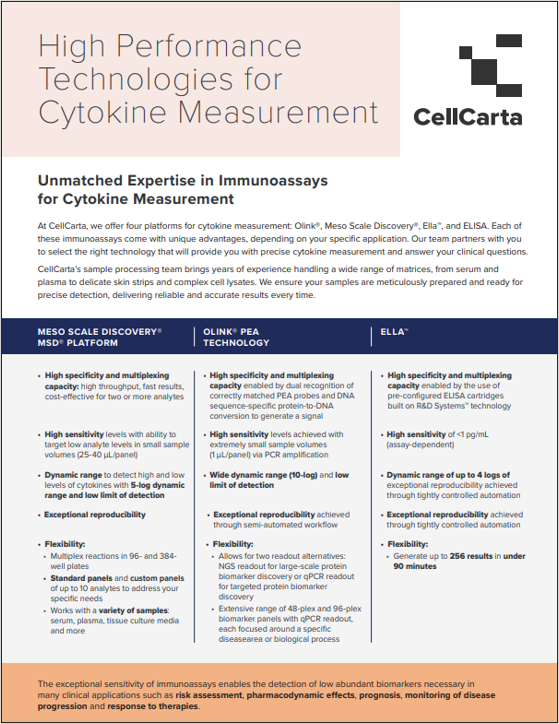
High-plex panels are most valuable when the biological landscape is not yet fully defined. In early-stage autoimmune studies, you can’t predict with confidence which immune pathways your therapy will engage. A broad, high-plex approach, such as Olink PEA technology, allows hundreds of proteins to be measured simultaneously, letting the data surface relevant pathways. That exploratory view is useful for hypothesis generation and for identifying which cytokines will be most informative in later studies.
Custom panels add further flexibility. Where standard commercial options do not include all the analytes of interest, or where prior research points to a specific combination of cytokines relevant to the mechanism being studied, a custom panel allows the study to be designed precisely around the scientific question.
As a program matures and the most informative cytokines become established, the approach typically narrows. More targeted, quantitative platforms, such as MSD, offer the reproducibility and dynamic range needed for formal analytical validation, supporting the regulatory requirements of late-phase studies.
That progression, from broad early exploration to focused late-stage measurement, is the most rational way to build a cytokine profiling strategy across a development program.
| Platform | Best for | Strengths | Main limitations |
|---|---|---|---|
| Olink | Broad discovery, low sample volume, pathway level profiling | Very high multiplexing, small input volume, good specificity, useful for pattern discovery | Usually relative quantification, less direct absolute concentration reporting, can miss some very low abundance analytes depending on panel/matrix |
| ELISA | Validation of a few cytokines | High specificity, familiar, often easier for absolute quantification | Low plex, more sample volume per analyte, inefficient for broad profiling |
| MSD | Sensitive multiplexing, low abundance cytokines, translational work | Strong sensitivity, good dynamic range, good for absolute quantification, useful for biomarker work | Lower plex than Olink, higher cost/complexity than ELISA |
| Ella | Fast, automated single or low plex quantification | Easy workflow, strong reproducibility, good for targeted validation | Not a discovery platform; limited plex compared with Olink/MSD |
Table 1: Overview of cytokine profiling platforms and their key strengths and limitations
Overall, what would you say are the key things sponsors should keep in mind when designing a cytokine profiling strategy for autoimmune trials?
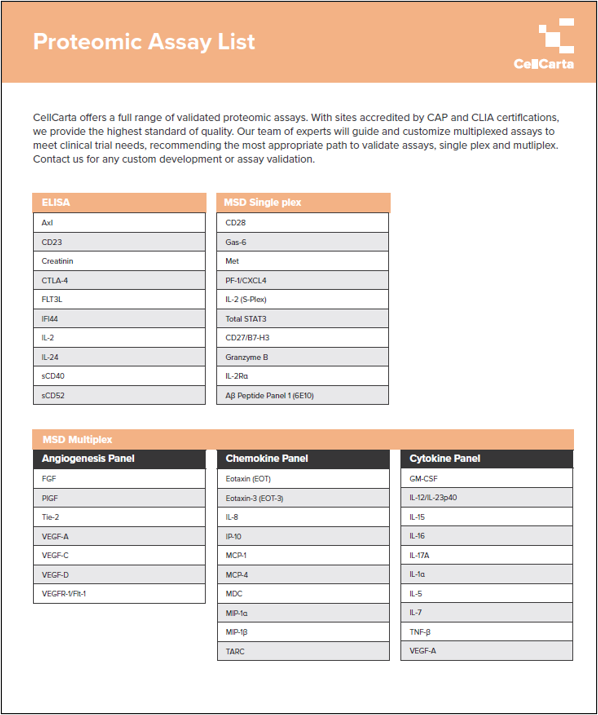
Get the sensitivity right first. It sounds basic, but this can be where profiling strategies most often fall short. For example, cytokines such as IL-2 and IL-4 circulate at very low levels in peripheral blood. For these targets, standard ELISA platforms are often insufficient. Electrochemiluminescent platforms such as MSD, and specifically S-PLEX MSD assays, can extend the sensitivity floor significantly, making it possible to reliably quantify targets that would otherwise fall below the limit of detection. Getting that right requires platform expertise and careful assay optimization.
Sample type is another critical factor. Different matrices—blood, serum, plasma, urine, cerebrospinal fluid, saliva, tissue, stimulated and unstimulated cells—carry different background levels and interfering substances that affect assay performance. Technical and interpretive challenges vary substantially between sample types, so having access to validated workflows across all of these matrices means sponsors are not constrained by their sample collection strategy.
After that, let your stage of development guide your platform choice, and think carefully about your sample type from the outset. Careful consideration of target sensitivity, development stage, and matrix are what a well-designed cytokine profiling strategy is built on.
Comprehensive cytokine profiling for your autoimmune programs
CellCarta offers integrated cytokine profiling solutions, backed by decades of expertise, across platforms and sample types, tailored to the stage and goals of your program.
- MSD & S-PLEX MSD: ultra-sensitive, multiplex electrochemiluminescent detection for low-abundance targets including IL-2 and IL-6.
- Olink PEA Technology: high-plex protein profiling, including custom panels, for broad exploratory studies.
- Ella™: automated, high-throughput ELISA multiplexing for focused panels at scale.
- Broad sample type expertise: validated workflows across blood, serum, plasma, urine, CSF, saliva, tissue, and stimulated/unstimulated cells.
About the author:

Mirzo Kanoatov is a Scientific Group Leader at CellCarta, where he works with sponsors, scientists, and data analysts to ensure that each project’s bioanalytical testing needs are met. His team also ensures that the analytical design, assay design, and platform selection generate the appropriate data to support the regulatory requirements of sponsors’ programs. He supplemented his PhD in bioanalytical chemistry with a post-doctoral fellowship , where he focused on translating novel biomarker assay platforms from exploratory research methods into robust tools suitable for clinical application.