Complete cell therapy services across all clinical stages, backed by more than 25 years of experience in custom development and analysis.

Having supported over 150 cell therapy programs with key pharmaceutical partners in cell therapy, we understand the analytical challenges that arise at every stage and how to address them before they slow your program down.
All cell therapy services are delivered across our globally accredited and owned facilities operating under harmonized quality systems, with dedicated sample logistics services to keep everything running smoothly.

CellCarta's Chief Scientific Business Officer Christopher Ung sits down with Dr. Carl June, a leading figure in CAR T-cell therapy, to discuss the development, challenges, and future of immunotherapy, including an in-depth conversation on developing immuno- and CAR T-cell therapies.
Confirm how your therapeutic construct is behaving in the body with our comprehensive range of assay technologies, including:
Limit toxicity and improve treatment efficacy by ensuring proper patient selection. Our scientists can help improve patient stratification, performing:
Obtain the data needed for therapy approval with CellCarta’s safety assessment capabilities, including:
Track patient response over time with a complete, longitudinal picture of therapy action, including:
Understand the full pharmacokinetic and pharmacodynamic profile of your drug product with integrated cellular kinetics workflows across molecular, cellular, and imaging methods, including:
Confirm how your therapeutic construct is behaving in the body with our comprehensive range of assay technologies, including:
Limit toxicity and improve treatment efficacy by ensuring proper patient selection. Our scientists can help improve patient stratification, performing:
Obtain the data needed for therapy approval with CellCarta’s safety assessment capabilities, including:
Track patient response over time with a complete, longitudinal picture of therapy action, including:
Understand the full pharmacokinetic and pharmacodynamic profile of your drug product with integrated cellular kinetics workflows across molecular, cellular, and imaging methods, including:

Protect the integrity of every sample and keep your cell therapy program on track with our meticulous global sample handling, transport, and storage services. With over 25 years of experience and more than 60 countries supported, our team ensures your program moves forward without logistical delays.
Scientific depth and global infrastructure built around the distinct demands of cell therapy development.
Cross-Platform Capabilities
Customized Solutions
Highest Quality Standards
Vast Biomarker Targets
AI-Supported Analysis
Access high-parameter flow cytometry services built for the complex phenotyping demands of clinical cell therapy programs.

Validated platforms and specialized immunology expertise for key biological insights.

Proven and emerging molecular platforms for clinical sample analysis and reporting.


Cell therapy product characterization typically combines molecular, cellular, and functional readouts. Vector copy number is quantified using dPCR or qPCR to confirm transduction efficiency and lot consistency. Replication-competent retrovirus/lentivirus (RCR/RCL) monitoring is required throughout development to confirm safety of viral-vector-based products.
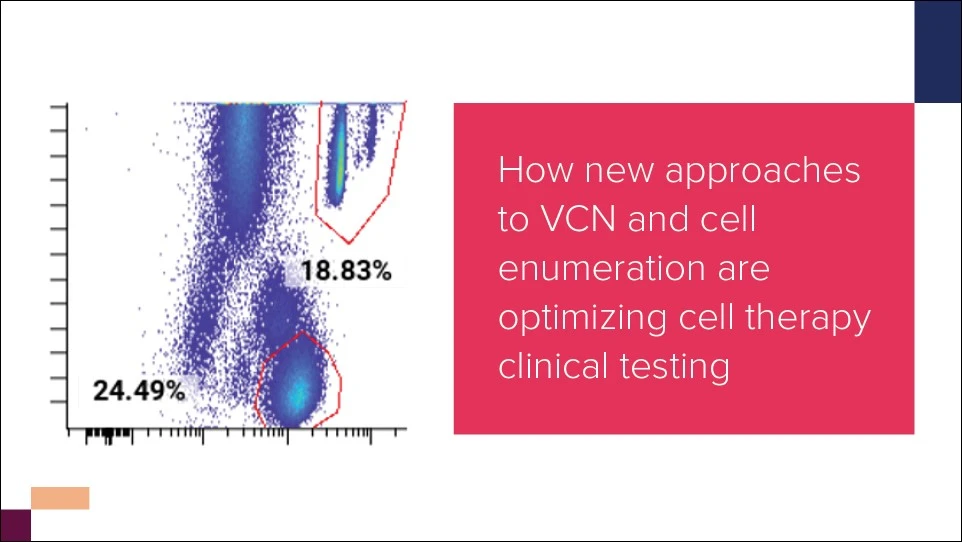
Cell enumeration by flow cytometry determines absolute cell counts, while high-parameter phenotyping characterizes memory and effector subsets, as well as activation and exhaustion markers. Single-cell sequencing adds transcriptional depth and immune repertoire analysis where modular characterization is needed. CellCarta integrates all four modalities under one harmonized quality management system for multi-site trials.
Cytokine release syndrome (CRS), immune effector cell-associated neurotoxicity (ICANS), and macrophage activation syndrome (MAS) are monitored through validated multiplex cytokine panels, typically IL-6, IL-10, IFN-γ, TNF-α, ferritin, and additional inflammatory markers, alongside immune cell phenotyping by flow cytometry.
Platform choice (MSD®, Olink®, ELISA) depends on required sensitivity, multiplex breadth, and sample volume. Serial sampling enables early detection and severity grading. CellCarta supports CRS, ICANS, and MAS monitoring across multiplex immunoassay platforms and flow cytometry.
Early phase cell therapy programs emphasize exploratory product characterization, dose-finding, and broad biomarker profiling to identify mechanisms and responder signatures. As programs advance, assays must be qualified or formally validated for their intended regulatory use, vector copy number and cellular kinetics workflows lock as primary or key secondary endpoints, and CRS/ICANS monitoring follows defined regulatory-grade protocols. Multi-region harmonization and submission-ready data become critical. CellCarta supports cell therapy programs from discovery through commercialization across our eight globally owned and integrated facilities.
Cell therapy development requires an integrated analytical package spanning five domains: product characterization (vector copy number by dPCR/qPCR, replication-competent virus monitoring, phenotyping by flow cytometry, single-cell sequencing), patient selection (HLA typing, target expression profiling, lymphodepletion and immune-exhaustion assessment), safety assessment (cytokine profiling for CRS/ICANS, immunogenicity), efficacy (immune profiling, tumour burden via ctDNA and circulating tumor cells, soluble target monitoring), and drug product monitoring (cellular kinetics by flow cytometry, tissue infiltration by multiplex imaging). CellCarta delivers all five domains under one harmonized CRO.
Cellular kinetics in cell therapy trials is most commonly monitored using dPCR or qPCR to quantify vector copy number in patient blood (analogous to pharmacokinetics for biologics), next-generation sequencing (NGS) to assess the T-cell repertoire, and high-parameter flow cytometry to enumerate CAR-positive cells in the periphery, characterize their persistence, and assess phenotypic evolution (memory, effector, exhaustion).
Tissue infiltration of CAR-T cells can be assessed by IHC, providing spatial resolution within the tumor microenvironment. Together, these readouts inform dose-response, persistence, durability, and mechanism of response or failure. CellCarta delivers integrated cellular kinetics workflows across flow cytometry, dPCR/qPCR, and tissue imaging.