Sensitive and robust assessments of the frequency of cytokine-secreting cells at the single-cell level.
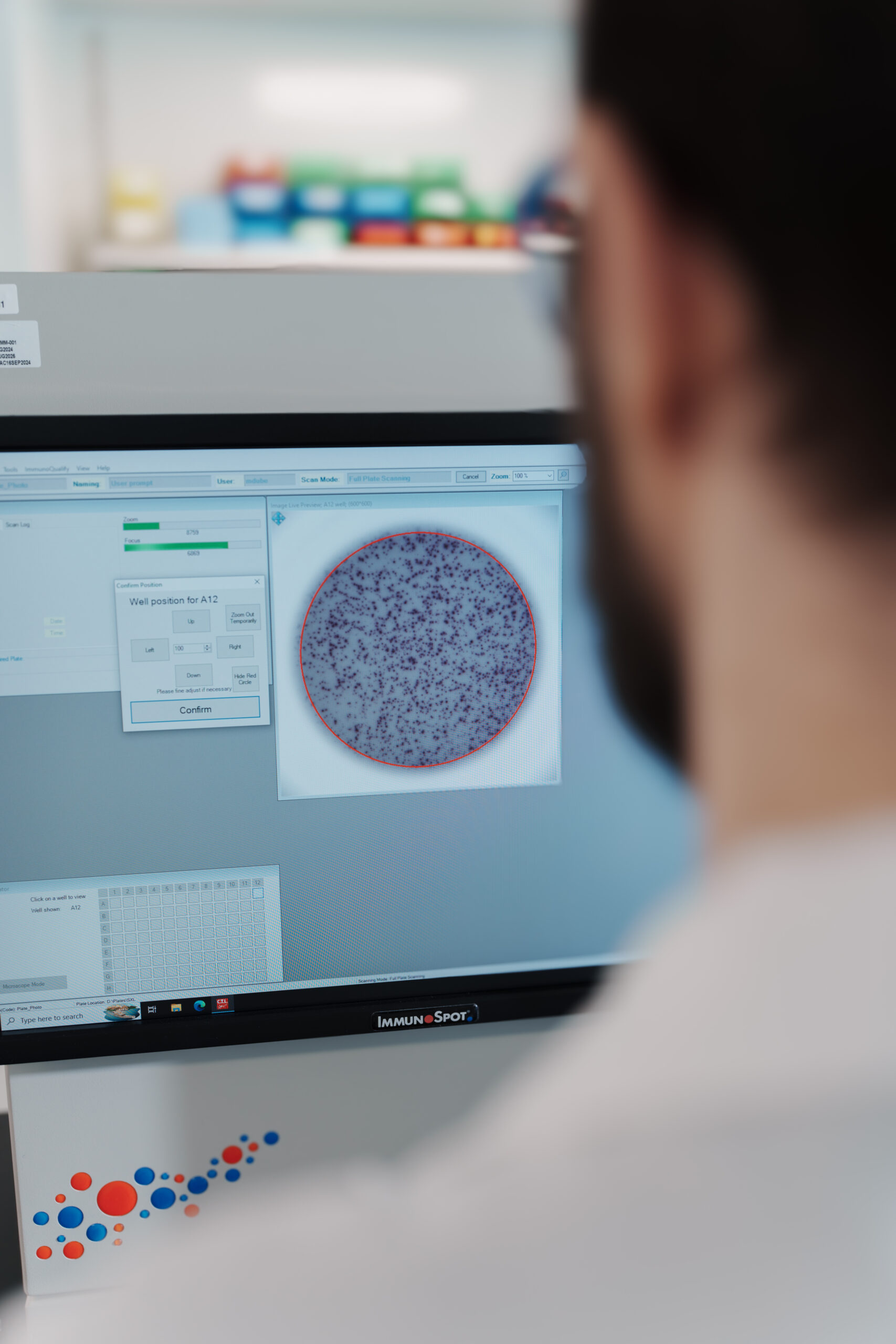
Our team has expertise in FluoroSpot and ELISpot (Enzyme-Linked Immunosorbent Spot) for PBMCs, and the customization and validation of their assays for exploratory, primary, and secondary clinical endpoints.
The robust sensitivity of our FluoroSpot and ELISpot tests makes it an excellent addition for a variety of therapeutic programs. Their clinical applications are vast, including characterization of pre-existing immune responses, vaccine immunogenicity monitoring, and immunotherapy assessment.
ELISpot and FluoroSpot provides a highly sensitive count of functional antigen-specific responses at the single-cell level.
These assays require only a small number of cells, allows for multiple stimulations, and involves minimal cell manipulations — no fixation or permeabilization required.
ELISpot uses enzymatic action to measure the secretion of a single cytokine, uncovering critical information about cell-mediated immunity. All resulting SFU counts are standardized using the ImmunoSpot® S6 Universal analyzer.
For example, CellCarta can easily monitor memory T cell responses using a fit-for-purpose ELISpot test for IFNγ detection. This assay is readily available for exploratory use and can be validated for secondary and primary endpoints.
FluoroSpot uses fluorophore-labeled antibodies for one-step direct detection, enabling simultaneous analysis of multiple analytes in a single well.
Not only does this technology allows users to identify cells producing each analyte individually, but it can also detect cells co-producing analytes simultaneously.
We have validated several multiplex FluoroSpot assays for use, including:
CellCarta's scientists can customize both ELISpot and FluoroSpot assays according to the antigen stimulation selected and cell type investigated.
Our customization workflow follows a well-established validation process designed to produce optimized, reproducible assays. Whether your study calls for singleplex or multiplex design, our team adapts to your protocol rather than fitting your program to some standard template.
ELISpot and FluoroSpot provides a highly sensitive count of functional antigen-specific responses at the single-cell level.
These assays require only a small number of cells, allows for multiple stimulations, and involves minimal cell manipulations — no fixation or permeabilization required.

ELISpot uses enzymatic action to measure the secretion of a single cytokine, uncovering critical information about cell-mediated immunity. All resulting SFU counts are standardized using the ImmunoSpot® S6 Universal analyzer.
For example, CellCarta can easily monitor memory T cell responses using a fit-for-purpose ELISpot test for IFNγ detection. This assay is readily available for exploratory use and can be validated for secondary and primary endpoints.
FluoroSpot uses fluorophore-labeled antibodies for one-step direct detection, enabling simultaneous analysis of multiple analytes in a single well.
Not only does this technology allows users to identify cells producing each analyte individually, but it can also detect cells co-producing analytes simultaneously.
We have validated several multiplex FluoroSpot assays for use, including:
CellCarta's scientists can customize both ELISpot and FluoroSpot assays according to the antigen stimulation selected and cell type investigated.
Our customization workflow follows a well-established validation process designed to produce optimized, reproducible assays. Whether your study calls for singleplex or multiplex design, our team adapts to your protocol rather than fitting your program to some standard template.

Knowing when to use ELISpot versus ICS to evaluate immune response, particularly for T cells, can be tricky. Our scientists outline key considerations for both assays that serve to optimize your immune monitoring workflow based on your study’s specifications.
CellCarta’s FluoroSpot and ELISpot tests can support vaccine immunogenicity monitoring, epitope mapping, HLA-restricted response detection, B and T cell responses, dendritic cell co-culture models, and selected cell population analysis across cancer, infectious disease, and autoimmune programs.

Leading assays to measure cytokine secretion and immune response.
Superior Sensitivity
Multiplex Capabilities
Easy Clinical Integration
Custom Assay Development
Immune Biomarker Expertise
FluoroSpot and ELISpot integrate with CellCarta’s immunoassay and cellular immune monitoring services to support a complete biomarker program.
Generate up to 256 results in under 90 minutes with automated benchtop ELISA multiplexing.

Measure up to ten analytes in each plate well using serum or plasma samples as small as 25 μL.

Multiplex assays for immune response monitoring across the clinical trial continuum.


ELISpot (Enzyme-Linked Immunosorbent Spot) is an immunoassay that measures the frequency of antigen-specific cytokine-secreting cells at the single-cell level. It builds on familiar immunoassay principles and is characterized by its high sensitivity. The assay requires a small number of cells, allows for multiple stimulations, and avoids the need for fixation or permeabilization, which simplifies the workflow and preserves cell function. Notably, ELISpot is a singleplex assay, meaning one cytokine can be analyzed per run.
FluoroSpot detects analyte-secreting cells using antibodies labeled with fluorophores rather than enzymes, which results in a one-step direct detection method compared to ELISpot’s two-step system. The key practical advantage of FluoroSpot is its ability to analyze multiple analytes in a single well, identifying cells producing each analyte individually as well as those producing both analytes simultaneously. This makes FluoroSpot well-suited to programs that require simultaneous cytokine profiling.
Yes. CellCarta's team customizes both FluoroSpot and ELISpot tests according to the antigen stimulation selected and the cell type being investigated. The customization process follows a well-established validation framework, resulting in assays optimized to each sponsor's specific study design. Scientists have extensive experience developing assays for exploratory, secondary, and primary endpoint use in clinical trials.
FluoroSpot and ELISpot tests support a broad range of clinical applications, including monitoring the immunogenicity of vaccines, cell therapies, and immune-modulating therapies such as CAR-T cells, checkpoint inhibitors, cytokines, agonists, and adjuvants. They are also used for large-scale epitope mapping, detection of HLA-restricted responses, and measurement of memory B-cell and T-cell responses from PBMC samples. Across therapeutic areas, these assays are applied in cancer, infectious diseases, autoimmune conditions, and rare diseases.
Both ELISpot and intracellular cytokine staining (ICS) measure antigen-specific T cell responses, but each has distinct practical advantages. ELISpot typically shows higher sensitivity than ICS, making it well-suited for detecting low-frequency antigen-specific responses. It also requires fewer cells and avoids fixation and permeabilization steps. ICS, by contrast, provides information about the cellular subpopulation expressing the cytokines of interest and allows characterization of cytokine-producing T cell subsets by surface phenotype. The right choice depends on the study’s endpoint requirements and the information needed.
For more insight, read our article on ICS vs ELISpot for clinical trials, and consult with our experts.