April 14, 2026

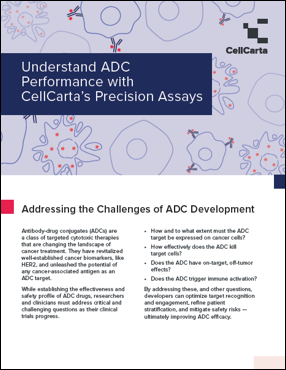
Antibody-drug conjugates (ADCs) have emerged as one of the most promising therapeutic modalities in oncology. To date, 21 ADCs have been approved worldwide1, with hundreds more currently in clinical development.2 While a small group of established biomarkers—HER2, TROP2, EGFR, and Claudin18.2—currently dominate the field and account for more than half of ADC clinical pipelines3, the landscape is quickly evolving.
A growing number of new biomarker targets are now entering ADC development programs, reflecting both advances in tumor biology and increasing investment across the pharmaceutical industry. As these targets emerge, laboratories must stay ahead of the field to support their measurement and validation.
Key biomarkers gaining traction in ADC development
Beyond the dominating, established biomarkers, recent advances in tumor biology have identified a number of additional antigens with characteristics that make them promising ADC targets.
HER3, for example, which is commonly overexpressed in non-small cell lung cancer (NSCLC) and breast cancer, has become the focus of several ADC programs, with the investigational therapy patritumab-deruxtecan showing promising efficacy in NSCLC and breast cancer.4
Similarly, B7-H4, an immune checkpoint protein, is overexpressed in several epithelial cancers while showing relatively limited expression in normal tissues, making it an attractive target for therapeutic development.5 In a phase-I dose-escalation trial, a B7-H4-directed dolasynthen ADC demonstrated promising antitumor activity and a manageable safety profile, highlighting the potential of this antigen as a therapeutic target.5
Other emerging targets are also gaining traction in ADC research. For example, ROR1 and CEACAM5 have been investigated as tumor-associated antigens in multiple solid tumors6,7, while CD142 (tissue factor) has been explored as a target for ADCs due to its role in tumor progression and angiogenesis.8
As researchers continue to identify tumor-associated proteins with favorable expression profiles and biological relevance, the number of potential ADC biomarkers will continue to grow.
Characterizing emerging ADC biomarkers
As new ADC targets continue to be identified, accurately characterizing their expression within tumor tissues will be critical for the development of next-generation ADC therapies. For ADCs, both the level and spatial distribution of target antigen expression can directly influence drug binding, internalization, and ultimately therapeutic efficacy.
Many tumor-associated antigens display heterogeneous expression across tumor types, between patients, and even within different regions of the same tumor, making biomarker evaluation more complex.9 In addition, newly identified targets may lack well-established antibodies or validated assays, creating further challenges when attempting to assess target prevalence and suitability during early development.
Enabling biomarker evaluation for next-generation ADC targets
To support the growing number of biomarker targets entering ADC development pipelines, we are expanding our portfolio of tissue-based biomarker assays at our California, Lake Forest laboratory. The site currently offers immunohistochemistry (IHC) assays for several established ADC targets and is actively developing assays for a range of emerging biomarkers identified through ongoing research across the ADC field (Table 1).
| Current ADC biomarker assays | Biomarkers coming in 2026 |
|---|---|
| B7H3 | CDCP1 |
| Claudin18.2 | B7-H4 |
| cMET | STEAP1 |
| DLL3 | CD25 |
| EGFR | HER3 |
| FOLR1 | CEACAM5 |
| HER2 | CD142 |
| Nectin2 | ROR1 |
| TROP2 | SEZ6 |
Table 1: Table to show current and emerging biomarker offering at the CellCarta Lake Forest Laboratory
At the Lake Forest facility, these targets are evaluated using singleplex and multiplex immunohistochemistry (IHC) and multiplex immunofluorescence, and spatial biology approaches, including COMET™, further enable high-plex analysis of biomarker expression within the tumour microenvironment. The site supports the rapid development of assays for emerging ADC biomarkers, enabling researchers to characterize antigen expression within tumor tissue and generate data that support biomarker discovery, target validation, and clinical development.
As ADC development continues to evolve, the range of tumor-associated antigens under investigation is expanding well beyond a small group of established targets. New biomarkers are emerging across multiple tumor types, reflecting both advances in tumor biology and growing interest from pharmaceutical developers.
As this landscape continues to broaden, the ability to rapidly evaluate and characterize emerging targets will be essential for translating new discoveries into viable ADC therapies.
Working on an ADC development program?
About CellCarta’s California, Lake Forest Laboratory
For over 20 years, CellCarta’s CLIA and CAP-accredited Lake Forest laboratory has supported pharmaceutical and biotechnology sponsors across preclinical, discovery, and clinical development programs. Key capabilities include:
- Multiplex immunohistochemistry and immunofluorescence expertise
- Integrated digital pathology and spatial analysis workflows
- In-house tissue biobank access
- Rapid turnaround times designed for early-stage decision-making
Since its opening, the Lake Forest team has worked with over 230 sponsors on over 2,400 unique projects. Operating independently and capable of participating in multi-site joint studies, Lake Forest delivers the speed and flexibility required to advance early-stage programs with confidence.
Find out more about our Lake Forest lab and how it can support your early-stage programs
About the Author:

Steven Wilkes is a Scientific Business Director at CellCarta, specializing in the histopathology platform. Steven has 15+ years of experience in the field of histopathology at academic centers, large pharmaceutical companies, and clinical laboratories. At CellCarta, Steven uses his expertise to help our clients find the best scientific and technical solutions to address their program needs.
References
- https://www.biochempeg.com/article/208.html
- https://www.biochempeg.com/article/447.html
- https://www.linkedin.com/pulse/global-adc-drug-clinical-development-2025-key-d3t5c/
- https://www.mdpi.com/1422-0067/26/13/6523
- https://www.targetedonc.com/view/early-phase-study-shows-promise-for-novel-b7-h4-targeted-adc
- https://academic.oup.com/abt/article/4/4/222/6397795
- https://www.sciencedirect.com/science/article/pii/S0923753422000035
- https://link.springer.com/article/10.1186/s40364-023-00504-6
- https://www.mdpi.com/1424-8247/18/6/915